
Last Updated on October 24, 2026 by Umar Farooq
An at home mold test kit can show that mould spores are present in your home, but not whether you have a problem, because spores are in indoor air almost everywhere. The EPA’s own advice is that sampling is usually unnecessary when you can see growth, and the better test is to find the moisture feeding it.
I would not tell you never to buy one. I would tell you to spend the first hour on a torch, your nose and a hygrometer, because they answer the question the kit cannot: why is it damp here?
How does a DIY mold test kit work?
Most kits fall into two types, and neither is complicated.
- Settle plate (petri dish). You close the windows and doors of one room for about a day, open the dish, leave it for a set time, then seal it. Spores that land on the nutrient gel are allowed to grow for a few days. Bob Vila’s guide describes this exact routine, and it asks you to keep the dish somewhere dark afterwards.
- Swab or tape lift. You press tape or a swab against a suspect patch and either read it yourself or post it to a lab.
Some kits include a lab fee; some leave that as an extra. I have not priced them for you, because the numbers move, and because the price is not the interesting part.
The interesting part is what the result means. A dish that grows colonies has told you that spores landed on gel. That was always going to happen.
What does the EPA say about an at home mold test?
The EPA’s guidance is blunter than most kit packaging.
- In most cases, if visible mold growth is present, sampling is unnecessary. The clean-up is the same whichever species it turns out to be.
- There are no EPA or other federal limits for mold or mold spores, so a result cannot show you are “over” or “under” a safe level.
- The EPA’s mould course says indoor mould levels should be similar to those outside, which is why any sensible sample is compared with an outdoor one.
- Air sampling shows only what was in the air at the moment of sampling, and a negative result must not replace a visual survey.
- Surface sampling may be useful to check that an area has been cleaned adequately.
That fifth point is the honest niche for testing. The first four are why a kit on its own rarely settles anything.
What a kit result can and cannot tell you
| The question you actually have | What a DIY kit can tell you |
|---|---|
| Is there mould in my home? | Spores landed on the dish. Spores are normally present, so this is not a verdict |
| Is the level safe or unsafe? | Nothing. There is no federal limit to compare against |
| Is there mould inside the wall? | Very little. A dish in the room samples room air, and a clean one is not an all-clear |
| Where is the moisture coming from? | Nothing |
| Did my clean-up work? | A surface sample may help, but a clean, dry surface does the job better |
Two practical weaknesses sit underneath this. A dish tells you about a single room on a single day, and the EPA notes that humidity, temperature, weather and household activity all change spore counts. And a handful of colonies on gel looks alarming even when the room is perfectly ordinary. That is a good way to lose a weekend to worry and still not know what to fix.
Five free checks that beat the kit
This is the part worth your time. None of it needs a purchase, apart from a cheap hygrometer.
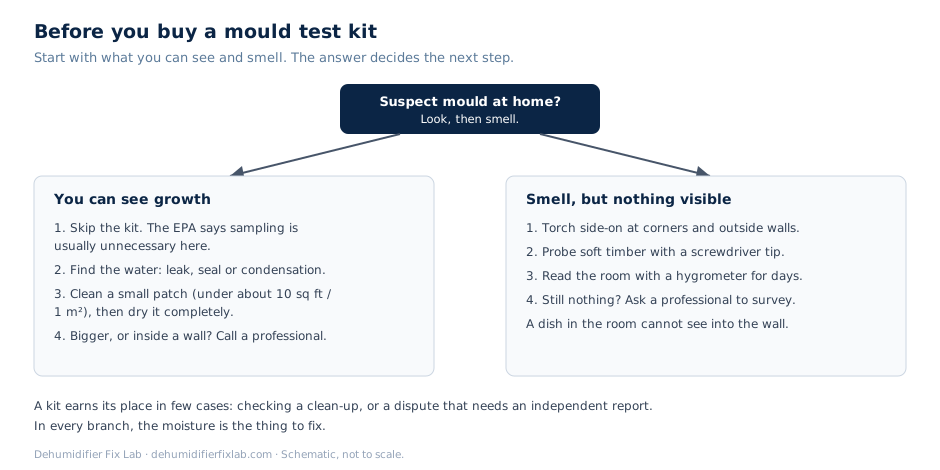
- Look with a torch, side-on. Hold it nearly parallel to the surface. Speckles, fuzz and tide-marks show up that overhead light hides. Check ceiling corners, window reveals, behind wardrobes on outside walls, and under sinks. If you are unsure what you are seeing, what black mold looks like covers the look-alikes.
- Follow the smell. The EPA lists a musty smell with no visible source as a reason to suspect hidden mould. Smell is strongest in a room that has been shut overnight, so check first thing.
- Probe soft spots. On skirting boards or timber near a suspected leak, press gently with a screwdriver tip. Soft or crumbling wood means the moisture has been there for a while. This one is a tip from the Family Handyman guide, and it is a good one.
- Read the humidity. A hygrometer costs less than most kits. If a room sits high for days, you have the likely cause. Here is what indoor humidity should be.
- Trace the water. Leaking pipe, failed sealant, blocked gutter, or condensation on a cold surface. The EPA says the key to mould control is moisture control, and that if you clean mould but do not fix the water problem, it will most likely come back.
Do not scrape, dry-brush or sand a suspect patch to get a better look, and do not blast it with a fan: that puts spores in the air you breathe. Wear gloves and a well-fitting mask if you must touch it, and never mix cleaning products. If it covers more than about 10 square feet (roughly 1 square metre), is inside a wall or ductwork, or follows flood or sewage water, stop and call a professional.
When is paying for mold testing justified?
Testing is not useless. It is just rarely the first step. These are the cases where I would consider it:
- After a professional clean-up, to check the job is done. The EPA says surface sampling can help here, though a visual check usually does as much.
- A persistent mouldy smell and no visible source, once you have inspected and found nothing. A consultant with moisture and thermal equipment is more useful than a dish.
- A dispute, such as with a landlord or an insurer, where a documented, independent report matters more than your own kit.
Notice what is common to all three: a qualified person, a plan for interpreting the results and a comparison with outdoors. That is not what a boxed kit gives you.
What to do when you find mould, or the damp that feeds it
If you find growth, the order matters. Find and fix the water, clean the area carefully if it is a small patch, then dry the surface and keep the room dry. The EPA says wet materials need to be dried within 24 to 48 hours to avoid mould growth, so speed counts, and how long mould takes to grow explains the timing. For wall clean-up on painted surfaces, see how to get mould off walls.
If the cause is general damp air, a dehumidifier is the tool that helps. Sizing is covered in what size dehumidifier do I need. It will not cure a leak, but it keeps a damp room from staying damp.
Test the damp, not the spores
My view is simple. An at home mold test answers a question nobody needs answered, which is whether spores exist, and skips the two that matter: where the water is and whether it is gone. If you can see mould, skip the dish and fix the moisture. If you cannot see it but you smell it, inspect first, then bring in a professional rather than a kit. The cheapest, most reliable instrument in this whole story is a torch and a hygrometer.
FAQ
Do at home mold tests work?
They work as a way to grow spores on a gel or lift them with tape, but they cannot say whether your home has a mould problem. Spores are normally present indoors, and the EPA says there are no federal limits to judge a result against.
Can a mold test kit find mould inside walls?
Not reliably. A settle plate samples the room air, not the wall cavity, and the EPA notes a negative air sample must not replace a visual survey. Hidden mould is usually found by following smell, damp readings and the water source.
How can I check for mould without a test kit?
Use a torch side-on, follow musty smells, probe soft timber with a screwdriver, watch the room humidity with a hygrometer and trace any leak or condensation. These show where the moisture is, which is the part that needs fixing.
Is it worth paying for professional mold testing?
Sometimes: after a clean-up, for a persistent smell with no visible cause, or for a dispute where an independent report is needed. If mould is already visible, the EPA says sampling is usually unnecessary.
When should I call a professional instead of testing?
When the affected area is larger than about 10 square feet (around 1 square metre), when it is inside a wall or ventilation system, or after flood or sewage water. Those are clean-up jobs, not testing jobs.

