
Last Updated on September 7, 2026 by Umar Farooq
A dehumidifier freezing up is nearly always the room being too cold, not the machine being broken. Put a thermometer in the room. Below about 18°C / 65°F output falls sharply, and below 5°C / 41°F frost forms faster than the unit can clear it. That single reading splits the problem in two and tells you whether to reach for a spanner or leave it alone.
If the room is genuinely warm and the dehumidifier is freezing up anyway, then something has failed — and there are only three candidates. Worth knowing which, because two of them are free and the third is a part most people have never heard of.
First: switch it off and let the ice melt
Before diagnosing anything, unplug it and give the coil an hour to thaw completely — longer if the ice is thick. Point a fan at the grille if you want to speed it up.
There are two reasons this is not optional. A machine running with an iced coil is telling you nothing, because no air is reaching the fins. And every reading you take while it is frozen is a reading of a blocked machine rather than a faulty one.
While it drips, put a thermometer in the middle of the room, away from the unit.
A dehumidifier freezing up: the room temperature branches it
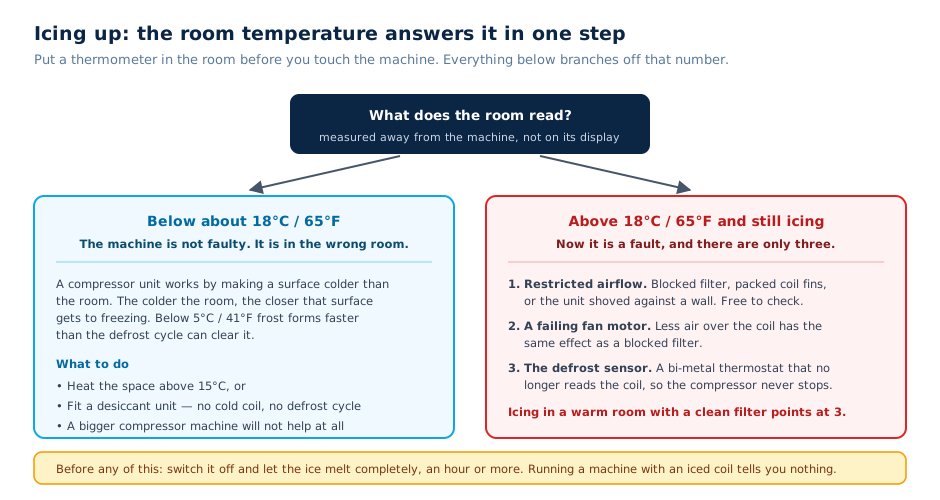
Below about 18°C / 65°F — the machine is fine, the room is wrong
This is the answer most of the time, and it is not a fault.
A compressor dehumidifier works by making a coil colder than the room, so water condenses on it. The colder the room, the closer that coil sits to freezing. Below about 18°C output drops away sharply. Below 5°C / 41°F, GE’s own documentation says frost forms faster than the machine can clear it — so the compressor cuts out, the fan carries on, and you get a block of ice instead of a tank of water.
No part fixes this. A bigger compressor machine does not fix it either — it will ice up in exactly the same room. Your options are:
- Heat the space above about 15°C, or
- Fit a desiccant unit, which uses a moisture-absorbing wheel rather than a cold surface and works down to a few degrees above freezing with no defrost cycle at all. The full comparison covers the trade-off, which is higher running cost in a warm room.
- Accept it and switch off for the winter, which is the right answer for a lot of garages and unheated cellars. Running one in winter goes through when it is worth bothering.
Above 18°C / 65°F and still icing — now it is a fault
Three things, in order of likelihood and cost.
1. Restricted airflow — free to check. A blocked filter starves the coil of air. Less air over the fins means the coil runs colder than it was designed to, and it frosts instead of dripping. Same effect from coil fins packed with dust, or a unit shoved against a wall so it cannot breathe.
Take the filter out and hold it to the light. If you cannot see clear light through the mesh, that is your answer — wash it in warm soapy water, never hot, and dry it completely before refitting. Then look at the coil behind it and vacuum the fins gently with a soft brush. The cleaning routine has the detail.
2. A failing fan motor. If the fan is turning slowly, or not at all while the compressor runs, the coil gets the same starvation as a blocked filter. Listen to it: a fan that has slowed usually announces itself with a whine or a grinding note first.
3. The defrost sensor. This is the one almost nobody mentions, and it is the answer when the first two check out clean.
Most units carry a bi-metal thermostat clipped to the evaporator whose only job is to notice the coil getting too cold and stop the compressor until it clears. If that sensor loses contact with the coil, or fails, nothing tells the compressor to stop — so it runs continuously and the coil freezes solid even in a warm room.
The signature is specific: warm room, clean filter, healthy fan, and it still ices over. That combination points at the defrost sensor and almost nothing else.
What it is not
Two things get blamed for this that rarely deserve it.
Low refrigerant. It does get mentioned everywhere. A genuinely undercharged system usually presents as a coil that never gets properly cold and a tank that stays dry — not collecting water at all rather than icing. And on a domestic portable, a sealed-system repair costs more than the machine is worth.
The humidity setting. Setting it lower does not cause icing. The setpoint decides when the machine stops, not how cold the coil gets. What a very low setting does do is keep the machine running for far longer in a cool room, which gives frost more time to build — so it is an accomplice rather than a cause. Settings, properly.
Stopping a dehumidifier freezing up again
- Clean the filter every 250 running hours — about monthly at eight hours a day. This prevents more icing than everything else combined.
- Vacuum the coil once a season, unplugged, with a soft brush along the fins.
- Give it 30 cm / 12 inches clear at the intake and exhaust.
- Do not run a compressor unit below about 15°C. It is not doing useful work down there, and the wear from constant defrost cycling is real.
- Use the auto-defrost setting if it has one, rather than continuous mode, in a cool room.
Never chip, scrape or prise ice off the coil. The fins are thin aluminium wrapped around tubing that carries refrigerant under pressure, and a screwdriver will go through them. Puncture that circuit and the machine is finished. Let it thaw on its own, unplugged.
Frequently asked questions
Why does my dehumidifier keep freezing up?
Almost always because the room is too cold. Below about 18°C a compressor unit’s output falls sharply, and below 5°C frost forms faster than the defrost cycle can clear it. If the room is warm, suspect a blocked filter first, then the fan, then the defrost sensor.
At what temperature does a dehumidifier freeze up?
Icing becomes likely below about 18°C / 65°F and close to inevitable below 5°C / 41°F on a compressor machine. Desiccant models do not ice at all, because they use an absorbent wheel rather than a cold coil.
How do I stop my dehumidifier from icing up?
Warm the room above about 15°C, keep the filter clean, vacuum the coil each season, and leave 30 cm clear around the unit. If the space genuinely cannot be heated, a desiccant machine is the answer rather than a bigger compressor one.
Should I scrape the ice off my dehumidifier?
No. The coil fins are thin aluminium over pressurised refrigerant tubing and are easily punctured, which ends the machine. Unplug it and let the ice melt on its own — an hour or more, with a fan pointed at the grille if you want to hurry it.
Is it normal for a dehumidifier to have some frost?
A light frost that appears and clears again on its own is the defrost cycle working exactly as designed. A solid sheet of ice that keeps building is not.
Why is my dehumidifier icing up in a warm room?
That is the combination worth investigating. Check the filter and coil for restricted airflow, then the fan motor, then the bi-metal defrost thermostat clipped to the evaporator — if it stops reading the coil, the compressor never gets told to stop.
Does a dirty filter cause a dehumidifier to freeze?
Yes, and it is the most common mechanical cause. Restricted airflow makes the coil run colder than intended, so water freezes on it instead of running off into the tank.
Related guides: Dehumidifier not collecting water · Dehumidifier in winter · Desiccant vs compressor dehumidifiers · Dehumidifier filters
Sources
- GE Appliances — Dehumidifier: Ideal Operating Conditions — the 41°F frost limit and defrost behaviour quoted above.
- Frigidaire — Dehumidifier: Frost Buildup — a second manufacturer describing the same low-temperature icing behaviour.
- ENERGY STAR — Dehumidifiers — operating guidance and the 30–50% target band.
Where this guide and your appliance’s own manual disagree, follow the manual. And if yours is in an unheated garage in February — it is not underperforming. It is on strike, and its demands are reasonable.

