
Last Updated on September 1, 2026 by Umar Farooq
A 50 pint dehumidifier removes 50 US pints — about 24 litres — of water in 24 hours, measured at 65°F / 18°C and 60% relative humidity in a laboratory. It is a test result, not a promise about your house. In a cooler or drier room it will collect considerably less, and that is not a fault.
The more useful thing to know is that the test itself moved in 2019, which means the number on a machine bought last year and the number on one bought in 2015 are not comparable. Get that wrong on the second-hand market and you will pay over the odds for less machine.
The 2019 change, and why it matters more than the number
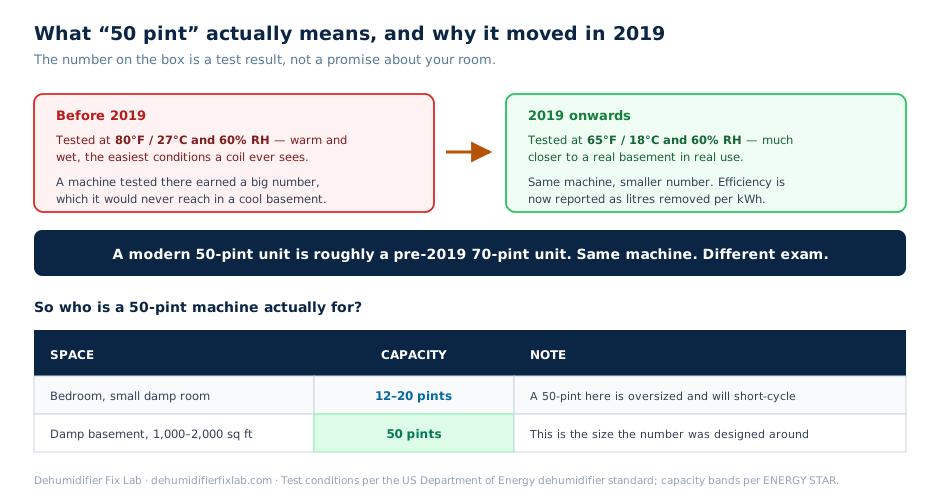
Before 2019, US dehumidifiers were rated at 80°F / 27°C and 60% RH — warm and wet, the easiest conditions a coil will ever see. A machine tested there earned a flattering number that it would never reach in a cool basement.
From 2019 the Department of Energy moved the test to 65°F / 18°C and 60% RH, much closer to how these things are actually used. Efficiency also moved to Integrated Energy Factor — litres of water removed per kilowatt-hour — which is a far better comparison between two current machines than capacity is.
The practical consequence:
A modern 50-pint unit removes roughly what a pre-2019 70-pint unit did.
So if you are weighing a second-hand “70 pint” against a new “50 pint” and thinking the old one is better value — it isn’t. Same machine, smaller number on the box. The old one is also several years into its five-to-ten-year service life and rated under a standard nobody uses any more.
Who a 50 pint machine is actually for
| Space | Sensible capacity | Note |
|---|---|---|
| Bedroom, small damp room | 12–20 pints | A 50-pint here is oversized and will short-cycle |
| Average damp room, 500–1,000 sq ft | 20–30 pints | Comfortable, quiet, cheap to run |
| Damp basement, 1,000–2,000 sq ft | 50 pints | This is the size the number was designed around |
| Wet basement, or continuous ingress | 50–70 pints | And find the water first |
A 50 pint dehumidifier is a basement machine. That is the honest summary. It is the standard size for a moderately-to-very damp basement of ordinary size, and it is too much appliance for a bedroom.
That matters, because oversizing is not free. A machine far too big for its room reaches the setpoint quickly, switches off, drifts up, restarts a few minutes later, and repeats that all day. Compressors tolerate steady running far better than repeated starts. Working out what size you need goes through the arithmetic properly.
What it will actually collect in your house
Here is where the number stops being a promise.
The rated capacity assumes 60% RH at 18°C. Move away from that and output falls, sometimes dramatically:
- A cooler room means the air is carrying less water to begin with, so there is less available to condense out.
- A drier room means the same. A 50-pint machine in a room already at 50% will collect a trickle, because there is not much left to take.
- Below about 18°C / 65°F a compressor unit’s output falls sharply, and below 5°C / 41°F frost forms faster than it can be cleared.
So a 50-pint unit filling half a tank a day in a cool basement is not underperforming. It is being asked a different question from the one the test asked. If the tank is filling at all, the machine is working.
Pints, litres, and what the tank does not tell you
Fifty US pints is about 24 litres. A typical tank on a machine that size holds four to six litres, which is where people get caught out: a 50-pint unit working properly in a genuinely damp basement will fill its tank several times a day, and every hour after it fills is an hour it is switched off.
Which makes continuous drainage the highest-value upgrade on a machine this size. A hose to a floor drain converts it from something you tend into something that just works. Setting it up properly is twenty minutes, and if the only drain is above the unit, a built-in pump solves it.
The number worth comparing instead
If you have two machines in front of you at the same capacity, capacity has stopped being useful. Compare Integrated Energy Factor — litres removed per kilowatt-hour. That is the figure that decides your running cost over a season, and it is the one shoppers ignore in favour of the bigger pint number.
Take the wattage from the rating plate, multiply by hours run, divide by 1,000 for kWh, then apply your own tariff. I am not going to guess what you pay per unit, and neither should anyone else.
Frequently asked questions
What size room is a 50 pint dehumidifier for?
Roughly 1,000–2,000 sq ft of moderately to very damp space — in practice, a basement. In a bedroom or a single damp room it is oversized and will spend its time starting and stopping.
How much water does a 50 pint dehumidifier remove per day?
Up to 50 US pints, about 24 litres, under the test condition of 65°F / 18°C and 60% RH. In a cooler or drier room, considerably less. That reduction is normal rather than a fault.
Is a 50 pint dehumidifier the same as a 70 pint?
A modern 50-pint is roughly equivalent to a pre-2019 70-pint, because the US test conditions changed in 2019 to a cooler, drier point. Comparing a new 50 against an old 70 is comparing two different exams.
Is a 50 pint dehumidifier too big for a bedroom?
Usually, yes. A bedroom is better served by 12–20 pints. An oversized unit hits the target quickly and then short-cycles, which is harder on the compressor and no quieter to live with.
How often will I need to empty a 50 pint dehumidifier?
In a genuinely damp basement, several times a day — tanks on this size typically hold four to six litres against a 24-litre daily capacity. Run a drain hose instead if the machine is unattended.
Does a 50 pint dehumidifier use a lot of electricity?
Less than most people expect, and far less than air conditioning. Compare Integrated Energy Factor between models rather than capacity, then work out kWh from the rating plate and your own tariff.
Can a 50 pint dehumidifier work in a cold garage?
A compressor one, not well. Below about 18°C output drops sharply and below 5°C it will spend its time defrosting. A desiccant machine is the answer for genuinely cold spaces.
Related guides: What size dehumidifier do I need? · Dehumidifier for basement · How dehumidifiers work · Dehumidifier drain hose setup
Sources
- US Department of Energy — Dehumidifier standards — the federal test procedure and efficiency standard behind the pint rating.
- Energy Vanguard — The confusing world of dehumidifier capacity — a clear account of the 2019 test-condition change and what it did to published capacities.
- ENERGY STAR — Dehumidifiers — current efficiency ratings and capacity guidance by dampness.
- GE Appliances — Dehumidifier: Ideal Operating Conditions — why output falls in cooler rooms.
Where this guide and your appliance’s own manual disagree, follow the manual. And if you are standing in front of a second-hand 70-pint machine that looks like a bargain — check the year before the price. That one number has cost people more than any other in this category.

