
Last Updated on September 1, 2026 by Umar Farooq
How do dehumidifiers work? They make one part of themselves cold, blow your room’s air across it until water gives up and turns into droplets, then blow that same air back out. That is the entire machine. Everything else is a fan, a bucket, and something to switch it off when the bucket is full.
Understanding that one sentence properly will save you more money than any troubleshooting checklist, because roughly half the faults I write about on this site turn out to be the machine doing exactly what the physics says it should, in a room where the owner did not expect it.

The one bit of physics you need: dew point
Air holds water as invisible vapour, and warm air holds far more of it than cold air. Cool a parcel of air far enough and it reaches a temperature where it cannot hold what it is carrying. The surplus condenses out as liquid. That temperature is the dew point.
It is the same reason a cold drink beads up on a summer afternoon, and the same reason your bathroom mirror fogs. Nothing in a dehumidifier is cleverer than the outside of a cold glass. The machine simply guarantees a cold surface, and forces a great deal of air past it.
Two consequences fall straight out of that, and both explain complaints people bring to Google every day:
- If the room is cold, the air is not carrying much water in the first place — so a machine will collect very little, and the owner concludes it is broken. It usually is not. Running one in winter covers where that line actually sits.
- If the coil gets too cold, the water freezes rather than dripping — which is why a dehumidifier in an unheated garage spends its life defrosting.
The five parts that matter
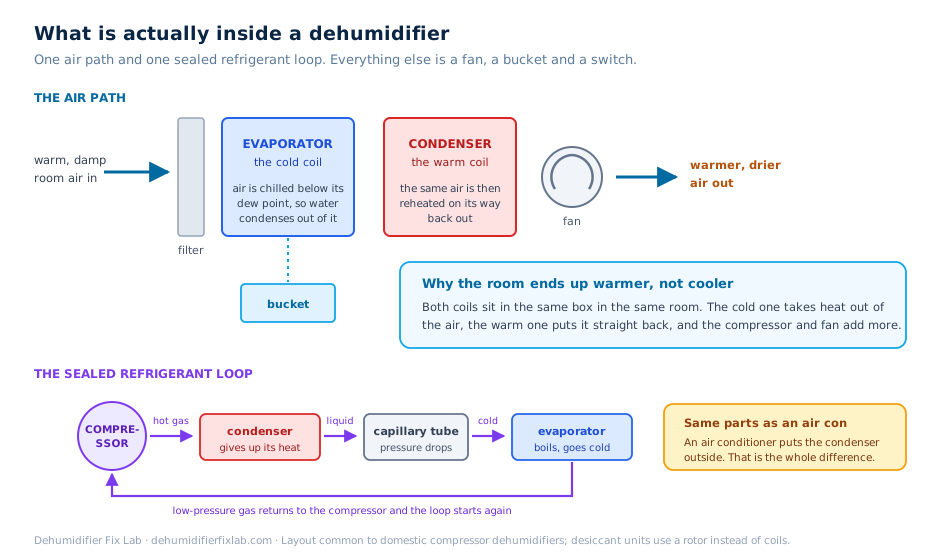
1. The fan. Pulls room air in through a grille and pushes it through everything else. It is not glamorous, but it decides how much air gets treated per hour, which decides how fast the room dries.
2. The filter. A washable mesh sitting in front of the coil. Most people assume it is about air quality. On a dehumidifier it is really there to stop household dust landing on a permanently wet surface, where it packs into the fins and is very hard to remove. More on why it matters so much.
3. The evaporator — the cold coil. Refrigerant boils inside it, which makes it cold. Air passes over the outside and drops below its dew point. Water condenses on the fins and runs down into the bucket.
4. The condenser — the warm coil. The same air, now drier, passes straight over a hot coil on its way out. It leaves warmer than it arrived.
5. The compressor. A sealed pump that squeezes the refrigerant gas until it is hot, sends it round the loop, and starts the cycle again. It is the expensive part, the one that decides whether a repair is worth doing, and the reason a failed machine is usually a finished machine.
How do dehumidifiers work as a loop, step by step
The refrigerant goes round and round while the air goes straight through. That is the bit worth separating out.
- The compressor squeezes refrigerant gas. Compressing a gas heats it, so it leaves as a hot, high-pressure gas.
- The condenser lets that hot gas give up its heat to the passing air. As it cools it condenses into a liquid — hence the name.
- A capillary tube — just a very narrow pipe — drops the pressure sharply.
- The evaporator is where that low-pressure liquid boils back into a gas. Boiling absorbs heat, which is what makes the coil cold. Your room’s water condenses on the outside of it.
- Back to the compressor, and round again.
If that sounds like a fridge, it is. It is also an air conditioner. The three appliances share the same four components; the only real difference is where the hot coil points. A fridge puts it into your kitchen, an air conditioner puts it outside the building, and a dehumidifier puts it back into the very room it just cooled — which is why the machine is a net heater and why it cannot cool a room no matter how long you leave it on.
The other kind: desiccant dehumidifiers
Not every machine uses a cold coil. Desiccant units have no compressor and no refrigerant at all. Instead, a slowly rotating wheel coated in a moisture-absorbing material takes water directly out of the air, and a small heater drives that water back out of the wheel and into the tank.
The practical difference is temperature. A compressor unit depends on making a surface colder than the room, which gets harder and harder as the room gets colder. A desiccant wheel does not care — it works down to a few degrees above freezing with no defrost cycle at all. It costs more in electricity in a warm room, and puts out noticeably more heat. The two types compared properly if you are choosing between them.
Why yours runs but collects nothing
Now that the mechanism is clear, the four most common “it’s broken” complaints explain themselves:
The room is too cold. Below about 18°C / 65°F output falls off sharply. Below 5°C / 41°F, GE’s own documentation says frost forms faster than the machine can clear it. The compressor shuts off, the fan keeps running, and the owner assumes a fault.
The humidity target has been reached. The machine stops when the room hits the number you set. An empty bucket and a working dehumidifier are entirely compatible.
It is in a restart lockout. Compressors are held off for three to five minutes after any stop, to avoid restarting against system pressure. Watch it for ten minutes before concluding anything.
The filter is blocked. Less air over the coil means the coil runs colder than intended, ices up, and stops dripping. This is the most common of the four and the cheapest to fix.
If yours is running fan-only right now, that specific symptom has its own guide.
What the numbers on the box mean
Pints or litres per day is capacity — how much water the machine removes in 24 hours under a defined test condition. The critical thing almost nobody explains: the US Department of Energy changed that test condition in 2019 to a cooler, drier point. A modern 50-pint unit removes roughly what a pre-2019 70-pint unit did. Comparing a second-hand machine’s rating against a new one is comparing two different exams.
Integrated Energy Factor (IEF) is efficiency — litres of water removed per kilowatt-hour. It is the number worth comparing between two current machines, and the one buyers ignore in favour of the bigger capacity figure.
Sizing follows from those, not from room area alone. Working out what size you need goes through it properly.
Frequently asked questions
How do dehumidifiers work in simple terms?
They chill a metal coil below the dew point of the room’s air, blow the air across it so water condenses out into a tank, then blow the drier air back into the room. A fan moves the air, a compressor makes the coil cold, and a humidistat switches it off at your target.
Where does the water in a dehumidifier come from?
Out of the air in your room. It was always there as invisible vapour; the cold coil simply forces it back into liquid form. The tank filling up is the clearest evidence the machine is doing its job.
Do dehumidifiers use a lot of electricity?
Less than most people expect, and far less than air conditioning. Take the wattage from the rating plate, multiply by the hours it runs, divide by 1,000 for kWh, and apply your own rate. Efficiency varies a lot between models, which is what IEF is for.
Why does my dehumidifier blow out warm air?
Because it is designed to. The air passes over a cold coil to shed water and then over a warm coil on the way out. Warm, dry outlet air is a working machine, not a fault.
Do dehumidifiers work in cold rooms?
Compressor models struggle badly below about 18°C and effectively stop below 5°C, where frost forms faster than the defrost cycle clears it. Desiccant models keep working down to a few degrees above freezing because they use an absorbent wheel rather than a cold surface.
How long does a dehumidifier take to work?
The air in a room drops within hours. Damp plaster, timber and soft furnishings take days to weeks, because the water has to travel to the surface before the machine can reach it.
Is a dehumidifier just an air conditioner without the outside bit?
That is very close to the truth. Same compressor, same two coils, same refrigerant loop. An air conditioner puts the hot coil outdoors so heat leaves the building. A dehumidifier keeps both coils indoors, so the heat stays with you.
Related guides: Can a dehumidifier cool a room? · Desiccant vs compressor dehumidifiers · Dehumidifier filters · What size dehumidifier do I need?
Sources
- GE Appliances — Dehumidifier: Ideal Operating Conditions — the low-temperature limits and frost behaviour quoted above.
- ENERGY STAR — Dehumidifiers — capacity ratings, the 30–50% target band, and current efficiency standards.
- Energy Vanguard — The confusing world of dehumidifier capacity — a clear account of the 2019 DOE test-condition change and why pint ratings are not comparable across eras.
Where this guide and your appliance’s own manual disagree, follow the manual. And if you have never taken the front grille off one — do it once, with the plug out. Everything above turns out to be visible in about thirty seconds, and the machine stops feeling like a black box.

