
Last Updated on September 1, 2026 by Umar Farooq
How long does a dehumidifier take to work? The air in a normal room reaches your target within a few hours. The room itself — plaster, timber, carpet, soft furnishings — takes days to weeks. Those are two different jobs on two different clocks, and confusing them is behind almost every disappointed review of an otherwise perfectly good machine.
Short version: judge a new machine on a fortnight, not an evening. And if you are asking how long a dehumidifier takes to work because the hygrometer has already dropped but the room still feels damp, that is entirely normal and explained below.

Timeline one: the air, in hours
The fast part, and the arithmetic explains why.
Take a 4 × 5 metre room with a 2.4 metre ceiling — 48 cubic metres of air at a comfortable 24°C. Air at that temperature holds about 21.8 grams of water per cubic metre when saturated.
- At 70% relative humidity, that room’s air is holding roughly 730 grams of water.
- At 50%, it holds roughly 520 grams.
The gap is about 210 grams. That is it. Less than a mugful.
A modest 12-litre-a-day machine removes 500 grams an hour, so in a sealed room with no other moisture source it would clear that gap in around twenty-five minutes.
That is why the hygrometer moves so fast. The air is a very small reservoir.
Timeline two: everything else, in days and weeks
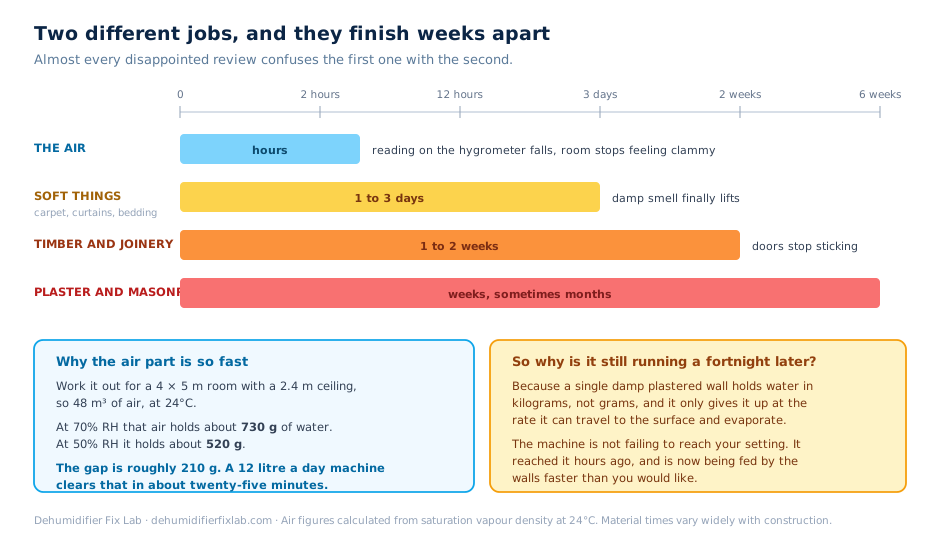
So why is the machine still running a fortnight later, with the tank still filling?
Because a single damp plastered wall holds water in kilograms, not grams. So does a saturated carpet with its underlay, so do the joists under a floor, and so does a room full of soft furnishings that have been sitting at 75% all winter.
None of that water is available to the dehumidifier directly. It has to travel to the surface of the material and evaporate into the room air first — and it does that at whatever rate the material allows, which is slow and which you cannot speed up by buying a bigger machine.
Rough expectations, which vary hugely with construction:
| What you are drying | Realistic timeline |
|---|---|
| Room air reaching your setting | 2 to 12 hours |
| Carpets, curtains, bedding | 1 to 3 days |
| Timber, joinery, sticking doors | 1 to 2 weeks |
| Plaster and masonry | Weeks, sometimes months |
The machine reached your setting hours ago. What it is doing now is holding that setting against a wall that keeps feeding moisture back into the room. That is not failure — that is the entire point of the appliance, and the tank filling is the evidence.
What changes how long a dehumidifier takes to work
Four things, in roughly the order they matter:
How wet the room is to start with. A room at 80% has vastly more work ahead of it than one at 62% — the materials are the variable, not the air.
Whether the doors and windows are shut. An open window means you are dehumidifying the outdoors, which is a job with no end. Internal doors are a judgement call: closed is faster for one room, open is better for a whole floor. Where you put it matters more than most people expect.
The room temperature. A compressor unit’s output falls sharply below about 18°C / 65°F, and below 5°C / 41°F frost forms faster than the machine can clear it. A cold room is not a slow room, it is a room where the machine is barely working. Winter running covers where that line sits.
Capacity, but less than you would think. A machine twice the size does not dry a wall twice as fast — the wall is the bottleneck. Sizing matters for keeping up with continuous moisture, not for the initial dry-down. Working out what size you need goes through it.
How to tell whether it is working
Use these, in order:
- The tank. Water in it means the machine is extracting. The clearest signal there is, and it beats any judgement about how the room feels.
- The hygrometer, over days. Same time each morning, written down. A downward trend over a week is the measurement; one reading is noise.
- The windows. Morning condensation reducing, then stopping.
- The smell. Last to go, usually a week or two in, because it lives in soft materials rather than in the air.
If the tank is dry after a full day and the room is above 60%, then something genuinely is wrong — and the usual causes are the room being too cold, the target having already been reached, or a blocked filter icing the coil. If yours is running with the fan on and nothing else happening, that specific symptom has its own guide.
How long does a dehumidifier take to work across a whole house?
Longer, because the machine only dries the air that physically reaches it. One unit on an open landing will hold a floor of a normal house at a sensible reading within a few days, but it will not dry a two-storey house — dry air does not climb stairs against warm damp air coming down them, and it certainly does not pass through closed doors.
So add days rather than hours, open the internal doors, and accept that a damp basement and condensation upstairs are two jobs. Where you put it changes this timeline more than capacity does.
The case where it will never finish
The one situation where patience is the wrong answer.
A dehumidifier does not fix damp. If water is actively getting in — a failed seal, a leaking gutter, rising damp, a cracked render — the machine will run permanently, cost you a great deal in electricity, and never win. It is removing water at the same rate the wall is supplying it.
The tell is weeks of running with no downward trend at all, in a room where one specific area stays wet. Find the water first, then size a dehumidifier for whatever humidity is left.
Frequently asked questions
How long does it take for a dehumidifier to work in a room?
The air reaches your target in roughly two to twelve hours depending on room size and starting humidity. The materials in the room — carpet, plaster, timber — take days to weeks, which is why the machine keeps running long after the hygrometer has settled.
How long should I run a dehumidifier each day?
Leave it on a humidistat and let it decide. Set 50%, and it will cycle itself on and off as the room drifts. Running it on a timer instead means it is either working when it does not need to, or off when it does.
Why is my dehumidifier still full every day after two weeks?
Because it is still pulling water out of plaster and timber rather than out of the room air. Plaster, timber and carpet release moisture slowly, and the machine collects it as it arrives. A steadily reducing daily volume is the sign of progress.
Does a bigger dehumidifier dry a room faster?
For the air, marginally. For the room, barely — the materials release water at their own rate and that is the bottleneck. Capacity matters most where moisture is being generated continuously.
How long does a dehumidifier take to dry a wall?
Weeks for plaster, and sometimes months for masonry, assuming the source of the water has been fixed. If it has not been fixed, the answer is never.
Will running it on the lowest setting dry the room quicker?
No. The setpoint decides when the machine stops, not how hard it works. Setting 30% instead of 50% removes water at the same rate, it just carries on for longer than you need.
How long before a musty smell goes away?
Usually one to two weeks. The smell lives in soft furnishings and building materials rather than in the air, so it lags well behind the hygrometer. If it survives a month of dry air, something else is generating it.
Related guides: How dehumidifiers work · Dehumidifier settings · What size dehumidifier do I need? · Where to put a dehumidifier
Sources
- GE Appliances — Dehumidifier: Ideal Operating Conditions — the low-temperature limits behind slow performance in cold rooms.
- ENERGY STAR — Dehumidifiers — the 30–50% target band and capacity ratings.
- EPA — A Brief Guide to Mold, Moisture and Your Home — why finding and fixing the water source has to come before any drying equipment.
So, how long does a dehumidifier take to work? Hours for the air, weeks for the room.
Where this guide and your appliance’s own manual disagree, follow the manual. And if you bought one yesterday and are already disappointed, check the tank. Water in it means the machine is fine and you are earlier in the process than you thought.

