
Last Updated on September 1, 2026 by Umar Farooq
How to clean a dehumidifier: unplug it, wash the filter in warm soapy water, wash the tank with dish soap, vacuum the coil fins with a soft brush, wipe the grilles, and let everything dry completely before it goes back together. An hour, once a season, plus five minutes on the filter every month. No specialist products and nothing you cannot buy in a supermarket.
The reason it is worth doing properly rather than occasionally is that a dehumidifier is a warm, permanently damp box with a fan in it. That is a description of the machine and also, unfortunately, a description of ideal growing conditions. Left alone it will quietly get less efficient and start smelling, and the owner will conclude the unit is dying when it is simply dirty.
Unplug the machine at the wall before opening any panel, and keep water away from the control board, the fan motor and the wiring. If a unit has been dropped, has a damaged cable, or smells of burning, do not clean it — stop using it. Two large recalls in this category involved fire risk, and a burning smell is not a maintenance issue.
What you need
- Warm water and washing-up liquid
- A soft brush, and a vacuum with a brush attachment
- A microfibre cloth
- Optionally, household bleach — diluted to roughly 10 parts water to 1 part bleach, and only for the tank
That is the whole list. Everything written below about how to clean a dehumidifier uses those and nothing else — in particular, you do not need coil cleaner. Aerosol coil cleaners are formulated for air-conditioning condensers that can be rinsed down outdoors; a dehumidifier evaporator sits inside a cabinet you cannot flush, so anything you spray on stays there. A soft brush and a vacuum do the job without leaving residue on a surface that spends its life wet.
The five parts, and how often each needs doing
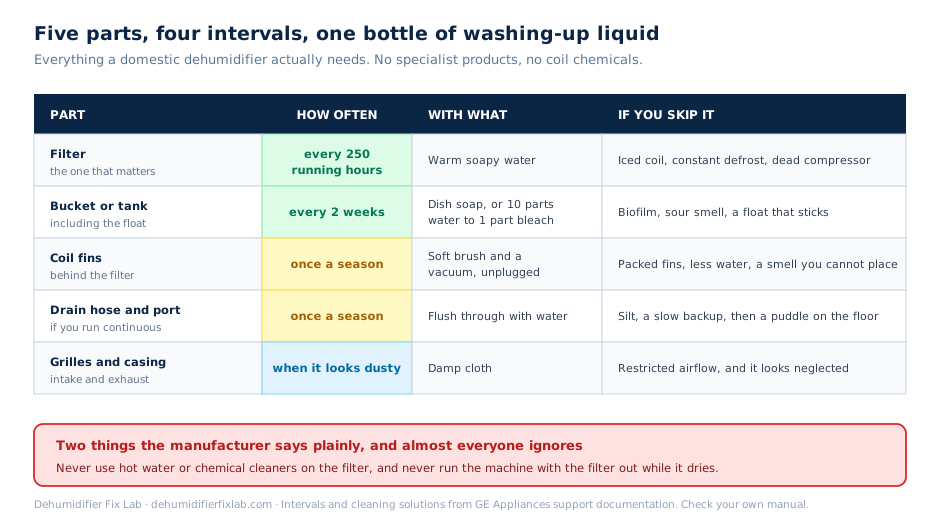
| Part | How often | With what |
|---|---|---|
| Filter | Every 250 running hours | Warm soapy water |
| Bucket or tank | Every two weeks | Dish soap, or 10:1 water to bleach |
| Coil fins | Once a season | Soft brush and a vacuum, unplugged |
| Drain hose and port | Once a season | Flush through with water |
| Grilles and casing | When it looks dusty | Damp cloth |
250 running hours is the interval GE specifies for its newer units, and it is a far more honest measure than a calendar date. A machine running twelve hours a day reaches it in three weeks; one running two hours a day takes four months.
How to clean a dehumidifier, step by step
1. Switch off and unplug at the wall. Then empty the tank before you move the machine, unless you enjoy mopping.
2. Take the filter out and wash it. Vacuum the loose dust off first — it turns to mud the moment it meets water. Then wash in warm soapy water, never hot water and never chemical cleaners. Hot water can distort the plastic frame; solvents damage the mesh. Rinse thoroughly and set it flat on a towel.
3. Wash the tank. Dish soap and warm water for routine cleaning. If mildew has taken hold, GE’s own guidance is a solution of roughly 90% water to 10% bleach — swish it round, empty it, rinse well with plain water. Pay attention to the float: it is a hinged plastic part in the tank and a film of gunk on it is one of the reasons a machine will insist the bucket is full when it is empty.
4. Vacuum the coil fins. With the filter out you can usually see the evaporator behind it — a dense grid of thin aluminium fins. Vacuum gently with a brush attachment, working in the direction of the fins rather than across them. They bend if you look at them sharply. This is where the smell usually lives, and where most people never go.
5. Flush the drain port and hose. If you run continuous drainage, disconnect the hose and run water through it. Silt builds up slowly and the first sign is a puddle. The drain hose guide covers doing the whole setup properly.
6. Wipe the grilles and casing. Damp microfibre cloth. Both grilles, intake and exhaust — a blocked exhaust is as bad as a blocked intake.
7. Let everything dry completely, then reassemble. This is the step people rush, and it undoes the whole job. A damp filter refitted is a mould starter kit and the machine will smell within days. Half an hour flat on a towel, and not on a radiator.
The two warnings nearly everyone ignores
These come straight from the manufacturer documentation and both get disregarded constantly.
Never use hot water or chemical cleaners on the filter. Warm and soapy. That is it. It is a plastic-framed mesh and it does not need more.
Never run the machine with the filter removed. GE states this plainly, and the reason is practical rather than legalistic. The filter is the only thing between household dust and a permanently wet coil. Dust that lands on a wet evaporator sticks, packs into the fins, and is far harder to shift than it ever was from a filter. If the filter is drying, leave the machine off.
Cleaning it before storage
If the machine goes away for winter — or for summer, depending on your climate — the storage clean matters more than the routine one, because whatever you leave inside has months to develop.
- Run the full clean above.
- Empty and dry the tank thoroughly. Water standing for months is how floats seize and how a smell you cannot shift gets started.
- Leave the tank out of the machine, or the lid off, so air can move through it.
- Coil the drain hose and store it dry.
- Store upright, in a dry place, ideally with the filter in but the tank not sealed shut.
Bringing it back out, give it a couple of hours upright before switching on if it has been on its side at any point.
When cleaning will not fix it
Knowing how to clean a dehumidifier solves a surprising number of complaints, but not all of them. If the machine is properly clean and still not performing, the usual suspects in order are: the room is too cold for a compressor unit, the humidity target has already been reached, or the machine has genuinely aged out. How long dehumidifiers last covers where that line falls and which repairs are worth doing.
And if a smell survives a full clean, it is worth working through the smell diagnosis properly rather than cleaning the same three parts again — the answer is often that the smell is in the room, and the machine is only circulating it.
Frequently asked questions
How often should I clean my dehumidifier?
The filter every 250 running hours — monthly if it runs eight hours a day. The tank every two weeks. The coils, hose and grilles once a season. More often with pets, in a workshop, or if anyone smokes indoors.
Can I use vinegar to clean a dehumidifier?
White vinegar is fine on the tank and the casing, and useful on limescale. It is not necessary on the filter, where warm soapy water does the job. Do not use it, or any liquid cleaner, on the coil fins — vacuum those instead.
How do I clean the coils on a dehumidifier?
Unplug it, take the filter out, and vacuum the exposed fins with a soft brush attachment, working along the fins rather than across them. Avoid liquids: an evaporator inside a cabinet cannot be rinsed, so anything you spray on stays there.
Why does my dehumidifier still smell after cleaning?
Usually because the filter went back in damp, or because the coil was not cleaned at the same time as the tank. The coil is the part that stays wet longest and it is the part most people skip.
Can I put a dehumidifier filter in the dishwasher?
No. Dishwasher water is hot enough to distort the plastic frame, and detergent tablets are far harsher than washing-up liquid. Hand-wash it in warm soapy water.
Should I use bleach in my dehumidifier tank?
Only diluted, and only in the tank. Roughly 10 parts water to 1 part bleach, swished round, emptied and thoroughly rinsed. Never pour bleach into a machine that is running, and never put it anywhere near the coil.
Does cleaning a dehumidifier make it more efficient?
Yes, measurably. A blocked filter starves the coil of air, which makes it run colder than intended, ice up and trigger defrost cycles — so the machine spends its time defrosting rather than collecting water while drawing the same power.
Related guides: Dehumidifier filters · Dehumidifier smells like mildew · Dehumidifier drain hose setup · How long do dehumidifiers last?
Sources
- GE Appliances — Dehumidifier: Cleaning and Maintenance — the 250-hour filter interval, the warm-soapy-water instruction, the 10% bleach tank solution, and the warning against running without a filter.
- GE Appliances — Dehumidifier: Ideal Operating Conditions — coil and frost behaviour behind the blocked-filter failure chain.
- EPA — Mold Cleanup in Your Home — sensible practice for cleaning mould from hard surfaces, and when a job is beyond a cloth.
Where this guide and your appliance’s own manual disagree, follow the manual. And if you have never had the filter out of yours — go and look at it now, before you read anything else on this site. I have yet to open one that had run a season where it was not worse than the owner expected.

