
Last Updated on September 1, 2026 by Umar Farooq
Can a dehumidifier cool a room? No — not the number on the thermometer. A dehumidifier is a sealed loop sitting inside the room it is drying, so every watt it draws ends up as heat in that same room. Run one for an afternoon in a closed space and the air temperature goes up, usually by a degree or two.
And yet people who buy one for a muggy August bedroom are often delighted with it, and they are not imagining things. The room genuinely feels cooler. Those two facts sit together perfectly well once you separate air temperature from how warm you feel, which are not the same measurement and never have been.
Truth 1: it makes the room slightly warmer
Here is the mechanism, and it takes about thirty seconds to follow.
A dehumidifier makes one coil cold, blows room air across it so water condenses out, then blows that same air across a second, warm coil on the way out. Both coils are inside the box. Both are in your room. The heat the cold coil removed goes straight back in through the warm one — and the compressor and fan add their own work on top.
Nothing leaves. That is the entire difference between a dehumidifier and an air conditioner: the air con puts its hot coil outside the building. Same components, one decision about where the hot end points. I have written up the full mechanism, part by part if you want to see where each piece sits.
So the honest position, which retailers are reluctant to put this plainly: if your problem is heat, a dehumidifier is the wrong appliance and no amount of running it will fix that. If your problem is that the heat feels intolerable, keep reading, because that is a different problem with a different answer.
Truth 2: it strips a genuinely large amount of felt heat
You cool yourself by sweating. Sweat only cools you when it evaporates, and it evaporates slowly into air that is already carrying a lot of water. That is the whole of it. In damp air your body’s cooling system is throttled, and you feel every degree far more.
The US National Weather Service publishes a table for exactly this — the heat index, which converts air temperature plus humidity into an apparent temperature. It is designed for outdoor safety warnings, but the physiology does not care which side of a wall you are standing on.
Hold the air at 30°C / 86°F and change nothing but the humidity:
| Relative humidity | Feels like |
|---|---|
| 45% | 30°C / 86°F |
| 50% | 31°C / 88°F |
| 55% | 32°C / 89°F |
| 60% | 33°C / 91°F |
| 65% | 34°C / 93°F |
| 70% | 35°C / 95°F |
| 80% | 38°C / 100°F |
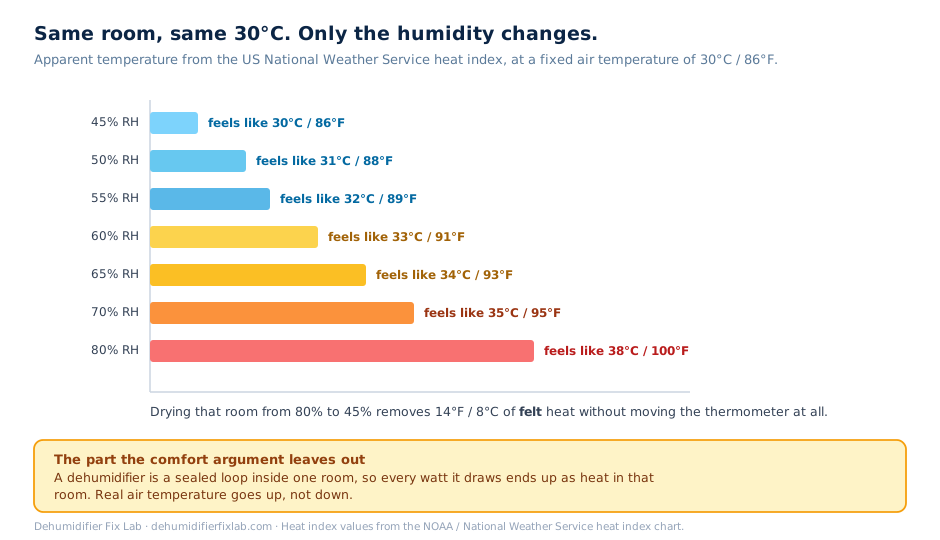
Drying that room from 80% to 45% takes 14°F / 8°C off the apparent temperature without the thermometer moving at all. That is not a marketing claim, it is a government safety table, and it is considerably more than the degree or so of real heat the machine adds on its way to achieving it.
Which is why the answer to “can a dehumidifier cool a room” is genuinely both yes and no, and why almost every article on the subject picks one half and stops.
Truth 3: can a dehumidifier cool a room? It depends which room
The heat index only helps you if there is humidity to remove. Two rooms at the same temperature can be completely different propositions.
A basement, a bathroom-adjacent bedroom, or a room where washing dries — these sit high on that table. Dropping them from 70% to 50% is worth several degrees of comfort and you will notice it the same evening.
A dry room in a dry climate at 40% RH — you are already at the bottom of the table. There is nothing left to take. The machine will run, add its heat, collect very little, and make the room marginally worse. I would not buy one for this room and I would tell a neighbour the same.
The way to know which room you have is to spend a few pounds on a hygrometer and watch it for a week. Not to buy a 20-litre machine and hope. The settings guide covers what to do with the number once you have it.
The myth: that it can stand in for an air conditioner
It cannot, and the marketing that implies otherwise is the single most common bit of nonsense in this category.
Air conditioning removes heat from the building. A dehumidifier moves heat around inside one room and adds a bit. If your bedroom is 32°C at midnight because it has been in the sun all day and the fabric of the house is holding that heat, no dehumidifier is going to rescue you. Open the windows once the outside air is cooler, or buy the right appliance.
Where the confusion comes from is that air conditioners also dehumidify — that is a genuine and useful side effect of running a cold coil. People notice the comfort improvement, correctly attribute part of it to drier air, and then reason backwards to a machine that only does the drying part. The reasoning is half right, which is the most dangerous kind.
When a dehumidifier is genuinely the better buy
Asking whether a dehumidifier can cool a room is really asking what is making the room uncomfortable. There are cases where I would pick the dehumidifier over the air conditioner without hesitating:
- The room is damp rather than hot. Musty smell, condensation on the windows, washing that never dries. Cooling it does nothing for any of that.
- You are trying to protect the building, not yourself. Mould can begin on a suitable surface within 24 to 48 hours above 60% RH. An air conditioner running only when someone is home will not hold that line.
- The room is 24–27°C but unbearable. That is a humidity problem wearing a temperature costume, and the table above tells you exactly how much you stand to gain.
- You want it running unattended. A dehumidifier on a hose and a humidistat will hold a basement at 50% all summer for a fraction of what continuous cooling costs.
When you need the air conditioner instead
- The thermometer genuinely reads above about 28–30°C and that is the complaint.
- Humidity is already at or below 50% and you are still too warm.
- Someone in the house has a heat-sensitive medical condition. Perceived comfort is not the metric that matters there.
Running both without wasting money
If you have both, the mistake is putting them in the same room at the same time. The dehumidifier’s condenser is dumping heat into the air the air conditioner is paying to cool, and each is making the other’s job harder.
Put the dehumidifier where the moisture originates — the basement, the utility room, the space where washing dries — and let the air conditioner handle the living space. Dry air is cheaper to cool than damp air, because the cooling coil no longer has to condense water out before it can drop the temperature, so the two do genuinely help each other. Just not from a metre apart. There is more on the seasonal side of this in running a dehumidifier in summer.
One thing worth knowing if you are choosing a machine for a warm room: a compressor unit is the efficient choice at these temperatures. Desiccant models put out noticeably more heat, which is exactly what you want in a cold garage in February and exactly what you do not want in August. The comparison between the two types goes into the trade-off properly.
Frequently asked questions
Does a dehumidifier cool a room or heat it?
It heats it, very slightly. Both coils are inside the room, so the heat removed by the cold one is returned by the warm one, plus the electrical work of the compressor and fan. Expect a degree or two over a long run in a closed space.
Will a dehumidifier make a room feel cooler?
Yes, and often by a surprising amount. At 30°C, dropping the humidity from 80% to 45% removes about 8°C of apparent temperature on the National Weather Service heat index. The thermometer does not move, but your ability to sweat improves dramatically.
How much does a dehumidifier raise room temperature?
Typically one to two degrees Celsius in a closed room over several hours, and less in a room with any air movement. The exact figure depends on the machine’s power draw and the room’s size, so anyone quoting you a precise universal number is guessing.
Can a dehumidifier replace an air conditioner?
No. An air conditioner exports heat out of the building; a dehumidifier does not. If the actual temperature is the problem, only cooling will fix it. If dampness is making a moderate temperature feel worse, the dehumidifier is the cheaper and more targeted answer.
Is it worth running a dehumidifier and air conditioner together?
Yes, provided they are not in the same room. Put the dehumidifier where moisture is generated and let the air conditioner cool the living space. Drier air is cheaper to cool, so they complement each other when separated.
Do dehumidifiers cool the air that comes out of them?
No — the outlet air is warmer and drier than the air that went in. That is by design. The air passes over the cold coil to shed its water, then over the warm coil on the way out.
Which is cheaper to run, a dehumidifier or an air conditioner?
A dehumidifier, comfortably, because it is doing far less work. Take the wattage from the rating plate, multiply by hours run and divide by 1,000 to get kWh, then apply your own tariff. I am not going to guess what you pay per unit.
Related guides: How dehumidifiers work · Dehumidifier in summer · How to dehumidify a room · Dehumidifier settings
Sources
- NOAA National Weather Service — Heat Index — the apparent-temperature figures behind the table above.
- EPA — Mold Course, Chapter 2 — humidity thresholds and how quickly mould establishes above 60% RH.
- ENERGY STAR — Dehumidifiers — the 30–50% target band and current efficiency standards.
- GE Appliances — Dehumidifier: Ideal Operating Conditions — operating limits and coil behaviour.
So: can a dehumidifier cool a room? Not the thermometer, and it never will. What it can do is take the misery out of a warm one, which for most people asking the question turns out to be what they actually wanted.
Where this guide and your appliance’s own manual disagree, follow the manual. And if you bought one hoping it would cool the bedroom — it will help, just not for the reason on the box. Put a hygrometer next to it and you will see exactly what it is earning you.

