
Last Updated on October 26, 2026 by Umar Farooq
Can you use a dehumidifier in a conservatory? Yes, but only within the temperature range the machine was built for: a compressor unit is rated for roughly 5 to 32°C (41 to 90°F), and a glass room can fall below that in winter and climb above it in summer. Inside that window it works exactly as it does in the rest of the house.
The conservatory is the one room where the question is not “do I need one” but “will it survive the thermometer”. The classic mistake is to put a perfectly good machine in an unheated glass box in January and conclude it is broken because the tank stays dry.

Why a glass room gets so wet
Glass is the problem and also the reason you built the room. Meaco’s guidance on condensation in a conservatory puts the cause plainly: warm, moist air meets cold glass and turns to liquid, and how much you get depends on the type of conservatory, its heating and its ventilation. A brick wall stays closer to room temperature. A sheet of glass or polycarbonate tracks the weather.
That tells you where the water comes from. Much of it is not made in the conservatory at all. It drifts in from the house, from cooking, showers and washing, and condenses on the first cold surface it meets. People often miss that point, and it is why a dehumidifier in the conservatory alone can be fighting a tap you have left running next door.

A machine lowers the moisture in the air, so the same cold glass has less to condense. It does not warm the glass. For the general mechanism, why condensation forms on windows is the longer version.
Limit one: cold mornings, where a compressor unit gives up
A compressor dehumidifier works by chilling a coil. Chill it too far and frost forms before water does. GE’s own page on ideal operating conditions says a dehumidifier “will not operate satisfactorily at temperatures below 41 degrees Fahrenheit”, and that models with frost control will switch off before a major freeze-up. The Honeywell manual is tighter on both ends: designed for 41°F (5°C) to 89°F (32°C), and placed where the temperature will not drop below 5°C.
An unheated conservatory spends a good part of winter below 5°C overnight, and Meaco’s advice for exactly that room is a desiccant model, because it expects winter temperatures to be well below 10°C and says desiccant units cope better under that line. That is a manufacturer’s view, so take the 10°C figure as a rule of thumb rather than a measured threshold.
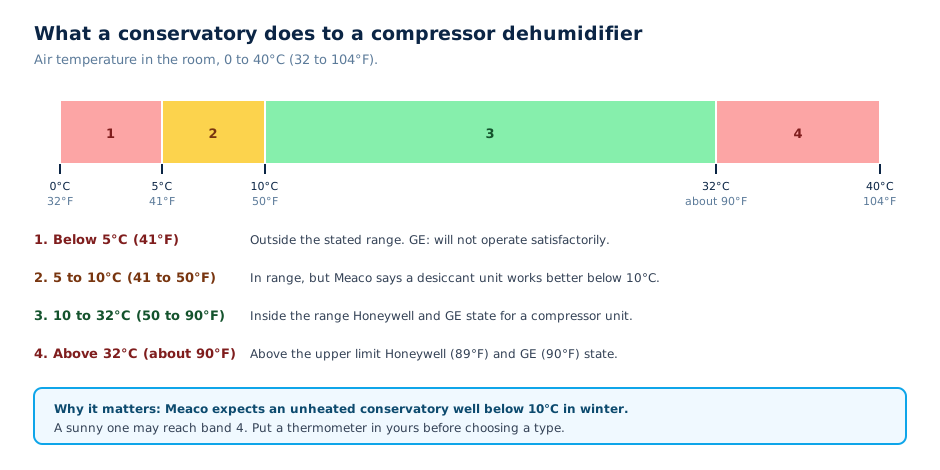
| Conservatory air temperature | What to expect from a compressor unit |
|---|---|
| Below 5°C / 41°F | Outside the stated range; frost control stops it, little or no water |
| 5 to 10°C / 41 to 50°F | In range, but Meaco says a desiccant unit does better |
| 10 to 32°C / 50 to 90°F | Inside the range both makers state |
| Above 32°C / about 90°F | Above the upper limit both makers state |
If your conservatory is cold, the choice is a desiccant unit, or accepting that a compressor unit will sit idle on the coldest weeks. Desiccant versus compressor lays out what each costs you, and running one in winter covers the frost behaviour in more detail.
Limit two: summer, which nobody warns you about
Most of the guides I opened worry about the cold. The upper limit gets much less attention, and for a south-facing glass room it matters more than people think. Both Honeywell and GE state a ceiling of about 32°C (89 to 90°F), and a conservatory in a hot spell can sit above that.
I have not measured conservatory temperatures, and yours will differ with orientation, blinds and vents. So the sensible move is a cheap thermometer on the wall for a fortnight in July. If it reads above the maker’s ceiling, a dehumidifier is not your problem that week, shade and ventilation are. In summer the glass is rarely cold, so condensation is rarely the complaint anyway.
Limit three: an open door to the house
Here is a quiet one. If the door between the house and the conservatory stands open, the machine is trying to dry the whole ground floor through a glass room. If it stays shut, the conservatory dries more quickly and takes in less warm, damp house air.
My rule is to treat the conservatory as its own room: door shut after cooking and showers, a trickle of ventilation, and the dehumidifier running while the door is closed. Meaco also suggests adding vents and airflow to an old or poorly ventilated conservatory, with the machine handling what is left.
Two practical points on top of that. Plants and watering add moisture, and a lot of conservatories are full of both, so do houseplants raise humidity is worth a look. And place the unit away from the glass, with clear space on every side and a short lead into a wall socket. Not an extension cord run across the floor: that one is in the manual, not just my opinion.
Setting it: start at 50 per cent and judge by the glass
You do not need a conservatory-specific setting. Start the humidistat at around 50 per cent, look at the glass in the morning, and nudge it down a few points if it is still streaming. Dehumidifier settings explains what the dial really does, and why chasing a lower number costs more than it dries.
If the glass is wet even with the machine cycling, the cause is probably the door, the vents or a source of moisture next door, not the machine.
Can you use a dehumidifier in a conservatory? In spring and autumn, and with the right type in winter
Yes, between roughly 5 and 32°C, which covers most of spring, autumn and a mild winter. A cold conservatory wants a desiccant unit, a hot one wants shade, and every one wants the door shut and the water source found.
FAQ
Do I need a dehumidifier in my conservatory?
Not always. If the glass only mists on cold mornings and the room is ventilated, vents and a shut door may be enough. A dehumidifier helps when condensation keeps returning, especially in an older or poorly ventilated room.
What type of dehumidifier is best for a cold conservatory?
Meaco recommends a desiccant model for an unheated conservatory, because winter temperatures are likely to be well below 10°C. Compressor units work best in the middle of their stated range, so check your manual’s minimum.
Will a dehumidifier stop condensation on conservatory windows?
It can cut it by removing moisture from the air, but it cannot warm the glass. Where the glass is very cold, some misting on the coldest mornings is normal even with the machine on.
Can I leave a dehumidifier in a conservatory all year?
Probably not on a compressor unit. It will stall in cold weather and may exceed its upper limit in a hot spell, so move it or switch it off outside the range your manual gives.
Should the conservatory door be open or closed when the dehumidifier runs?
Closed, if you mean to dry the conservatory itself. An open door makes the machine treat the house as well, and lets warm damp air flow into the coldest room.

