
Last Updated on October 24, 2026 by Umar Farooq
Does opening windows reduce humidity? Yes, but only when the air outside holds less water than the air inside; on a muggy or rainy day it does the opposite. The relative humidity figure on the weather app will not tell you which kind of day it is, which is why this advice goes wrong so often.
I used to throw the windows open on principle, as if fresh air were a moral good. It is, mostly. It is also, in July, a very efficient way to import a bucket of water.

Does opening windows reduce humidity? Only when outside air carries less water
Air holds water vapour, and warmer air can hold more of it. Relative humidity (RH) is just how full the air is for its temperature, so it moves up and down when the temperature does even if no water is added or removed.
That is why RH is a poor way to compare indoors with outdoors. The measure that does not wobble with temperature is the dew point: the temperature the air would have to cool to before it starts shedding water. The US National Weather Service makes the same point: a 30°F day with a 30°F dew point is 100% RH but feels mild, while an 80°F day with a 60°F dew point is only 50% RH and feels far muggier. A higher dew point means more water in the air.
So the whole question reduces to one comparison. If the outdoor dew point is lower than the indoor dew point, open air is drier than your house, and swapping the two dries it. If it is higher, you are swapping dry for wet.
Three rules that settle it
Here is the simple version. These are my own rules of thumb, not a standard, so treat the margins as judgement.
- Open up when the outdoor dew point is clearly below the indoor one. I use a gap of about 3°C (5°F) as “clearly”, so that measurement error does not decide it for me.
- Keep shut when it is the other way round, or when it is close. Close means you gain nothing and still lose heat.
- Air a room straight after you make moisture, almost whatever the weather, because a shower or a pan of pasta puts more water into one room than any weather can.
The EPA’s guidance on moisture and mould lines up with rule 3: it tells you to run the bathroom fan or open the window when showering, and to use exhaust fans or open windows when cooking or washing up.
Compare the water, not the percentage
Here is a worked example, using my own arithmetic from the standard saturation vapour pressure formula rather than anything I measured. Take a living room at 20°C (68°F) and 55% RH. That air holds about 9.5 g of water per cubic metre, and its dew point is about 10.7°C (51°F).
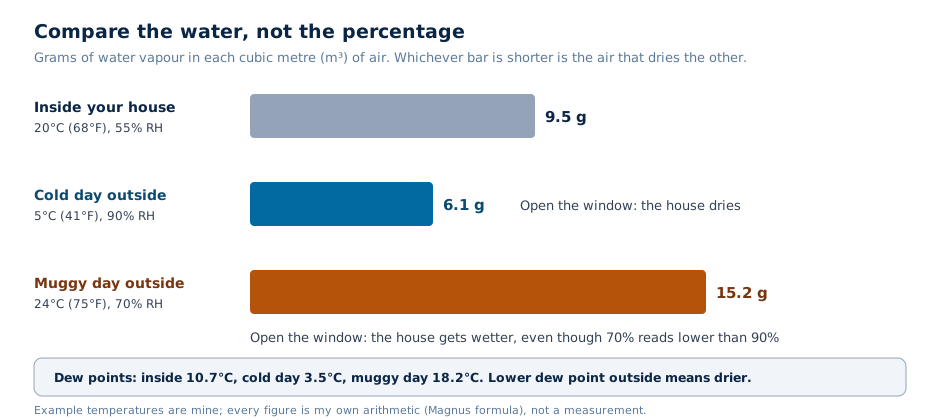
Now two days outside. A cold one at 5°C (41°F) and a soggy-feeling 90% RH has a dew point of only 3.5°C and holds about 6.1 g per cubic metre. Let that in and warm it to 20°C, and its RH falls to roughly 34%. The house dries.
A muggy one at 24°C (75°F) and 70% RH sounds less humid than the cold day. It is not: its dew point is about 18.2°C and it holds around 15.2 g per cubic metre, so opening the window adds water. The weather service rates dew points of 65°F (about 18°C) and above as “lots of moisture in the air, becoming oppressive”, which is the territory this second day sits in.
When airing out really works
Cold, dry days. Cold air cannot carry much water, so even when it feels raw and damp it often has a low dew point. Warm it indoors and it becomes thirsty air. This is the best case for ventilation, and the reason winter airing is such a reliable habit.

After showering and cooking. The moisture is concentrated and local, so letting it out fast stops it spreading to cold walls and ceilings. Do it in the room where it was made, and shut that room’s door so it does not travel.
After drying washing indoors. A full airer is a lot of water in one place. Ventilate the room once the clothes are dry, and read how to dry clothes indoors without mould for the rest of the routine.
Days when opening windows makes damp worse
Muggy summer days and after rain. This is the case above: the dew point outside is higher than inside, so the house takes on water. I wrote up why the damp feeling lingers in why your house is humid when it rains, and the short version is that wet weather air is already full.
Cool cellars and basements in summer. Warm, humid air meets cold masonry, cools, and drops water onto it. The window did that. Here, ventilation is the wrong tool, and drying the air mechanically is the right one. What size dehumidifier you need depends on the space and how wet it gets.
When the damp is coming from somewhere else. A leak, a bridged damp course or a gutter overflowing is not an air problem, and no window will dry it. Fix the water first.
How long to leave a window open
Short and wide beats long and ajar. I would open it fully for 5 to 10 minutes, ideally with another window or door on the far side of the house for a through-draught, and 15 minutes or so after a hot shower. That is my judgement from how quickly small rooms exchange air, not a figure from a study, so adjust it by what your hygrometer does.
Leaving windows open for hours in cold weather is mostly a way to cool walls, floors and furniture. Cold surfaces are exactly where moist indoor air condenses afterwards. It also means the reading often creeps back up once you close up: damp walls, fabrics and furniture hold water and release it again. If the number bounces straight back, the room is holding more moisture than air changes can fix, which is what the cause analysis in how to lower humidity in a house is for.
Use two hygrometers, one inside and one out
Weather apps give you a forecast for a spot somewhere else. A cheap pair of hygrometers that also show temperature gives you the real numbers at your own window, and there is a short guide to how humidity is measured if you want to know how far to trust them.
Put one in the room, one outside in the shade, give both ten minutes, then work out the dew point from temperature and RH with any free online calculator. Lower outside: open up. Higher: keep shut. There is no cleverer method, and it takes two minutes.
For a target, the EPA advises keeping indoor RH below 60%, ideally between 30 and 50%. If you are already inside that range, you do not need to ventilate for humidity at all.
Opening windows reduces humidity when the outdoor number is lower
That is the whole answer. It is not a seasonal rule either: a cold, wet January day can dry the house better than a bright, warm June one. Check the dew point, ventilate in short bursts, always after moisture is made, and when the outside air is never the drier one, stop relying on windows.
FAQ
Does opening windows reduce humidity in winter?
Usually yes. Cold outdoor air holds little water even when it feels damp, so once it warms indoors its relative humidity drops and it can take moisture from the room. Keep the airing short, so you are not just chilling the walls.
Does opening windows increase humidity in summer?
It can, whenever the outdoor dew point is higher than the indoor one, which on muggy days it often is. Keep windows shut then, and use air conditioning or a dehumidifier to bring the water down instead.
Should I open windows when it is raining?
Generally no, unless you are airing a shower or kitchen for a few minutes. Rainy-day air is usually carrying a lot of water, and letting it in raises the indoor level.
How long should I leave a window open to reduce humidity?
About 5 to 10 minutes wide open, with a through-draught if you can, is my rule of thumb. Longer in cold weather mainly cools the building without drying it much further.
Is it better to open windows or use a dehumidifier?
Use windows when the outdoor dew point is clearly lower, because it is free. Use a dehumidifier when it is not, or when the room is a cool, damp space like a cellar where ventilation fails.
Does opening a window stop condensation?
It helps if the outside air is drier, because lower indoor humidity means less water to condense on cold glass. It will not fix a window that stays cold, or a source such as drying washing that keeps adding moisture.

