
Last Updated on October 24, 2026 by Umar Farooq
Why is humidity higher in the morning indoors? Because the house is at its coolest just before you wake, and cooler air reads a higher relative humidity even when it holds exactly the same amount of water. Add a night of breathing behind shut doors and you get the 7am number that makes people think their house has grown a swamp.
It usually has not. The hygrometer is reporting a ratio, and the bottom of that ratio shrinks every time the temperature drops.

Why is humidity higher in the morning indoors? Cooler air is closer to full
Relative humidity (RH) is how much water the air holds as a percentage of the most it could hold at that temperature. Cold air can hold less, so the same water is a bigger share of a smaller capacity. A local TV meteorologist puts the outdoor version plainly: relative humidity is highest in the morning, when temperatures are coolest, and lower in the afternoon, even when the amount of moisture has not changed.
Indoors the swing is usually smaller than outdoors, but it is real. These numbers are my own arithmetic (the Magnus formula), not a measurement. Take a living room at 20°C (68°F) and 50% RH. It holds about 8.6 g of water per cubic metre. Let the house cool overnight with no water added or removed:
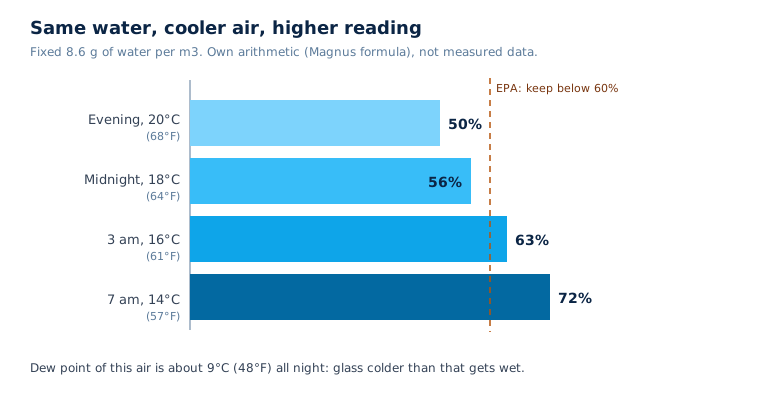
A bedroom that drops from 20°C to 14°C (57°F) walks from 50% to roughly 72% RH on the same water. Nobody opened a tap. The dew point stays at about 9°C (48°F) the entire time, which is why meteorologists prefer it: the National Weather Service notes that relative humidity “can be misleading” and shows how a cold day can read 100% RH while feeling mild.
Four things that stack up overnight
Falling temperature is the headline, but three other things push the same way.
- Cooling. The effect above. Heating off or turned down at night, thin walls and an old boiler all make the dip deeper.
- People. Every sleeper breathes out water vapour and loses some through the skin. I have no trustworthy measured figure for how much, since the numbers I found came from sales pages, so I will not quote one. Two sleepers in a small room add visibly more than one.
- Shut doors and windows. The water you add stays in the room instead of mixing with the whole house. Opening a window only helps if the air outside is drier, and at night that depends on the dew point outside, not the temperature.
- Cold surfaces. Glass, external walls and the back of a wardrobe are at their coolest around dawn. When a surface is colder than the air’s dew point, water leaves the air and lands on it. The morning peak and the wet window are the same event seen two ways.
What a wet window at 7am is telling you
The window is the cheapest hygrometer you own. If it is wet at 7am and dry by 11am, the room is simply passing through its daily peak. If it is wet all day, the air is carrying more water than the glass can tolerate at any hour.

My opinion, and I will stand behind it: a wet window on a cold morning is not a verdict on your house, but a window that needs wiping every day is. It means the indoor dew point is higher than the glass temperature for hours, and that is a moisture source or a ventilation problem rather than a weather quirk. The EPA notes that condensation can be a sign of high humidity and says to dry wet surfaces quickly and deal with the moisture source. For the glass itself, why condensation forms on windows and what the types mean goes further.
Why the reading drops as the day warms
The house warms, the capacity of the air rises, and the same water now reads lower. Reverse the chart: take that 14°C air back up to 20°C and it is back at 50%, with no drying at all. A shower and breakfast add a short spike on top; after that the curve slides down towards afternoon, helped by whatever you do with windows and fans.
Two things nudge the fall along. Warming walls and glass lift surfaces above the dew point, so condensation dries off. And moisture that soaked into fabrics and plaster overnight is slowly released again, which is why a very wet night can leave the afternoon reading a little above where it started the day before.
Normal peak or a problem? Compare your morning with your afternoon
Do not judge a single reading. Judge the shape of the day. The rules below are my own rules of thumb for a typical heated house, built around the EPA’s advice to keep indoor RH below 60%, ideally 30 to 50%; they are not a published standard.
| What you see | Likely meaning | What to do |
|---|---|---|
| 7am high, afternoon back inside 30-50% | Normal daily swing | Wipe the glass, nothing more |
| 7am high, afternoon still above 60% | The house is holding too much water | Find the moisture source; see the bedroom humidity guide |
| Wet windows all day, not just at dawn | Persistent condensation | Treat as a damp problem, not a time-of-day quirk |
| Peak only in one room | Local moisture or a cold wall | Check that room’s sources and surfaces |
If you have not yet decided where to put the meter, where to put a hygrometer covers the common mistakes, and what indoor humidity should be lays out the target range.
Do these three things in the first 30 minutes of the day
- Wipe the windows and sills, so water does not sit on frames and sealant. It takes a minute.
- Open windows briefly if the outside air is drier, which in cold weather it often is. Five to ten minutes is my judgement, not a researched number. Skip it on a muggy or rainy morning.
- Run the extractor fan while you shower and cook. The EPA says to run the bathroom fan or open a window when showering and to use exhaust fans or open windows when cooking.
Then glance at the same reading around 2pm. That one comparison tells you more than any single number.
A morning peak is normal; a peak that never leaves is the real damp
So, why is humidity higher in the morning indoors? Because the house is coolest, sealed and slept in. That is physics, and a reading of 65% at dawn that falls to 45% by teatime needs no action beyond wiping the glass. The time to worry is when the afternoon reading still sits above 60%, or the windows stay wet after the room has warmed up.
FAQ
What time of day is indoor humidity highest?
Usually around dawn, when the house has had its longest spell of cooling. The relative humidity then falls as the day warms, even if the water content barely changes.
Why is my bedroom more humid in the morning?
The room is coolest then, you have been breathing in it all night, and the door and window were probably shut. All three push the reading up together.
Is 70% humidity in the morning bad?
A one-off 70% reading at dawn that falls through the day is a normal swing. If it stays above 60% in the afternoon, the EPA’s guidance is to keep indoor RH below 60% and ideally between 30 and 50%, so look for the moisture source.
Does humidity go down during the day indoors?
Yes. As the house warms, the air can hold more water, so the same moisture reads lower. Cooking, showers and drying washing will add short peaks on top.
Should I ventilate in the morning?
Briefly, if the air outside is drier than inside, which is common on cold days. If it is muggy or raining, keep windows shut and use the extractor fan instead.

