
Last Updated on October 24, 2026 by Umar Farooq
What causes high humidity in a house is one of eight things: ground moisture, leaks, damp outdoor air, people, cooking, bathing, wet laundry, or too little extraction. By volume the biggest are usually the ones you cannot see, which is why the shower gets blamed for what the floor is doing.
Most guides hand you a list of causes in no useful order. This one ranks them by how much water each adds, tells you where the number is real and where nobody has measured it, and shows you how to work out which one is yours.

What causes high humidity in a house, ranked by how much water each adds
The best figures I could find come from a Canadian National Research Council paper by R. L. Quirouette, Moisture sources in houses, which measured real houses. It is from 1984 and Canadian, so read the litres as the shape of the problem, not as a promise about your semi in Leeds. Where it is silent, I say so in the table rather than inventing a number.
| Rank | Source | Litres of water vapour per day | How well sourced |
|---|---|---|---|
| 1 | Bare soil in a crawl space | 40 to 50 | NRC, measured |
| 2 | Wet concrete-block basement wall | 8 to 10 | NRC, measured |
| 3 | Stored summer damp released in autumn and winter | 3 to 8 | NRC, calculated |
| 4 | Four people breathing and sweating | about 5 (1.25 each) | NRC, measured |
| 5 | Cooking, bathing, laundry, floor washing | 2.4 extra on average | NRC, measured, lumped together |
| 6 | Leaks and wet building materials | Varies enormously | Not sized here |
| 7 | Damp warm air leaking in | Varies with weather | Not sized here |
| 8 | No extraction | Not a source: a multiplier | NRC’s balance argument |
The diagram below puts the first five on one scale. The crawl space is not a rounding error. It is the whole chart.

Here is my one firm opinion on this page: blame the occupants last. The same NRC paper reports that a major Canadian Mortgage and Housing Corporation study found people and their habits to be the exception rather than the rule as the cause of high humidity. Showering, cooking and breathing are real and steady, but a house with a ventilation rate even close to normal copes with them. When it does not cope, something else is feeding it.
Ground moisture is the heavyweight nobody sees
If any part of the floor is bare earth, start there. The NRC puts an exposed crawl-space surface at as much as 40 to 50 litres a day, which is more than the whole family’s breathing, cooking and bathing put together, several times over.
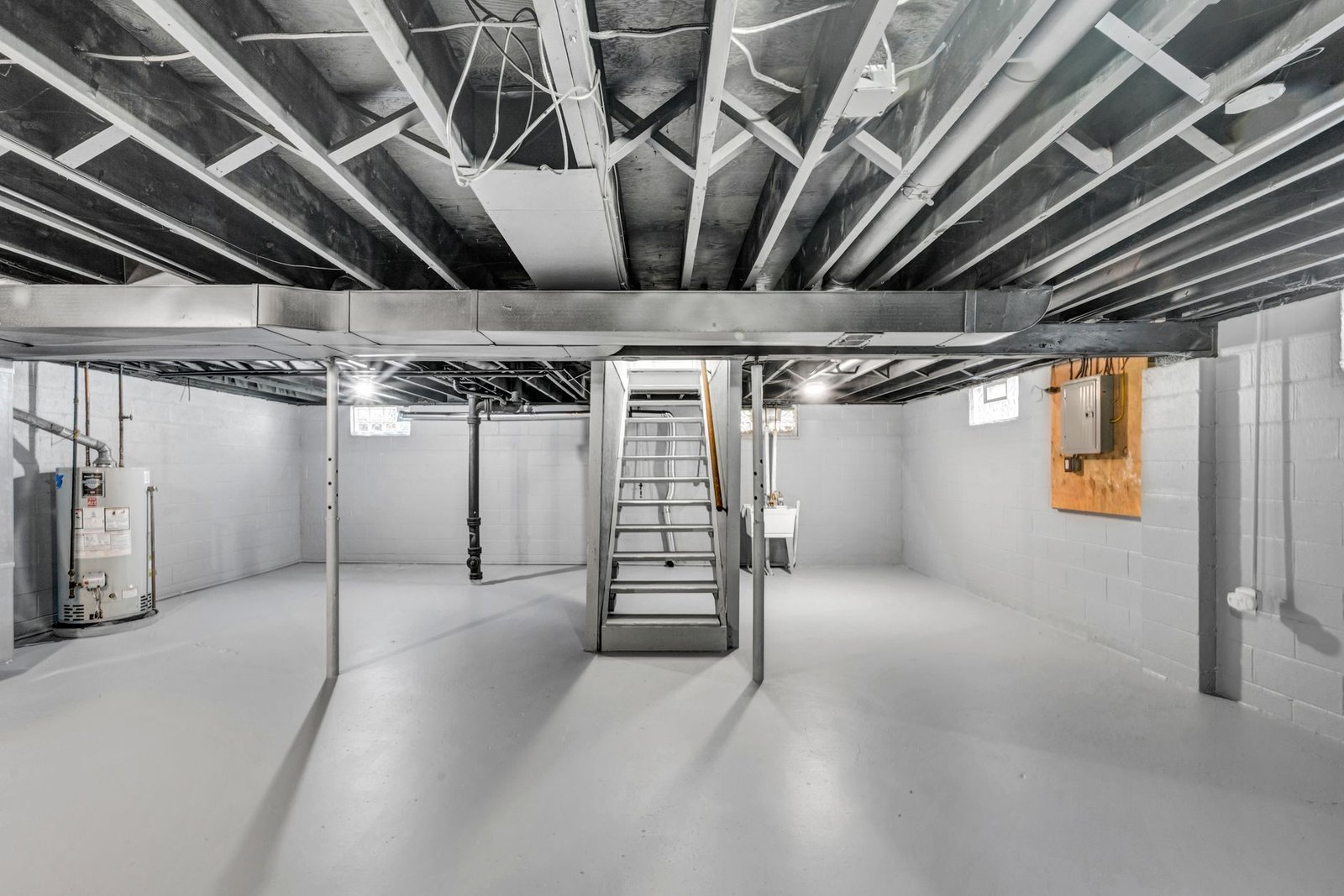
Basements are a gentler version. The paper estimates two to three litres a day diffusing through an average basement’s walls and floor, and as much as eight to ten from a block wall that is visibly wet several feet up all the way round. It also tells the story of a new bungalow with 50 to 60% humidity and streaming windows in winter, caused by a blocked perimeter drain. Once the blockage at the sump was cleared, water poured in from under the slab for about six hours.
The US Department of Energy’s weatherisation guidance describes the fix for the crawl space: a ground cover at least 6 mil (0.15 mm) thick, run up the walls and piers, with overlapped seams. It states that exposed dirt floors let ground vapour and soil gases in.
Leaks and wet materials: the sources that never switch off
A leak is the one cause that does not care how well you ventilate. A slow weep under a sink or a failed roof flashing adds water around the clock, and it gives no puddle to warn you, only a cupboard that is permanently a bit damp.
Two related sources get missed. First, wet building materials. The NRC calculates that the lumber and concrete in a new house can release 2,000 to 3,000 litres over about 18 months, roughly four to five litres a day, which explains why humidity complaints cluster in the first two years after a build. A big renovation with new plaster does the same on a smaller scale. Second, appliances that put water in the air on purpose or by accident: the NRC’s advice for a house with a humidity problem is to find any humidifier and switch it off, and it notes that a kerosene heater releases slightly more than a litre of water per kilogram of fuel burned, with similar rates assumed for natural gas and propane.
None of this has a typical figure I would trust. A pinhole drip and a failed roof are different universes, so I have left it unsized rather than make one up.
Warm, damp outdoor air gets in and the house stores it
The common version is simple. Air at 90% outdoors comes in through gaps, vents and open windows and the house takes the humidity with it. The less obvious version is storage: the NRC calculates that the structure and furnishings soak up damp through a humid summer and give it back as 3 to 8 litres a day once the heating comes on. That is also why condensation complaints peak in early autumn, when the stored water leaves quickly.
The practical test is whether the readings track the weather rather than your routine. If they rise on wet days and fall on dry ones, the cause is outside, and why a house gets humid when it rains walks through it, including the trap of opening windows when the air outside is the wetter.
People, cooking, bathing and laundry: the steam you add yourself
These are real, just smaller than their reputation. The NRC measured about 0.2 litres an hour, or five litres a day, from four people breathing and perspiring, and found that cooking, bathing, showering, clothes washing and drying and floor washing added an average 2.4 litres a day on top.
Two honest caveats. The paper lumps its activities together, so I cannot tell you the split between a shower and a saucepan, and I will not quote a per-load figure for drying washing on an airer because I cannot trace one to a source I have opened. What is clear is the pattern: steam arrives in bursts, in the kitchen and bathroom, and a lid, a door and a fan deal with most of it. The bigger question of the total is for how much moisture a household produces.
If you find unexplained, spreading dampness or visible mould, fix the water source first. The EPA advises keeping indoor humidity below 60%, ideally between 30% and 50%, and treating areas bigger than about 10 square feet (roughly 1 square metre) as a bigger job than a scrub. Do not run a dehumidifier over a live leak and call it solved.
Extraction is the multiplier: small sources, no way out
Nobody puts “no extractor fan” in a box labelled water, but the NRC’s central idea is that a house’s humidity is a balance: the moisture coming in must equal the moisture going out. Its worked example, for a winter house at 30% RH with -18°C outdoors, needs 16 litres per second of air change to cope with 7.4 litres a day of moisture and 39 litres per second to cope with 18 litres a day.
The paper’s real point sits next to it. Normal occupancy plus a normal air change rate does not add up to a high-humidity house. When it does, either the house is very airtight or something else is feeding it, and in practice it is often both. That is why a bathroom with no fan and a kitchen with a recirculating hood make a modest steam load into a permanent one.
Find your cause with a seven-day hygrometer log
You do not need a surveyor to begin. You need a cheap hygrometer, a notebook and a week. The method below is my own and it is not a published diagnostic, so treat it as a way to decide where to look first.
- Put three meters out: in the bedroom, in the room you cook in, and in the lowest or coldest space you have. A basement, utility room or north-facing back room is ideal.
- Read them three times a day: on waking, mid-afternoon and last thing at night. Write down the weather too.
- Change one habit at a time: a fortnight is better, but even a few days of extractor use or door-open showers will show a pattern.
- Compare against the EPA target: below 60%, ideally 30 to 50%. If you want the reasoning for that band, what indoor humidity should be covers it.
Then read the pattern:
| What the log shows | Likeliest cause | What to do first |
|---|---|---|
| Spikes after showers and meals, then falls | Steam with no exit | Run an extractor 15 to 20 minutes after, lids on pans |
| Highest in the lowest room, steady all week | Ground moisture | Cover bare soil, check drains, grade and gutters |
| High everywhere, day and night, with no pattern | A leak, wet materials or an airtight house | Inspect under sinks and roofs, then add background ventilation |
| Rises on wet days, falls on dry ones | Damp outdoor air getting in | Ventilate when outside air is the drier |
| Highest in the bedroom at 6am | People overnight, closed windows, cold walls | Trickle vents, space between wardrobe and wall |
| Climbs in autumn when the heating starts | Stored summer damp | Wait it out, ventilate, and watch whether it falls |
The 15 to 20 minutes is a common rule of thumb, not a sourced figure. The rest of the table is my reading of how these causes behave.
Fix the source you found, and size a machine last
Each cause above has a different fix, and the steps for them are in how to lower humidity in your house, so I will not repeat them here. The order is what matters: stop water arriving, get steam out where it starts, ventilate only when the outside air is drier, and then dehumidify what is left.
If a machine is the answer, size it to the problem you measured, not to the floor area. What size dehumidifier you need takes the readings you have just collected and turns them into a number. And the next time someone tells you what causes high humidity in a house is a family that showers too much, ask what the floor is doing.
FAQ
What is the main cause of high humidity in a house?
There is rarely one, but the largest sources by volume are usually ground moisture, leaks and wet building materials rather than daily activities. Measured Canadian houses lost far more water vapour from bare crawl-space soil than from four people breathing, cooking and bathing combined.
Why is my house suddenly so humid?
Something changed: a leak started, the weather turned warm and wet, the heating went on after a damp summer, or an extractor stopped working. Check the hygrometer against the weather first, then look under sinks and at the ceiling, because a new problem has a new cause.
Can a house be humid without a leak?
Yes. Damp outdoor air, stored summer moisture, wet soil under the building and ordinary steam with no extraction can all push a house above 60% without a single drip. Those are the causes a plumber will not find.
Does cooking and showering really raise humidity?
They do, in short bursts, but they are rarely the reason a house stays high all week. A lid on the pan and an extractor run for 15 to 20 minutes after a shower (my rule of thumb) usually clears the spike. If the reading never comes back down, look elsewhere.
Why is my house humid even with the air conditioning on?
The air conditioner only removes moisture while it is running, and one that cools the house quickly and shuts off may not run long enough to dry it. I cannot give you a sourced number for that, so check whether the reading falls while the unit runs, and see if a leak or damp air is feeding the house.
What humidity is too high in a house?
The EPA advises keeping indoor humidity below 60%, ideally between 30% and 50%. Above 60% on repeated readings, look for the cause and not just a machine.
Related guides: How to lower humidity in a house · Why is my house humid when it rains? · What should indoor humidity be? · How much moisture does a household produce? · What size dehumidifier do I need?
Where this page and a surveyor who has seen your house disagree, trust the surveyor. But start with the log, because it is free and it is the one thing they will ask you for. The EPA’s brief guide to mold, moisture and your home is the plain-English reference for the target numbers.

