
Last Updated on October 24, 2026 by Umar Farooq
How much moisture does a household produce? About 12 litres (21 pints) a day on the figure UK housing factsheets use, with the published estimates running from roughly 10 to 14 litres. The spread is not an error: it is mostly a measure of how much washing gets dried indoors.
I went looking for the primary source behind that 12 and could not find one, which is worth knowing before you build a sizing calculation on it. What follows is what the council leaflets actually say, the arithmetic I have done on them (labelled as mine), and what the number does and does not tell you about ventilation and dehumidifier size.

How much moisture does a household produce? Three published answers
Three UK sources I opened give three different headline numbers. None of them says how it was measured.
| Source | Household figure | Notes |
|---|---|---|
| Vico Homes tackling-condensation factsheet | 12 litres (21 pints) a day | “The average household”, no breakdown |
| Mid Sussex District Council damp leaflet | about 10 litres a day | Specifically a five-person household |
| East Ayrshire Council mould and condensation page | about 24 pints a day | About 13.6 litres, my conversion (1 UK pint is about 0.568 litres) |
So the honest answer is a range of 10 to 14 litres, not a single figure. Notice that the five-person home in the middle row is the lowest. Household size matters less than what the household does, which the next section shows.
Where the litres come from, activity by activity
Only two of those sources break the total down, and they do not use the same categories. Here are both, unedited.
East Ayrshire (pints a day, litre column is my conversion):
| Activity | Pints | Litres (mine) |
|---|---|---|
| Two active people, one day | 3 | about 1.7 |
| Cooking and boiling a kettle | 6 | about 3.4 |
| Bath or shower | 2 | about 1.1 |
| Washing clothes | 1 | about 0.6 |
| Drying clothes | 9 | about 5.1 |
| Paraffin or bottled-gas heater | 3 | about 1.7 |
| Total as printed | 24 | about 13.6 |
Mid Sussex (litres a day, as printed):
| Activity | Litres |
|---|---|
| Breathing, asleep | 0.3 |
| Breathing, awake | 0.85 |
| Cooking | 3 |
| Personal washing | 1.0 |
| Washing and drying clothes | 5.5 |
Adding up that second list gives 10.65 litres, which is my arithmetic and not theirs. The leaflet says “about 10”. It does not say whether the breathing figures are per person, so I would not scale them by headcount.
Two things are consistent across both. Cooking is about 3 litres either way (6 pints is 3.4 litres). And laundry dwarfs everything else: 5.1 litres for drying in one, 5.5 for washing and drying in the other. Breathing is the small line, which surprises people.
Drying washing indoors is the biggest line, and the optional one
Both budgets put laundry first. East Ayrshire’s 9 pints for drying clothes is more than the 6 for cooking and the 2 for bathing put together, and that is before the 1 pint for the washing machine itself.
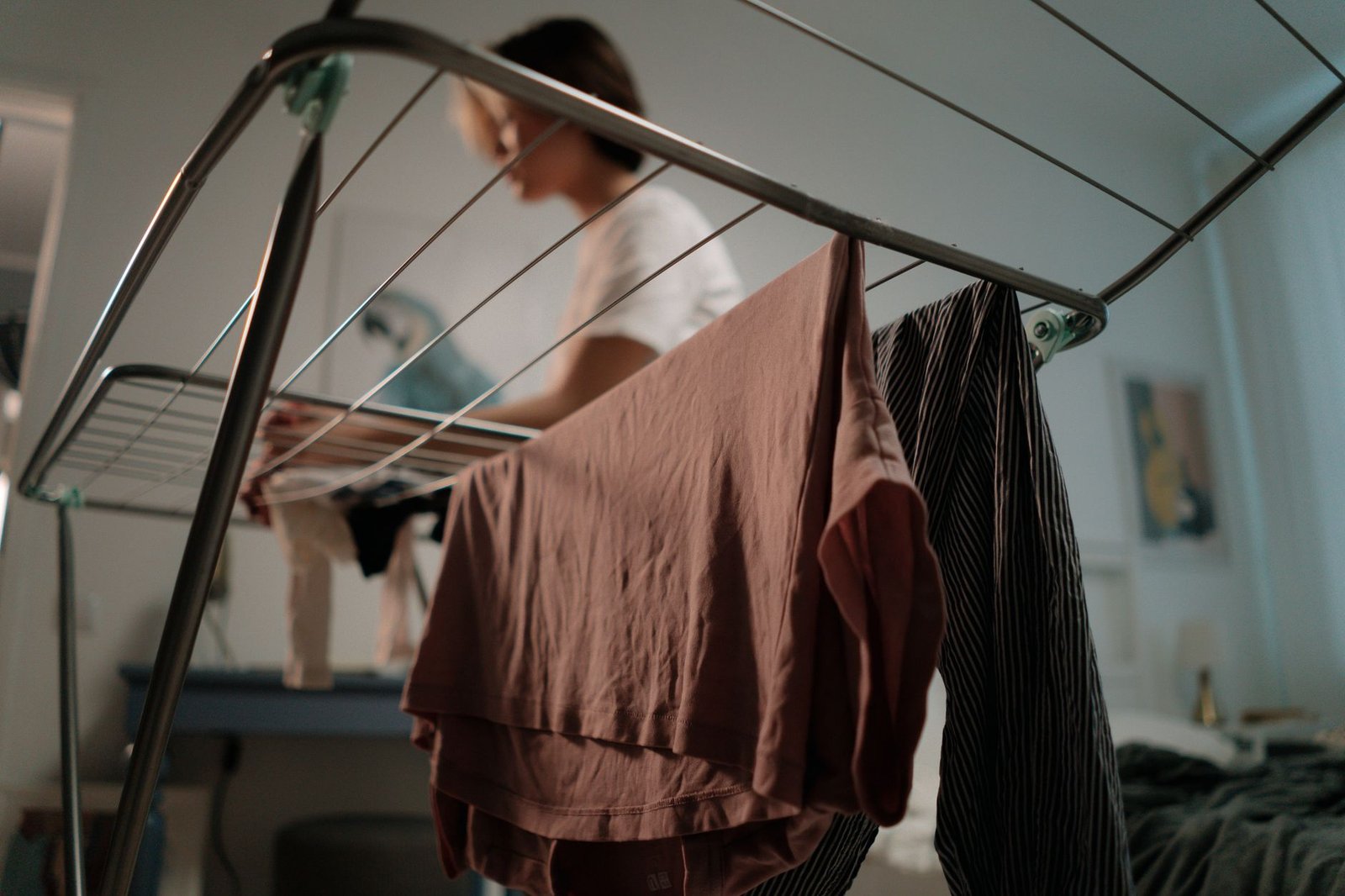
It is also the only large item you can change without changing how you live. You cannot stop breathing, and dinner has to be cooked, but a load of washing can go on a line, in a vented tumble dryer, or into a room with a machine running. Drying clothes indoors with a dehumidifier covers that last option.
Gas heaters are the other lumpy one. Mid Sussex says a bottled-gas heater produces about 4.55 litres of moisture from each gas cylinder, and East Ayrshire counts 3 pints a day for a paraffin or bottled-gas heater. If you have one, it is worth a line on your own budget.
What the 12 litres leaves out
Everything above counts people and appliances. It does not count the house itself. A Canadian National Research Council study I use elsewhere on this site measured real houses and found that bare ground in a crawl space, wet basement walls and building materials still drying out can rival or exceed the whole family’s daily output. I go through those figures in what causes high humidity in a house, including the caveat that the study is from 1984 and Canadian.
That is why the 12 litres is a floor for a home with a problem and a ceiling for a home without one. If your windows stream with water and you do not dry washing indoors, the leaflet number will not explain it.
What the number means for ventilation
Indoor humidity is a balance. Whatever the household adds has to leave, through ventilation or through condensing somewhere. If it does not, the air carries more of it until something gives, usually the coldest window or wall.
Here is my own arithmetic, not a published rate. Twelve litres spread over 24 hours is about 0.5 litres an hour, though in practice it arrives in bursts: a shower, a cooking session, a rack of washing. That is why extraction at the source beats general ventilation. A kitchen fan running during cooking removes the 3 litres where it is made, before it spreads through the house. My own opinion, for what it is worth: a working extractor in the kitchen and bathroom does more than any amount of window-opening later. Reducing humidity in a kitchen takes the cooking side in detail.
I cannot give you a safe air-change rate from these leaflets, because they do not provide one and I will not make one up. What they support is the direction: more moisture made means more ventilation needed, and the laundry is where the extra comes from.
What the number means for dehumidifier size
The 12 litres does not tell you what size dehumidifier to buy, and it is worth being clear why.
Machine ratings are quoted under a manufacturer’s test conditions, in pints or litres a day, and a real room is rarely at those conditions. A machine rated at several times your household’s output may still collect little in a cool, only mildly damp room, because collection depends on how warm and damp the air is, not on how much moisture you make. So do not match a rating to 12.
What the figure does give you is a sense of scale. A machine in a whole-house setting is working against a source of a few litres to perhaps a dozen a day. My judgement, not a published rule: if a unit is collecting far more than that, the moisture is probably coming from somewhere other than the household, such as the ground or a leak. Sizing by room volume and dampness is the right method, and the sizing guide walks through it.
Cut the laundry line first, then the rest
If you want to bring your own total down, the order follows the tables.
- Move washing outdoors, or into a vented dryer, or into one closed room with a dehumidifier on. This is the biggest single saving on both lists.
- Run the extractor fan while cooking and keep pan lids on.
- Use the bathroom fan during and after showers, and shut the door so the steam does not travel.
- Swap a flueless gas or paraffin heater for another type if you can.
- Then think about ventilating more or running a machine. How to lower humidity in a house puts those in a sensible order.
Do not seal vents or block trickle vents to “keep the heat in” if you run a gas or paraffin heater. Those heaters add moisture and combustion products, and they need the ventilation they were installed with.
FAQ
How much moisture does a family of four produce a day?
There is no single measured figure on the pages I could verify. The common UK factsheet figure is about 12 litres a day for an average household, and a five-person household is quoted at about 10 litres by Mid Sussex. Household size matters less than how much washing is dried indoors.
How many litres of water does a person breathe out per day?
Mid Sussex lists 0.3 litres for breathing while asleep and 0.85 for breathing while awake, without saying whether these are per person or per household.
Is 12 litres a day a lot of moisture?
It is about 21 pints, and it only becomes a problem when it has nowhere to go. In a ventilated, warm home it leaves as vapour. In a cold, sealed one it condenses on glass and walls.
Does cooking or drying laundry produce more moisture?
On the figures I read, drying laundry indoors produces more: 9 pints against 6 for cooking and boiling the kettle on East Ayrshire’s list, and 5.5 litres for washing and drying against 3 for cooking on Mid Sussex’s.
Does a dehumidifier remove all of the moisture a household makes?
Not necessarily, and it does not have to. Ventilation removes some, condensation and absorption into the building take some, and the machine collects the rest. How much it collects depends on temperature and dampness as well as on how much your household produces.
So, how much moisture does a household produce? Plan on about 12 litres a day, expect up to roughly 14 if you dry washing indoors, and treat anything much bigger as a sign that the house, not the household, is the source.

