
Last Updated on October 24, 2026 by Umar Farooq
Do heated airers cause damp? Not by themselves, but the wet washing on them does: every drop it holds ends up in the room’s air unless something carries it out of the house. The heat only makes the water leave faster, which is a mixed blessing if the room has nowhere to put it.
I like heated airers. I just don’t think they come with a free pass, and the box never mentions the window.
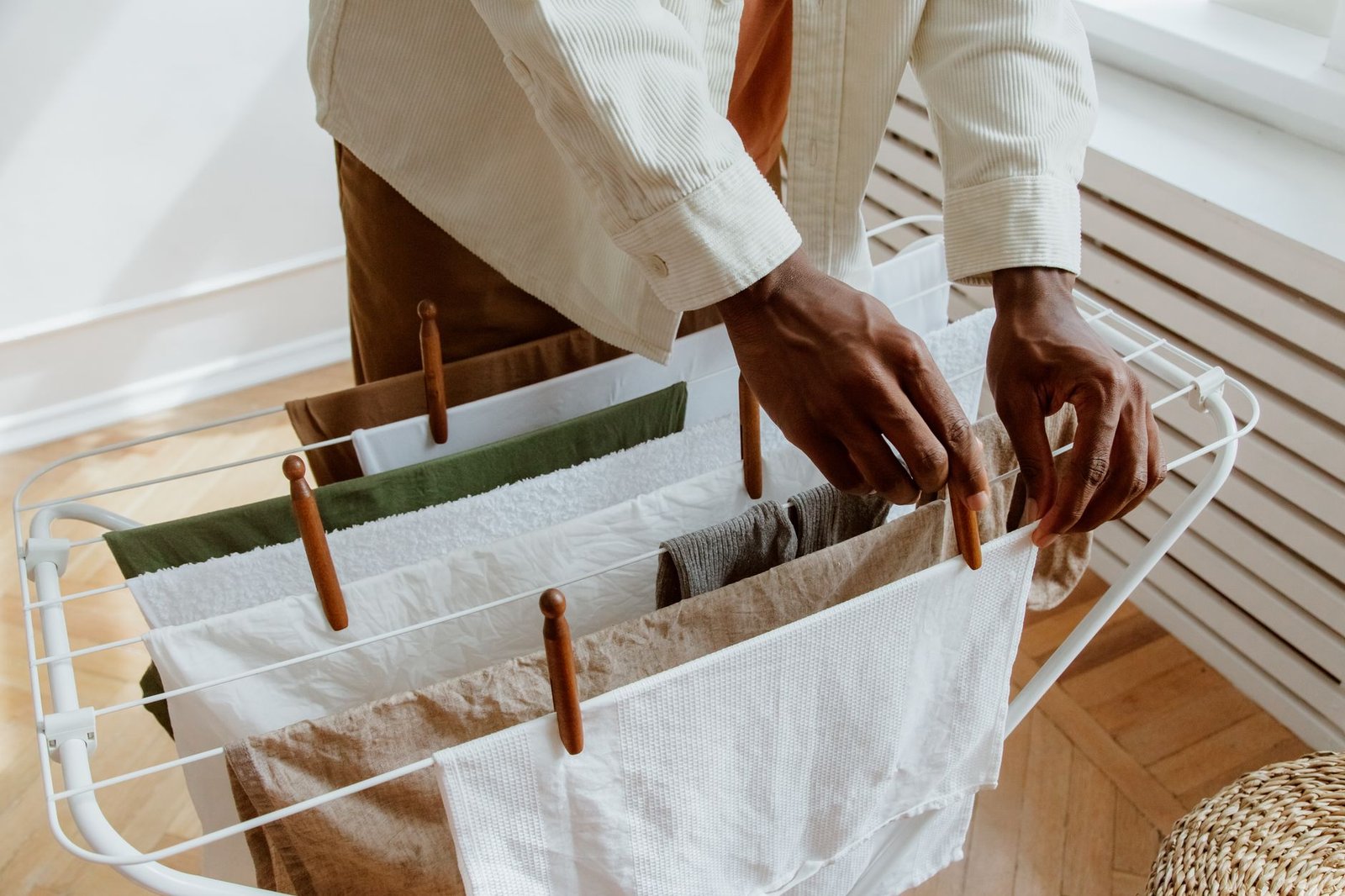
Where the water goes while the bars are warm
A heated airer does not make water. It takes the water your washing came out of the machine with and turns it into vapour, quicker than an unheated airer would. Healthy Homes puts the next bit plainly: drying clothes indoors, especially in confined spaces, can increase indoor humidity, and if ventilation does not remove it, that moisture condenses on walls and other surfaces.
That is the whole mechanism. Warm moist air drifts until it meets something colder than itself, typically window glass, an external wall or the corner of a ceiling, and turns back into liquid there. Which? warns against using a heated airer in a room with little or no air circulation, because that is how condensation ends up in ceiling corners and encourages mould.
Do heated airers cause damp? Quicker drying, same moisture
The water in a load is the same whichever airer you use, so the total moisture is not lower with a heated one. What changes is the timing. Which? tested heated airers on a small cotton load and found towers averaged 4 hours 40 minutes, which is a good deal quicker than the day-long job many people get from an unheated rack.
Faster drying has one real benefit: washing that is damp for hours instead of a day is less likely to go musty. It has one real cost: the vapour arrives in a rush, and a room with the door open or the window shut has to absorb all of it. I would rather have a slower airer in a ventilated room than a quick one in a sealed box.
What a heated airer costs against a tumble dryer
People choose them for the bill, so here is what Which? measured. The figures come from two different Which? articles (the second is its guide to the cheapest way to dry clothes indoors) with different assumptions, so I would not subtract one from the other.
| Figure (Which?) | Heated airer | Tumble dryer |
|---|---|---|
| Hourly running cost | about 8p an hour | no hourly figure given |
| Drying time | 4 h 40 min for a small cotton load (tower), about 39p | 1 to 3 hours for a big pile |
| Three loads a week, per year | about £54 (news article) | about £41 for a heat pump dryer |
| Three large loads a week, per year | about £143 | about £135 vented, £123 condenser |
Read that honestly: the airer is cheap per hour and cheap for a small load, but it is not automatically cheaper than a tumble dryer. For big loads Which? puts it close to a vented dryer, and a heat pump dryer beats it. The airer’s real advantage is that it needs no vent, which matters in a flat. What it will not do is remove the water. A vented tumble dryer sends it outside through a hose; tumble dryer condensation and venting covers what the other types do with it.
Five habits that stop a heated airer causing damp
Do not drape a sheet or cover over an airer unless its manual allows it, and do not overload it. Which? found that covers did not speed up drying and that plastic ones trap humidity, so a cover is not the answer to a damp room anyway.
- Spin the load hard first. Water left in the machine is water that never reaches the room. Use the highest spin the care label allows.
- Pick one small room, shut the door, give the vapour an exit. An extractor fan or a window open a crack. The shut door confines the moisture and the exit removes it, and you need both. The full routine is in how to dry clothes indoors without mould, so I won’t repeat it here.
- Fill the airer, then switch it off. Which? notes that empty heated bars still use power, so put a full load on and use a plug-in timer if you are prone to forgetting. A bar left on after the washing is dry just heats the room for nothing.
- Skip the cover and leave gaps. Air has to reach both sides of each garment. Thick items such as towels and jeans go on the outside.
- Add a dehumidifier if you do this most days. Which? says running one while clothes dry can speed things up, at an extra running cost. Settings and room layout are in dehumidifier for drying clothes, and dehumidifier laundry mode explains the button on the front. For capacity, see what size dehumidifier do I need.
A window only helps when the air outside is drier than the air in the room. On a still, wet day, the extractor does the work and the window is for show.
Signs your airer is already causing damp
You do not need a gadget to tell. Look for these, in roughly this order:
- Windows streaming with water on the morning after a drying day.
- Beads of water in the corners of the ceiling or along the top of an external wall.
- Black speckles in window seals, or on the wall behind the airer.
- A musty smell from a wardrobe on an outside wall, or from the washing itself.
- Wet marks on the floor under the airer, or on the skirting.
Wipe the glass rather than leaving it. Which? makes a related point: do not wipe condensation with a towel and dry it on a radiator, because the water just goes back into the air. If you see mould, remember that the cause is the water, and cleaning it without fixing the source resets the clock. If the patch keeps coming back, treat it as a ventilation problem, not a cleaning one.
A heated airer is fine in a room that can breathe
My view, and I will stand by it: a heated airer is a perfectly good way to dry washing in a small room with the door shut and an exit for the vapour, and a poor idea in an open-plan lounge or a bedroom with the window shut. Do heated airers cause damp? Only when the room cannot get rid of what they release. Fix the ventilation, time the airer and use a dehumidifier on heavy weeks, and it is one of the cheaper ways to get washing dry in an British winter.
FAQ
Do heated airers cause condensation?
They can. The airer speeds up evaporation, and the vapour condenses on the first cool surface it meets, usually windows, external walls and ceiling corners. A shut door plus an extractor fan or a cracked window keeps it in check.
Do you need a dehumidifier with a heated airer?
Not for an occasional load in a ventilated room. If you dry washing indoors most days, or you have no extractor fan and cannot open a window, a dehumidifier removes the vapour so it does not reach the walls.
Where does the moisture go when clothes dry on a heated airer?
Into the room’s air as vapour. From there it leaves through a vent or window, is removed by a dehumidifier, or condenses on cold surfaces. Nothing in the airer takes it away.
Should you open a window when using a heated airer?
Yes, a little, with the room door shut so the vapour goes outside instead of through the house. It helps most when the outside air is drier than the air indoors.
Can you leave a heated airer on overnight?
I would not. Which? found a small cotton load took about 4 to 5 hours, so a timer set for that covers it, and a bar left on afterwards uses power for nothing. A plug-in timer is the simple answer, and check your airer’s manual for its own limit.

