
Last Updated on October 24, 2026 by Umar Farooq
Do thermal curtains cause condensation? Not by adding any moisture, but a thick curtain drawn against the glass makes the pane colder and traps a still pocket of damp air behind it, so condensation (and the mould that follows it) often gets worse on the glass, the sill and the fabric. The curtain is rarely the cause. It is the thing that turns a damp-ish room into a dripping window.
I find this one oddly reassuring, because it means you do not have to throw out good curtains. You do have to stop treating them as a seal.

Why a thick curtain makes the glass colder
Condensation needs two things: humid air and a surface colder than that air’s dew point. Glass is the coldest surface in most rooms. Cornell’s extension service puts numbers on it: a single-glazed window has an R value (resistance to heat flow) of about 1 and a double-glazed one about 2, against 11-20 for a typical wall. Cornell’s fact sheet on window condensation also says condensation will often occur when shades or draperies are closed, because most window treatments separate the cold glass from the warm room air and let the glass cool further below the dew point.
That is the whole mechanism. Without a curtain, room heat and moving air reach the inside of the pane and keep it a little warmer. With a thick curtain shut, the pane gets cold air from outside on one side and almost nothing from the room on the other.
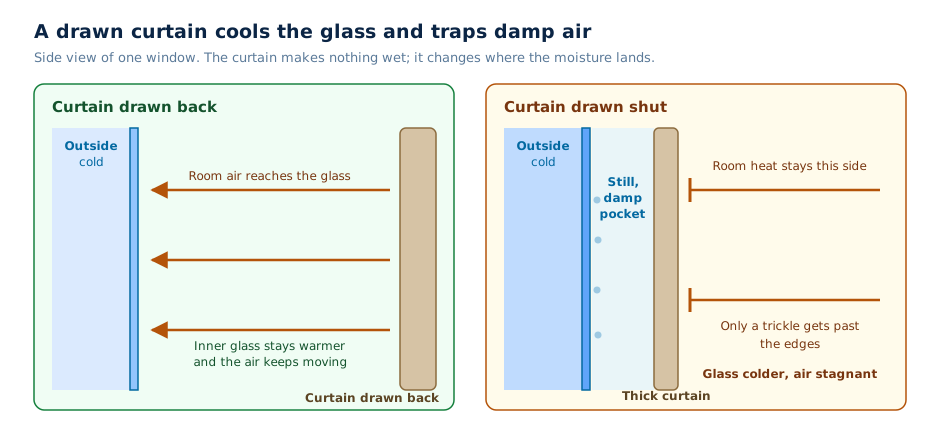
The second effect is the pocket. Curtains are not airtight, so some room air, carrying all your breathing, showering and kettle vapour, leaks in around the edges. It cools against the cold glass and has nowhere to go. A cold surface, damp air and no movement is the recipe behind condensation on windows in general, just delivered in a neat fabric-lined box.
Do thermal curtains cause condensation, or just show it up?
Both, in a sense, and which one depends on the room.
If your windows were bone dry before the curtains went up, a new set is unlikely to start a problem on its own. If the air was already humid, a curtain turns an occasional misting into a daily soaking, because it keeps the one thing that was holding the glass above the dew point away from it. The thermal lining makes the glass-side colder, not wetter, but colder glass in a damp room is how you get wet glass.
There is also a catch in the other direction. Cornell notes that you can prevent condensation entirely by covering the window with tightly sealed, movable interior insulation, which keeps room air off the cold glass altogether. A curtain hanging loose on a pole is not that. It is the half-measure: enough to chill the pane, not enough to keep the damp air away from it. I think that is the real reason people say thermal curtains “cause” condensation. They are good at the first job and useless at the second.
Four habits that stop the damp pocket forming

You do not need to give up the curtains. You need to stop them sitting on the glass all day.
- Open them in the morning. Cornell’s second option for conventional curtains is to accept that condensation may form overnight but stop it building up by opening the treatment during the day. Ten minutes of daylight and room air on the pane, and the overnight film is gone before it can run down onto the sill. Close them at dusk for the warmth. This is the single most useful habit.
- Leave a gap. Hang the pole so the fabric sits clear of the glass and the radiator or sill, with room for air to move behind it. A couple of centimetres (about an inch) is the minimum I would aim for. That is my own rule of thumb, not a measured figure, and more is better. Curtains that puddle on the sill act like a wick, which is how you end up with mould on curtains.
- Tie them back, or tuck the hem up. Tie-backs or a hook, once the curtains are open, keep them off the glass instead of drooping against it. If the room has deep sills, never push the curtain behind a plant or ornament that holds it against the pane.
- Ventilate the damp at source. Run the extractor fan while cooking and showering and leave a trickle vent open if the frame has one. What trickle vents actually do is let a little moist air leave all day, which is far cheaper than fighting condensation on the glass at 7am.
None of this costs money, only a little effort at either end of the day.
When the curtains are only the messenger
If you have done the four habits and the glass still streams, the curtain is not your problem. Humidity is.
The EPA advises keeping indoor relative humidity below 60 percent, ideally between 30 and 50 percent, and says that condensation collecting on windows, walls or pipes can be a sign of high humidity. A hygrometer costs a few pounds and takes the guesswork out: put one in the room, read it in the evening and again first thing, and you will see whether the air is the issue.
Typical signs that the room, not the fabric, is at fault:
- Condensation on windows with no curtains, or on the bare side of the same room.
- Wet glass in several rooms at once, not just the one with thermal curtains.
- Streaming glass after showers, cooking or drying washing indoors.
In those cases the fix is lowering the humidity: drying clothes elsewhere, ventilating wet rooms and, where a room stays damp, running a dehumidifier. The full list of fixes, cheapest first is in its own guide, and I would rather not repeat it here.
What to do if the curtain or sill already has mould
Fix the water first, then clean. Mould returns to any surface that goes on getting damp, no matter how well it was wiped.
The EPA’s guide says small patches (under about 10 square feet, roughly a metre square) are generally manageable by a householder, but mould on soft fabric is a judgement call: washable curtains can be laundered hot and dried completely, while lined thermal ones with a backing coat can be hard to dry through and may not be worth saving. I cover washing versus binning in the guide to mould on curtains. Do not dry-brush mould, because that spreads spores.
Dry the sill and frame, and from then on keep the curtain off them.
Keep the curtains, open them early and fix the humidity behind the problem
So, do thermal curtains cause condensation? They make the glass colder and the air behind them stagnant, which makes existing humidity show up as water. The cure is not a different fabric. It is opening them each morning, hanging them clear of the glass, venting the damp where it is made, and checking that the room sits at 30-50 percent humidity. If the glass is wet with curtains open as well, the curtains were innocent all along and your air is the thing to fix.
FAQ
Do thermal curtains make condensation worse?
They can, mainly when they hang against the glass and stay closed all day. They keep room heat off the pane, so it runs colder, and they leave a still pocket of damp air against it. They do not add moisture, so a dry room usually copes fine.
Should I close thermal curtains at night or leave them open?
Closing them at night keeps warmth in, and that is a reasonable trade if you open them again first thing. Leaving them shut all day is where trouble starts, because the glass never gets a chance to warm and dry out.
How far should curtains hang from the window?
Far enough that air can move behind them. I would aim for at least a couple of centimetres of clear space and keep the hem off the sill, but that is a rule of thumb rather than a standard. More space is better, and curtains over a radiator or deep sill need extra thought.
Do blackout curtains cause condensation?
The mechanism is the same. Anything thick that separates cold glass from warm room air can let the glass cool below the dew point, which is what Cornell describes for shades and draperies. The fix is the same too: open them in the day and keep them clear of the glass.
Do thermal curtains cause mould?
Not directly, but wet glass soaks into fabric that rests on it, and damp fabric in still air is where mould starts. Keep the glass dry and the curtain off it and the mould has little to work with.

