
Last Updated on October 24, 2026 by Umar Farooq
What are trickle vents? They are small, adjustable slots in a window frame or wall that let a slow, steady stream of outside air into a room while the window stays shut. Their whole job is background ventilation, which is how a sealed modern home gets rid of the water vapour its occupants produce.
This is a UK-weighted topic, because that is where the term, and the building rules behind it, are most familiar. If you live elsewhere, the idea still applies, but the regulations I quote below do not.

What are trickle vents, and where do you find them?
Look along the top of the frame of a newer window. If there is a narrow slot, usually with a small slider or flap, that is the trickle vent. Some are cut into the frame itself, some are fitted on top of it, and some are fitted in a wall rather than a window. The Federation of Master Builders describes the two main kinds as slot vents and glazed-in vents, and notes they work in uPVC, timber and aluminium frames. Wikipedia’s trickle vent entry uses the plainest wording I found: a relatively small opening that provides a limited amount of ventilation when windows and doors are closed.
The slider is the part people misunderstand. It is not an on-off switch for a draught. It is a volume knob for a slow, constant flow of air.

What a trickle vent actually does about moisture and condensation
Every household makes water vapour: breathing, showers, cooking, drying clothes. In a leaky old house some of it escaped through gaps. In a draught-proofed one it has nowhere to go, so it builds up and lands on the coldest surface it can find, usually the glass. Condensation on windows is the visible result.
A trickle vent works on the supply side. Cold outside air comes in, and because it holds little water vapour, it dilutes the damp air inside once it warms up. Damp air then leaves through an extractor fan, a chimney or the small gaps every home still has.
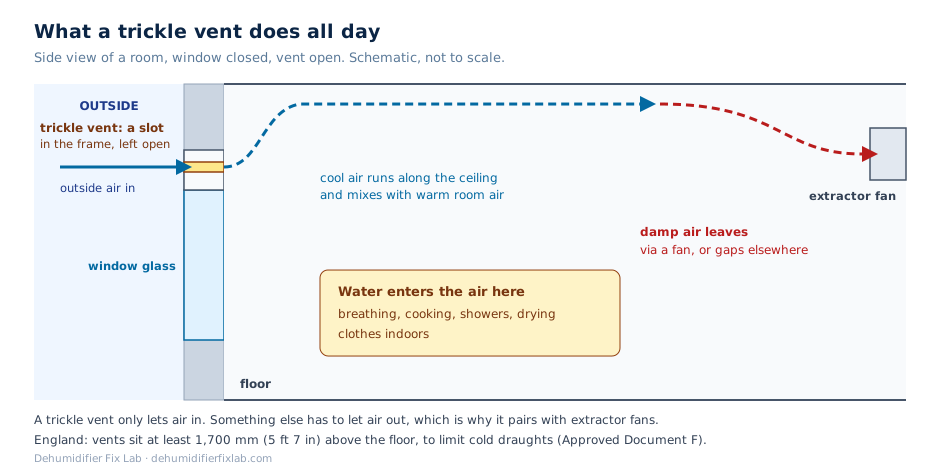
I want to be straight about the limits. A trickle vent is a small, permanent brake on humidity, not a cure. It will not clear the steam from a shower, and I have not found a measured figure for how much it lowers humidity in a typical room, so I will not give you one. What I can say is that it works around the clock, including the eight hours a night you spend breathing into a closed bedroom.
Five rules for using trickle vents
- Open them and leave them open. The national guidance for England puts it in a single line: “Background ventilators are intended to normally be left open.” Closing them in winter because of the draught is the most common mistake, and I think it is backwards: winter is when windows stay shut and indoor air is wettest.
- Keep them clear of curtains, blinds and furniture. A curtain pulled across a slot, or a heavy blind hanging in front of it, throttles the flow. If you can feel a faint movement of air with your hand at the slot, it is working.
- Never paint or caulk them shut. Decorators do this by accident. Mask the vent first, or take the cover off. If it was painted shut, a plastic scraper and a bit of patience usually frees it.
- Vacuum the slot twice a year. Dust and spider webs gather along the opening. A brush attachment is enough.
- Use the slider for the weather, not as a habit. Narrow it on a bitter, windy night if the draught bothers you, then open it again. Closed all winter defeats the point.
Trickle vent, open window or extractor fan: which does what
They are not rivals. Each deals with a different moment in the day.
| Method | Flow | Best for | Weak spot |
|---|---|---|---|
| Trickle vent | Small and constant | Overnight and everyday background moisture | Cannot clear a burst of steam |
| Opening a window wide | Large, short-lived | Clearing a shower, cooking or drying session | You have to remember, and it loses heat while open |
| Extractor fan | Moderate, at the source | Bathrooms and kitchens, where most moisture is made | Needs to run long enough, and a route outside |
Opening a window is the strongest tool you have and it is free, but it is a manual one, and it only helps when the air outside is drier than the air inside. For the fan side, see dehumidifier vs extractor fan. A vent gives you the baseline; a fan or an open window handles the peaks.
What the Approved Document says about trickle vents
In England, trickle vents are called background ventilators, and they are covered by Approved Document F, Ventilation (2021 edition), which I opened and read for this article. It says “All rooms with external walls should have background ventilators”, and that they “should be at least 1700mm above floor level, to reduce cold draughts, but still be easy for the occupant to reach.” That height is why they sit in the frame head, not the sill.
A few more points from the same document that people rarely hear:
- Replacement windows: “If the existing windows have background ventilators, the replacement windows should include background ventilators”, and they should be controllable and no smaller than the originals.
- Size is stated as equivalent area: in square millimetres, and the document says the figure should be marked where it can be seen from inside the room. Look for it on the vent.
- Noisy roads: where a wall faces sustained and loud noise, a noise-attenuating vent should be fitted. If you hear traffic through yours, that is the version to ask about.
- Fans: if a fan and a background vent are in the same room, they should be at least 500mm apart.
The Federation of Master Builders adds that listed buildings and conservation areas are usually exempt. That document is for England. Scotland, Wales and Northern Ireland have their own rules, which I did not open, so check locally if you are replacing windows there.
When trickle vents are not enough
Open vents will not fix a house that makes more water than the vents can carry away. The signs are straightforward:
- Streaming windows every morning even with the vents open.
- A bathroom or kitchen that stays steamy long after the fan stops.
- Washing dried indoors, which puts a lot of water into the air.
- Black speckling on cold corners, which means the surface is staying damp.
In these cases, add the stronger tools first: a working extractor fan with a timer, a proper ventilation routine for the whole house, and a window routine that fits your day. Fix the source of water before you add anything else.
A dehumidifier is the last step, not the first. It helps where the air stays wet after you have ventilated, such as a laundry-heavy winter or a room that cannot be vented. If you reach that point, what size dehumidifier do I need explains how to pick one. It sits alongside the vents, not instead of them: a machine does not bring in fresh air.
Leave the slot open and fix the water at the source
So, what are trickle vents in practice? A cheap, quiet, always-on way to keep air moving through a home that is otherwise sealed. They only help if they are open, clear and paired with something that lets air out. Open them, stop painting them, give them a quick vacuum, and treat any window that still streams as a sign that the room is making more water than the vents can handle.
FAQ
Should trickle vents be open or closed?
Open, most of the time. The English guidance says background ventilators are intended to normally be left open. Narrow them for a cold, windy night if you must, then open them again.
Do trickle vents make a room cold?
They let in a small amount of cold air, so you may feel it near the vent. Fitting them high in the frame, as the guidance requires, reduces the draught. A very small, steady flow costs you far less heat than a window left wide open.
Do trickle vents stop condensation?
They help reduce it by letting air in to dilute the damp air, but they do not stop it alone. Heavy sources like showers, cooking and drying clothes still need a fan or an open window.
Do I need trickle vents on every window?
Not necessarily. In England, rooms with external walls should have background ventilators, and the document sets a minimum area per room. Listed buildings and conservation areas are commonly exempt.
Can I add trickle vents to old windows?
Yes, retrofit vents exist, but check your window guarantee first, because drilling into the frame can affect it. If you are unsure, ask the original installer.

