
Last Updated on October 24, 2026 by Umar Farooq
Do electric heaters reduce humidity? They lower the relative humidity reading by warming the air, but they remove no water and add none, so a damp room is still damp. The hygrometer looks better, which is not quite the same thing as the room being better.
Plenty of people stand in front of a heater that has just made the display drop ten points, looking quietly pleased. It is a fair thing to be pleased about. It is also only half the story.
Why the reading drops when nothing has left the room
Warm air can hold more water vapour, so the same water reads as a smaller percentage.
That is the entire mechanism. Relative humidity is a ratio: the water the air holds, against the most it could hold at that temperature. Raise the temperature and the “most it could hold” goes up while the water stays put, so the percentage falls. The EPA lists “increase air temperature” among its steps for preventing condensation, and the same page asks you to keep indoor humidity below 60%, ideally 30 to 50%.
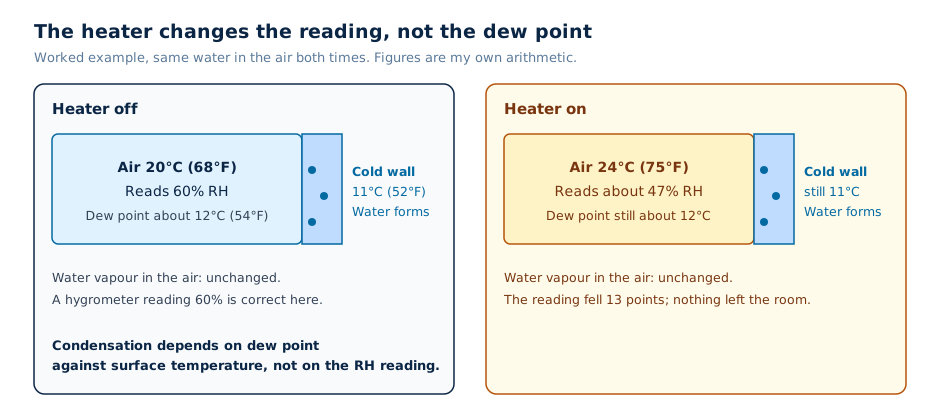
The diagram shows a worked example. The numbers are my own arithmetic from standard saturation vapour pressure values, not a measurement of any particular heater.
If you want the target numbers for the cold months, they are in what a sensible winter humidity level looks like. The point here is narrower: an electric heater is a thermostat for your hygrometer, not a dryer.
Gas and paraffin heaters do the opposite
Burning fuel makes water, so an unflued gas or paraffin heater adds moisture where an electric one adds none.
This is the real difference between heat sources, and it is the one most “do heaters dry the air” pages skip. Fuel is made of hydrogen and carbon. Burn it and you get carbon dioxide and water vapour, released straight into the room unless a flue carries it outside. The Centre for Sustainable Energy puts it plainly for portable gas heaters: they “release a lot of water vapour that can cause condensation, damp and mould problems if the room isn’t properly ventilated”. The EPA says the same about kerosene heaters, advising that appliances which produce moisture be vented outside where possible.
An electric heater has nothing to burn. Electricity goes in, heat comes out, and CSE notes that electric room heaters are “considered to be 100% efficient” because all of it becomes heat. That says nothing about running cost, which is a separate and less happy conversation.
Never run an unflued gas or paraffin heater in a sealed room, and never in a bedroom. Beyond the damp, combustion needs fresh air and makes fumes. If your only heat source is a portable fuel heater and the windows are streaming, an electric heater is the lower-moisture swap.
Convector, fan, oil-filled or infrared: does the type matter?
For humidity, the type barely matters; what matters is how many kilowatt-hours you put into the room and where the heat lands.
All four are electric, so all four turn the same electricity into the same heat and none touch the water. Where they differ is how they deliver it, and that shapes the reading you see.
| Heater type | How it heats | What it does to the reading | The catch |
|---|---|---|---|
| Convector | Warms the air next to it, which circulates | Lowers RH across the room, slowly | Needs a few hours to heat a whole room, per CSE |
| Fan heater | Same, with a fan pushing the warm air out | Lowers RH quickly, near the heater first | Noisy; the fast drop is local and fades when it stops |
| Oil-filled radiator | A convector with a thermostat and slow thermal mass | Steady, gentle drop that lingers | Slow to start; CSE calls it often the cheapest convector |
| Infrared / radiant | Warms people and objects, not the air | Little change to the reading | No warmth lingers; CSE warns of damp if it is the only heat in a room |
Some heater sites claim fan heaters dry a room more than the others. I could not trace that to a measurement. By my reasoning, the same wattage warms the same air to the same temperature either way; the fan just gets you there sooner and stirs the air, so the reading falls fast beside it. Treat that as reasoning, not a test.
Infrared deserves a second look. Because it warms surfaces and people rather than the air, the room can feel comfortable while the air temperature, and so the reading, barely moves. That is not drying. It is the cold-wall problem with a nicer sofa.
Where a heater helps, and where the dry reading misleads
Heat helps when a room is cold and under-used; it misleads when you use the reading as proof the damp is gone.
It genuinely helps. UK government guidance on damp and mould notes that homes which are insufficiently heated are more prone to moisture and condensation, and that people who cannot afford to heat properly or heat irregularly get more condensation. A heated room is slower to drop below the dew point on its walls and glass. A spare room that is never warmed is exactly where this shows up, which I cover in condensation in a spare room.
It misleads in three ways:
- The cold wall is still cold. Dew point does not move when you heat the air, so a surface colder than the dew point still collects water, as the diagram shows. Walls warm slowly, so for the first hours the heater has changed the reading far more than the surface.
- The reading is local. A hygrometer next to the heater is reading the warmest, driest air in the house. Put it on an outside wall and you may see a different number.
- It undoes itself. Switch the heater off and the air cools, the reading climbs back, and the same water settles on the coldest surfaces. Nothing was ever removed.
There is also a sealing trap. A well-draught-proofed house traps more of the moisture you make, so heat alone will not keep it dry; I explain that balance in does draught proofing cause damp.
Never dry laundry over an electric heater
Wet washing hands its water to the room, and a heater only helps it do so faster.
Draping clothes over a heater feels efficient: free heat, wet things, job done. But the water in those clothes does not vanish. It evaporates into the air of that room, which is the opposite of what you want, and a warm room can hold it long enough to look fine before it condenses somewhere colder.
Covering a heater with clothes is a fire risk as well as a damp one. Most portable heaters carry a “do not cover” marking, so check yours and keep fabric well clear of it.
If the washing has to dry indoors, a dehumidifier in the same closed room does the job without the fire risk. Whether the two can run together is answered in using a dehumidifier and a heater together.
An electric heater is a comfort tool, not a dehumidifier
So, do electric heaters reduce humidity? In the sense the hygrometer reports, yes. In the sense that matters for mould and condensation, no: the water is still in the building, the dew point has not moved, and the cold wall has not noticed.
Use the heater to keep a room above the temperature where its surfaces sweat, and to make the air comfortable. If water is the problem, remove the water at its source, ventilate, or run a dehumidifier. And if you are choosing between an electric heater and an unflued gas or paraffin one for a damp room, the electric one at least is not making more.
FAQ
Do electric heaters reduce humidity in a damp room?
They reduce the relative humidity reading but not the moisture in the room. Warmer air holds more vapour, so the percentage drops, yet the same water is still there and will condense again on cold surfaces once the room cools.
Do electric heaters dry the air?
Not in the sense of removing moisture. They make the air feel and read drier, which can irritate dry skin in a very sealed house, but absolute moisture stays the same unless you ventilate or run a dehumidifier.
Is an electric heater better than a gas heater for damp?
For moisture, yes. Unflued gas and paraffin heaters release water vapour as they burn, which CSE and the EPA both flag as a condensation and damp risk without ventilation. An electric heater adds none.
Do fan heaters dry a room more than other types?
I found no measurement showing it. A fan heater of the same wattage warms the air to about the same temperature as a convector; it simply does so faster and stirs the air, so the reading drops quickly beside it.
Can I dry clothes with an electric heater?
I would not. The water from the clothes evaporates into the room and raises moisture, and covering a heater with fabric is a fire risk. Use a vented tumble dryer or a dehumidifier in a closed room instead.

