
Last Updated on October 24, 2026 by Umar Farooq
In a dehumidifier vs air conditioner choice, buy the dehumidifier if the problem is damp and the air conditioner if the problem is heat. Both pull water out of the air, but only one of them is built to keep doing it, and only one gets heat out of the building.
I mention this because the two get sold as if they were cousins who do each other’s jobs on a bad day. They share a cold coil and very little else, and buying the wrong one is an expensive way to learn that.
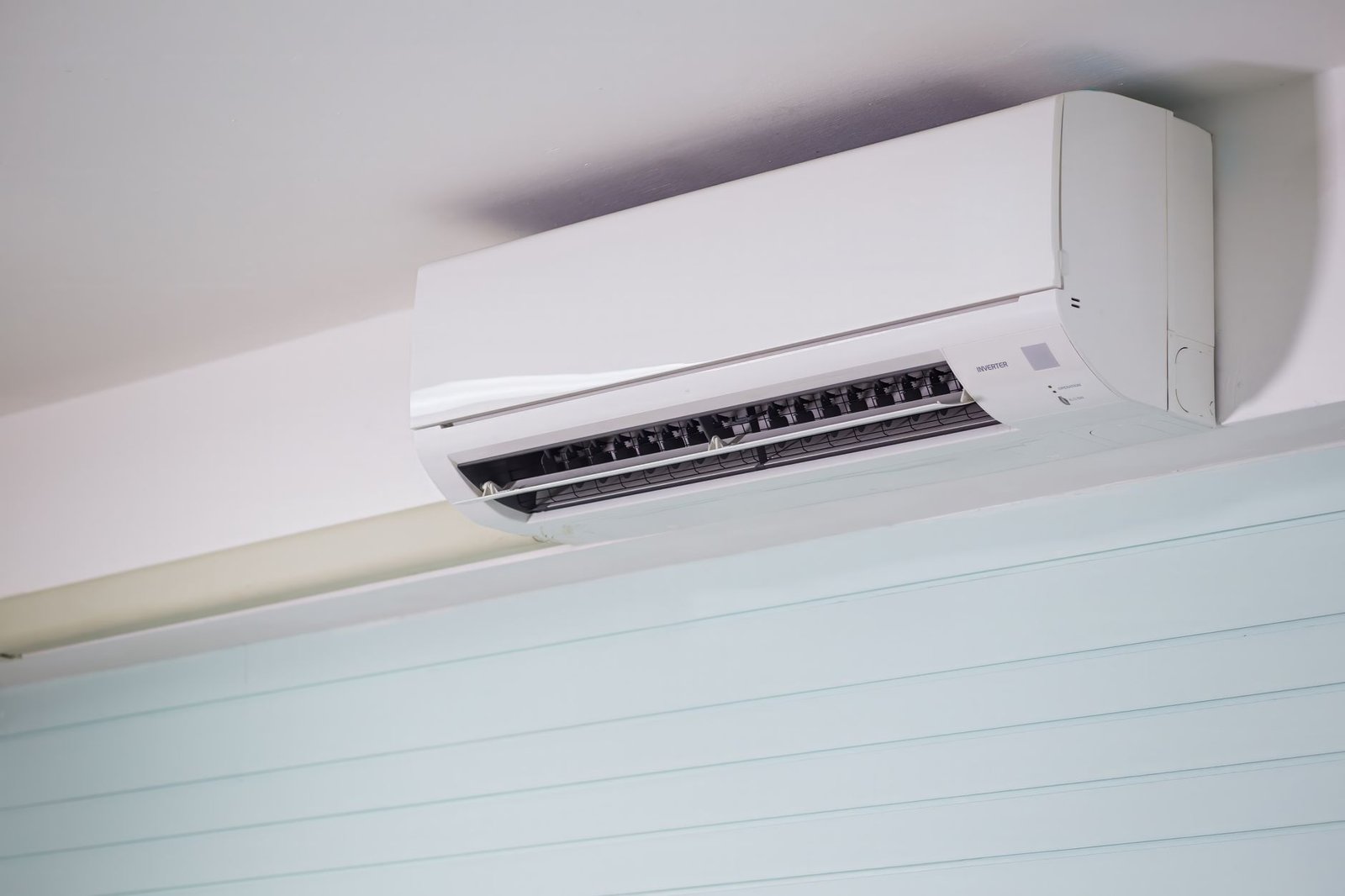
Same cold coil, opposite ending
An air conditioner and a dehumidifier both run refrigerant through a compressor, a cold coil and a hot coil. Room air blown over the cold coil drops below its dew point, and the water falls out as liquid. That much is identical. If you want the part-by-part version, how a dehumidifier works walks through it.
What differs is where the hot coil sits.
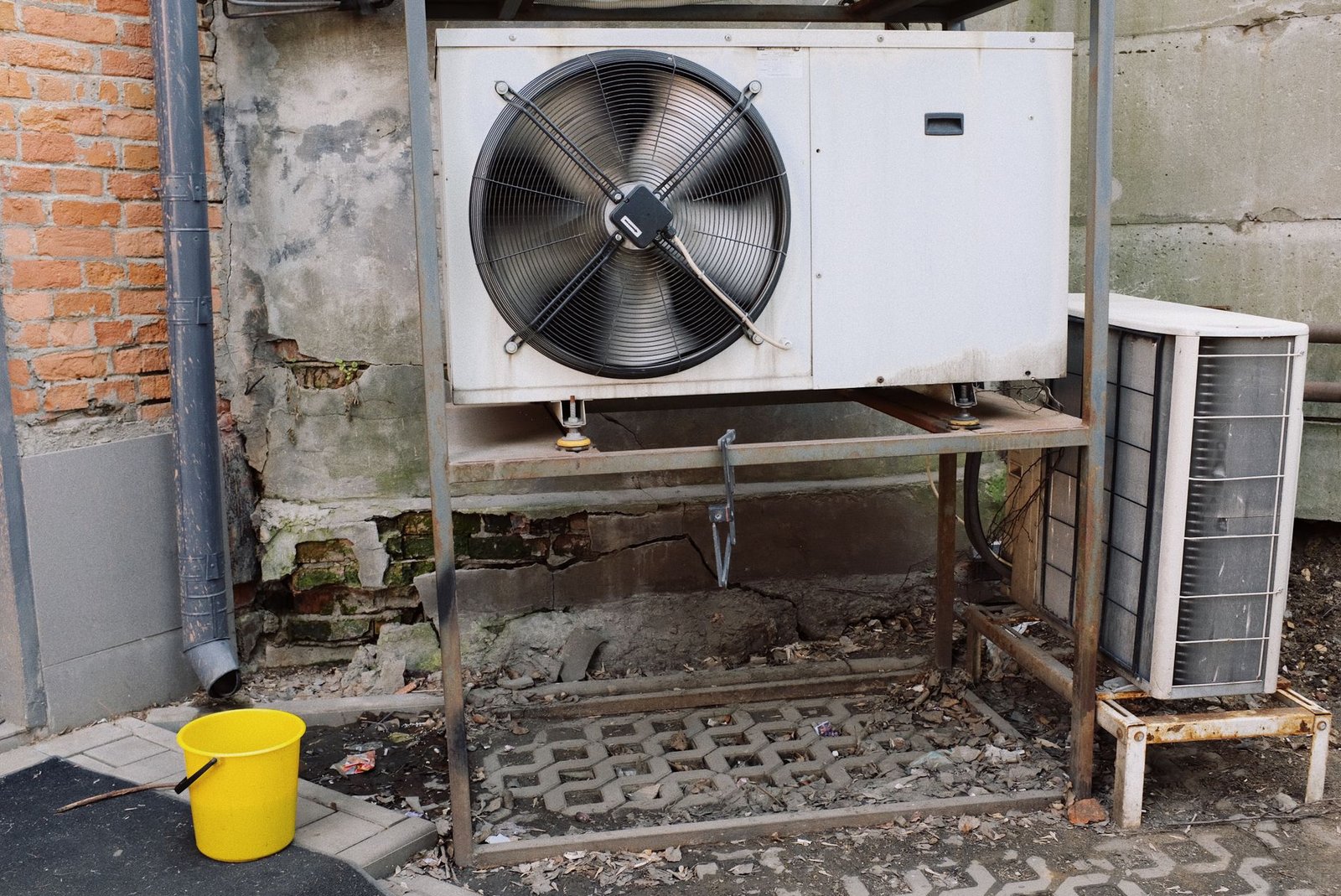
In an air conditioner the hot coil is in a box outside, or at the back of a window unit, or at the end of an exhaust hose. The heat leaves. In a dehumidifier both coils are inside the same casing, in your room, so the heat comes straight back in with the compressor’s own on top. I have already covered the consequence in can a dehumidifier cool a room: it dries the air and warms it slightly, and no amount of running changes that.
So one machine gets rid of heat and incidentally some water, and the other gets rid of water and incidentally adds heat. Every other difference follows from that.
What each one removes, side by side
| Air conditioner | Dehumidifier | |
|---|---|---|
| Takes heat out of the room | Yes, that is the job | No, it adds a little |
| Takes water out of the air | Some, as a by-product of cooling | Yes, that is the job |
| Stops when | The thermostat is satisfied | The humidity setting is reached |
| Useful in a cool, damp room | Barely, it has nothing to cool | Yes |
| Needs an outside connection | Yes, duct, pipe or outdoor unit | No, just a plug and a drain or bucket |
The “stops when” row is the one that causes trouble, so it gets its own section.
Why an air conditioner stops drying before the job is done
An air conditioner watches the temperature. A dehumidifier watches the humidity. Those are different questions, and a room can answer the first long before it answers the second.
Cooling a room is quick. Once the thermostat reads its target the compressor stops, and the cold coil, which was the only thing pulling water out, warms up. ENERGY STAR says it plainly for room units: if the unit is too large, it will cool the room before it has a chance to remove the humidity. You end up with a room that is the right temperature and clammy.
Time matters too. Energy Vanguard, a building-science blog, puts it at about 15 minutes of runtime before an air conditioner starts to dehumidify seriously, which is why an oversized system that cycles off after ten minutes leaves the air damp. It is writing about whole-house systems, but a cold coil behaves the same way whatever the size of the box.
My own view, and it is an opinion rather than a measurement: if your complaint is “it is hot and also sticky”, the air conditioner is still right, because it is solving the bigger problem. If your complaint is “it is sticky” and the thermometer says 20°C, an air conditioner is a very expensive way to run a cold coil you do not need. How far a cooling system can be trusted to dry a whole house is a separate question, and I am keeping the detail for does air conditioning remove humidity rather than repeating it here.
Is your AC’s dry mode a dehumidifier in disguise?
Mostly no, though it is better than nothing. Dry mode (often drawn as a water droplet on the remote) tells the air conditioner to prioritise removing moisture over dropping the temperature. Manufacturers describe it a little differently, so read your own manual, but the usual approach is a slower fan so the air spends longer against the cold coil. ENERGY STAR makes the same point about ordinary cooling on humid days: set the fan speed low, because slower air movement removes more moisture.
Dry mode earns its keep in one situation: a muggy, mild day when you want the stickiness gone without a cold room. Three limits are worth knowing.
- It has no humidity target. Most units still decide when to stop by temperature, so it cannot promise 50%.
- It will still cool the room a little, which is wasted if the room was already cool.
- It needs the air conditioner’s whole outdoor connection, so it is no help in a basement or a cellar with no window to hang a unit from.
I do not have a measured figure for how much electricity dry mode draws against cool mode, and I would be suspicious of a blog that quoted one without naming the unit. The rating plate and the manual are the places to look.
What each costs to run: labelled arithmetic
I will not print a table of money, because your tariff is not mine. Here is the sum, with placeholders you should replace.
The formula is watts times hours divided by 1,000, which gives kWh, then times your price per kWh. For the full method, see how to work out a dehumidifier’s running cost.
Assumptions, all mine and illustrative: a dehumidifier drawing 300 W, a small room air conditioner drawing 900 W while its compressor runs, and a price of 30p per kWh. Replace all three with your own.
| Watts | kWh per hour | Cost per hour at 30p | |
|---|---|---|---|
| Dehumidifier (assumed 300 W) | 300 | 0.3 | 9p |
| Room air conditioner (assumed 900 W) | 900 | 0.9 | 27p |
On those placeholders the air conditioner costs three times as much for every hour its compressor runs. That ratio is only as good as the two wattages I picked, but the direction is the usual one: moving heat out of a room is more work than condensing water out of it.
The honest caveat is that the comparison is not like for like. A dehumidifier hour and an air conditioner hour buy different things, and neither stands in for the other. The fair question is not “which costs less per hour” but “which solves my problem at all”. Another trap: a dehumidifier with the humidistat set to 35% may never reach its target, so it runs flat out, which can cost more than a sensibly set air conditioner doing a different job.
Dehumidifier vs air conditioner: the way I would decide, damp or hot
Look at what you would actually complain about, then pick from the grid.
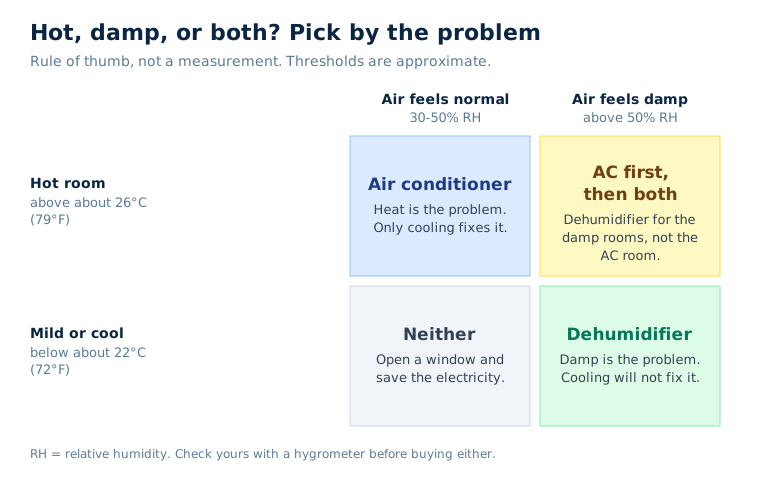
- Condensation, musty smell, washing that will not dry, a cool room that feels clammy: a dehumidifier. Size it with what size dehumidifier you need. ENERGY STAR gives 30 to 50% relative humidity as the range generally considered optimum for a building.
- A bedroom that sits above about 26°C and stays there: an air conditioner. Dry air will make it feel better, but it will not get the heat out.
- Hot and sticky: the air conditioner first. Add a dehumidifier only for a damp room elsewhere in the house, not the room the air conditioner is cooling.
- Neither problem: neither machine. A hygrometer costs a few pounds and tells you which row you are in before you spend a few hundred.
The problem decides the purchase, not the other way round
The dehumidifier vs air conditioner question mostly dissolves once you name the symptom. Heat that has to leave the building needs an air conditioner. Water that has to leave the air needs a dehumidifier. Where both are present, run the air conditioner for the living space and give the damp room its own dehumidifier, and keep them apart so neither undoes the other’s work.
FAQ
Is a dehumidifier cheaper to run than an air conditioner?
Usually, per hour, because it draws less power. On the placeholder wattages above it is a third of the cost. But they do different jobs, so the cheaper one is only a saving if it solves your problem.
Can I use a dehumidifier instead of an air conditioner?
Not when the room is genuinely hot, because it adds heat instead of removing it. In a mild but damp room it can replace an air conditioner you were only running to feel less sticky.
Does an air conditioner’s dry mode work like a dehumidifier?
Partly. It prioritises moisture removal over cooling, but most units have no humidity target. It helps on mild muggy days and is no substitute for a dehumidifier in a damp room.
Do I need a dehumidifier if I already have an air conditioner?
Only if a room stays damp, such as a basement, a utility room or any space the air conditioner does not serve. If your air conditioner leaves the house cool but clammy, that is also a sign it is cycling off too soon.
Is there a dehumidifier inside an air conditioner?
Not as a separate part. The cold coil does the dehumidifying as it cools, which is why water drips from a unit and why dry mode exists.
Related guides: How dehumidifiers work · Can a dehumidifier cool a room · Dehumidifier running cost · Does air conditioning remove humidity · What size dehumidifier do I need

