
Last Updated on October 26, 2026 by Umar Farooq
Can mold grow on concrete? Yes, but it feeds on the dust, dirt and paint film sitting on the surface rather than on the concrete itself, and only while the slab stays damp. Which is why a swept, dry garage floor stays clear and a dusty, sweating one grows dark patches when the weather turns.
I’ll use “mould” for the thing and “mold” for the search phrase, because Google insists. Same organism, same fix: take away the water and the dirt stops being dinner.

Concrete is the damp-holder, dirt is the meal
Mould needs three things: moisture, a temperature it can tolerate, and something organic to eat. A construction drying firm, Polygon, puts the working range at roughly 40 to 120°F (4 to 49°C), which covers every basement and garage in the temperate world. It also says precast concrete is not a dependable food source, yet can still support growth.
My reading of that, and it is a reading rather than a measurement: the slab supplies the water, and whatever has landed on it supplies the food. Dust, soil tracked in on shoes, cardboard fibres, old paint, sealant, skin flakes. Concrete is full of tiny pores, so it soaks up water from the ground below and from condensation above, then releases it slowly. That gives a surface that stays just damp enough, for just long enough.
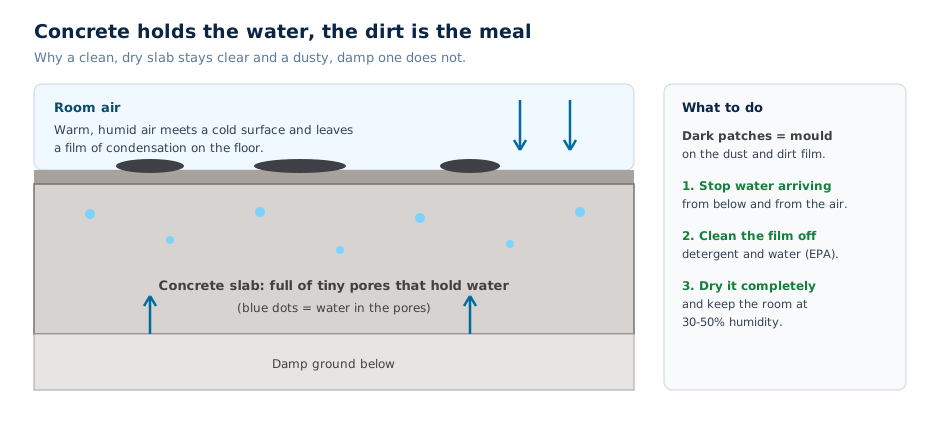
The EPA’s own line is the one to remember: the key to mold control is moisture control. It does not mention concrete by name, but the principle does not care what the floor is made of.
Can mold grow on concrete anywhere, or only in some places?
Not all slabs are equal. The ones I would check first:
- Basement and cellar floors and walls, where ground moisture and cold surfaces meet. My piece on mould in a basement covers the cause-hunting side.
- Garage floors, where wet car tyres bring in both water and soil.
- Utility rooms and laundry areas, where steam has nowhere to go.
- Anywhere stuff is stacked against the wall. Boxes and bags trap damp air and sit on exactly the dirt film mould likes.
If the surface looks wet when nobody has spilled anything, you have a condensation or moisture problem first and a mould problem second. Why a concrete floor sweats explains how to tell which.
Is that white fuzz mould or just salt?
White or grey powdery stuff on concrete is quite often efflorescence, a mineral deposit left behind when water travels through the slab and evaporates. It is not mould, and scrubbing it as if it were wastes an afternoon. I’ve set out how to tell them apart in white mould versus efflorescence.
One thing is useful either way: both mean water is moving through the concrete. Treat the water, not the colour.
How to clean mould off concrete without making it worse
Wear gloves, eye protection and a mask rated for dust, and ventilate the room before you start. Never mix bleach with ammonia-based cleaners, and as a rule I would not combine any two cleaning products.
The EPA’s method for hard surfaces is plain: scrub mold off hard surfaces with detergent and water, and dry completely. Concrete is porous, so the cleaning reaches the surface film and the top of the pores but cannot promise to empty a thick slab. That is the honest limit of any floor wash.
- Sweep or vacuum loose dust first.
- Scrub with a stiff brush, detergent and water, one small area at a time.
- Rinse with clean water, then dry it properly: fans, open doors, or a dehumidifier running.
- Keep an eye on it for a few weeks. If the dark patches reappear in the same spot, the water is still arriving.
The EPA says homeowners can usually handle a moulded area of less than about 10 square feet (roughly 1 square metre). Beyond that, or after flooding, its remediation guidance applies rather than a bucket and brush.
Four ways to stop mould on concrete coming back
- Stop the water at the source. Gutters, downpipes, a cracked wall, a leaking pipe, soil banked up against the wall. No amount of scrubbing outlasts a leak.
- Keep the air at 30-50% relative humidity. The EPA advises indoor humidity below 60%, ideally 30-50%, and a dehumidifier is how most basements get there. Not sure of your target? What indoor humidity should be has the numbers.
- Keep the surface clean. If dirt is the food, sweeping is cheap mould control. It is the least glamorous tip in this article and probably the most effective per minute spent.
- Lift stored things off the floor. Shelving, pallets or plastic crates leave an air gap. Cardboard sitting on a slab is a sponge sitting on a sponge.
My one firm opinion: skip the “mould-proof” sealer paint until the slab has been dry for a good while. In my view, paint over a damp slab just traps the water under a film.
Dry the slab, sweep it, and the mould has nowhere to live
So, can mold grow on concrete? Yes, on the dirt on top of it, fed by water the concrete holds. Cut off the water, remove the dirt, and you have taken both halves of the problem away. The floor never needed a miracle coating, just a dry week and a brush.
FAQ
Can mold grow on painted concrete?
Yes. Paint is itself a surface film, and dust settles on top of it, so damp painted concrete can still grow mould. If the paint is peeling or blistering, water is probably getting behind it, which is the thing to fix.
Can mold damage concrete?
The construction drying firm I cite above says the acid mould produces can degrade concrete over time. I have not seen independent testing, so I would treat that as a possibility rather than a certainty. The bigger risk is nearly always the water itself.
Does sealing concrete stop mold?
A sealer can make the surface easier to clean and slow water soaking in, but it does not stop damp arriving from below or condensing on it. Dry first, then seal, and expect to keep the room’s humidity in check regardless.
Is the white stuff on my concrete floor mould?
Often it is efflorescence, a salt deposit left as water evaporates. Mould tends to be darker, spotty or fuzzy, and often smells musty. Both point to moisture in the slab.
Will a dehumidifier stop mould growing on a concrete floor?
It helps by lowering the humidity that keeps the surface damp, as I explain in does a dehumidifier help with mold. It will not fix a leak or ground water coming through, so deal with those first.

