
Last Updated on October 24, 2026 by Umar Farooq
How to stop mold on books: keep the room’s relative humidity at or below about 55%, keep air moving round the shelves, and keep books off cold outside walls and damp floors. Paper and bindings are food for mould, so the only real defence is making the room too dry for it to bother.
A spray or a wipe does nothing for the next shelf along, so I start with the room, which is also where the conservation bodies start.

Why paper goes mouldy on a shelf nobody has spilled on
Mould spores are in every room already. The Northeast Document Conservation Center (NEDCC) says plainly that it is not possible to create a spore-free space: they sit on every object and every person who walks in, and they stay dormant until conditions suit them. Its leaflet names moisture as the most important factor, and says that high temperature, stagnant air and darkness make things worse. It adds that moulds digest paper and book bindings, which weakens them and can stain paper, cloth or leather.
A bookcase is a good match for that list. It is dark, the air between tightly packed spines barely moves, and it often stands against the coldest wall in the room. NEDCC specifically names shelves placed against an outside wall as a way books end up in higher humidity than the rest of the room. That is the same cold, still pocket I describe in mould behind furniture.
For the general picture of how humid is too humid, see what humidity mould grows at. The short version for books is below.
Aim for a humidity range, not a single magic number
Different institutions give slightly different limits, because some are describing an ideal and others a ceiling:
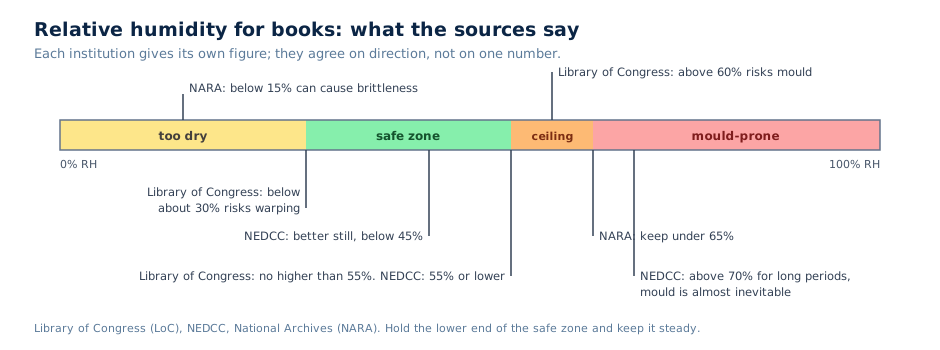
- The Library of Congress book-care guide says most books are best kept at a stable relative humidity of no higher than 55%, that levels above 60% risk warping and mould, and that below about 30% they can warp from contraction.
- The National Archives tells home owners to keep humidity under 65% to limit mould and insects, to avoid humidity below 15% (brittleness), and to keep the temperature below 75°F (24°C).
- NEDCC’s moldy books leaflet aims for 55% or lower, better still below 45%, with temperature below 70°F (21°C), and says that over 70% for an extended period mould growth is almost inevitable. (That link is a copy of the NEDCC leaflet hosted by Museum-SOS; the NEDCC site itself blocks automated checks.)
My own pick, and it is judgement rather than a published figure: aim for 40-50% and treat 55% as the line you do not cross. That sits inside every source above. The Library of Congress also warns that rapid swings are a worry, so steady beats perfect.
You cannot judge this by feel. NEDCC’s advice is to get a monitoring instrument and log readings rather than rely on your own impression, and a cheap hygrometer on the shelf does exactly that. If the room sits above 55%, a dehumidifier is the sensible fix. NEDCC lists bringing one in, with a way to drain it so it does not overflow, among its steps for a mould outbreak.
How to stop mold on books: five shelving habits
- Pull the bookcase away from outside walls. Leave a gap so air can pass behind it. I use roughly a hand’s width as a rule of thumb; that figure is mine, not a published one.
- Do not cram the shelf. Books wedged spine to spine have no air between them. Leave enough slack that you can slide one out without a fight.
- Keep them out of damp places. The National Archives says to store items out of damp basements, garages and hot attics. If a cellar is the only space, fix its humidity first.
- Keep the shelves clean and the plants elsewhere. NEDCC notes that dust and dirt can feed mould, and recommends no live plants in collection storage because they are a source of spores. It also suggests quarantining new acquisitions for a few days and checking them. That is worth doing with charity-shop and car-boot finds.
- Open a few books regularly. Look inside the spine and along the gutters near the endbands, which NEDCC singles out. Mould shows up there before it shows on the cover.

A word on boxes. Plastic tubs only help if the books and the air are dry when the lid goes on. I cover that trap, including the Library of Congress warning it cites, in preventing mould in a storage unit, so I will not repeat it here.
What to do when a book is already mouldy
NEDCC says anyone handling mouldy items should wear disposable gloves and a respirator with a HEPA filter; ordinary dust masks are not adequate. Do not try to clean active (soft and fuzzy) mould yourself, and avoid “quick cures” like Lysol or bleach, which can damage the book and are often ineffective. For anything valuable, stop and ask a conservator.
- Fix the cause first. Look for a leak, measure the humidity, and check for shelves against a cold wall or poor air circulation. A cleaned book returned to the same damp shelf will grow it again.
- Isolate it. NEDCC says to move affected items to a clean area below 45% relative humidity, away from the rest of the collection. Carry them there in a sealed plastic bag so spores do not spread, but take them out of the bag on arrival. Left sealed, the bag creates a small environment that can feed further growth.
- Dry it in moving, cool, dry air. The goal is to make the mould go dormant, so it looks dry and powdery rather than fuzzy. Use fans to circulate the air, but do not aim them directly at the book. Put paper towel or unprinted newsprint underneath and change it often. Do not turn the heat up: NEDCC says extra warmth in the presence of moisture makes mould grow faster. Check the inside of the spine as it dries.
- If you cannot dry it quickly, freeze it. NEDCC says mould will normally grow on wet materials in about 48 hours, and that freezing does not kill it but stops further growth until you can dry and clean the item. Treat it as a pause button.
- Clean only dry, powdery mould, only on books of no special value. Work outdoors if you can. Use a HEPA vacuum with a brush attachment covered in cheesecloth, or a soft wide brush with the residue going into the vacuum nozzle. Rubbing presses mould into the paper fibres for good.
The National Archives adds a sensible test: ask whether the item is valuable or replaceable. A mass-market paperback does not deserve a weekend of fan-and-blotter work; a family Bible or an annotated first edition deserves a conservator. And if the book got wet recently, NEDCC’s 48-hour figure above is the clock: drying comes before any other plan.
The cheapest book protection is a hygrometer
Here is my one strong opinion: before buying any book-specific product, spend the price of a couple of paperbacks on a hygrometer and put it on the shelf. NEDCC’s own advice is to measure rather than trust impressions. If it reads under 55% and stays there, the shelf is fine, however damp it feels in January.
FAQ
Can you save mouldy books?
Often yes, if the mould is caught early and the book is dried properly. Dormant, powdery mould on a book of no special value can be brushed or vacuumed off using the steps above. Active, soft mould, or a book that matters to you, needs a conservator. Staining can remain even after the mould is gone.
What humidity is safe for books?
The Library of Congress says no higher than 55%, with 60% the point where mould and warping become a risk. NEDCC aims for 55% or lower, and below 45% if you can. The National Archives allows up to 65% for family papers. Keeping it steady matters as much as the figure.
Should I put mouldy books in the freezer?
Only as a stopgap. NEDCC says freezing does not kill mould but stops it growing until you can dry and clean the item, and it suggests it when you cannot dry something within about 48 hours. Wrap it loosely in freezer paper, and ask about commercial freezing if you have many items.
Does sunlight kill mould on books?
Sunlight can make some moulds go dormant, according to NEDCC, but it warns that the sun fades and damages paper. If you try it at all, outdoors on a low-humidity day, for no more than an hour or so. It is a last resort, not a method.
Can a dehumidifier protect my books?
Yes, if the room is above about 55%. NEDCC lists dehumidifiers, set up so they can drain, among its steps to reduce humidity, alongside fans and open windows (unless it is more humid outside). Put it where air reaches the shelves and check the reading with a hygrometer.
Dry air, moving air and a cool wall: that is the whole recipe
Keeping the room at or below 55%, leaving air room behind and between the books, and checking the spines now and then is how to stop mold on books for good. Everything else is first aid. If you want the wider house version of the same job, how to prevent mould in a house covers it room by room.

