
Last Updated on October 24, 2026 by Umar Farooq
Mould on curtains almost always starts with fabric that stays wet: it touches a cold window pane running with condensation, and the air behind it never moves. The mould is the symptom. The wet glass is the problem.
A curtain is a big sheet of absorbent cloth hung a few centimetres from the coldest surface in the room and drawn shut every night. As places to grow mould go, I have seen worse designs, but not many.

Three ways a curtain ends up wet
None of these needs a leak. Ordinary household moisture is enough, which is why the hem and the side facing the glass go first.
1. Condensation soaks into the fabric. Warm indoor air carries water vapour, and when it meets a surface colder than its dew point the vapour turns to liquid. The EPA notes that condensation on windows, walls or pipes can be a sign of high humidity. A curtain resting on that pane acts like a blotter: it draws the water up from the sill and the glass.
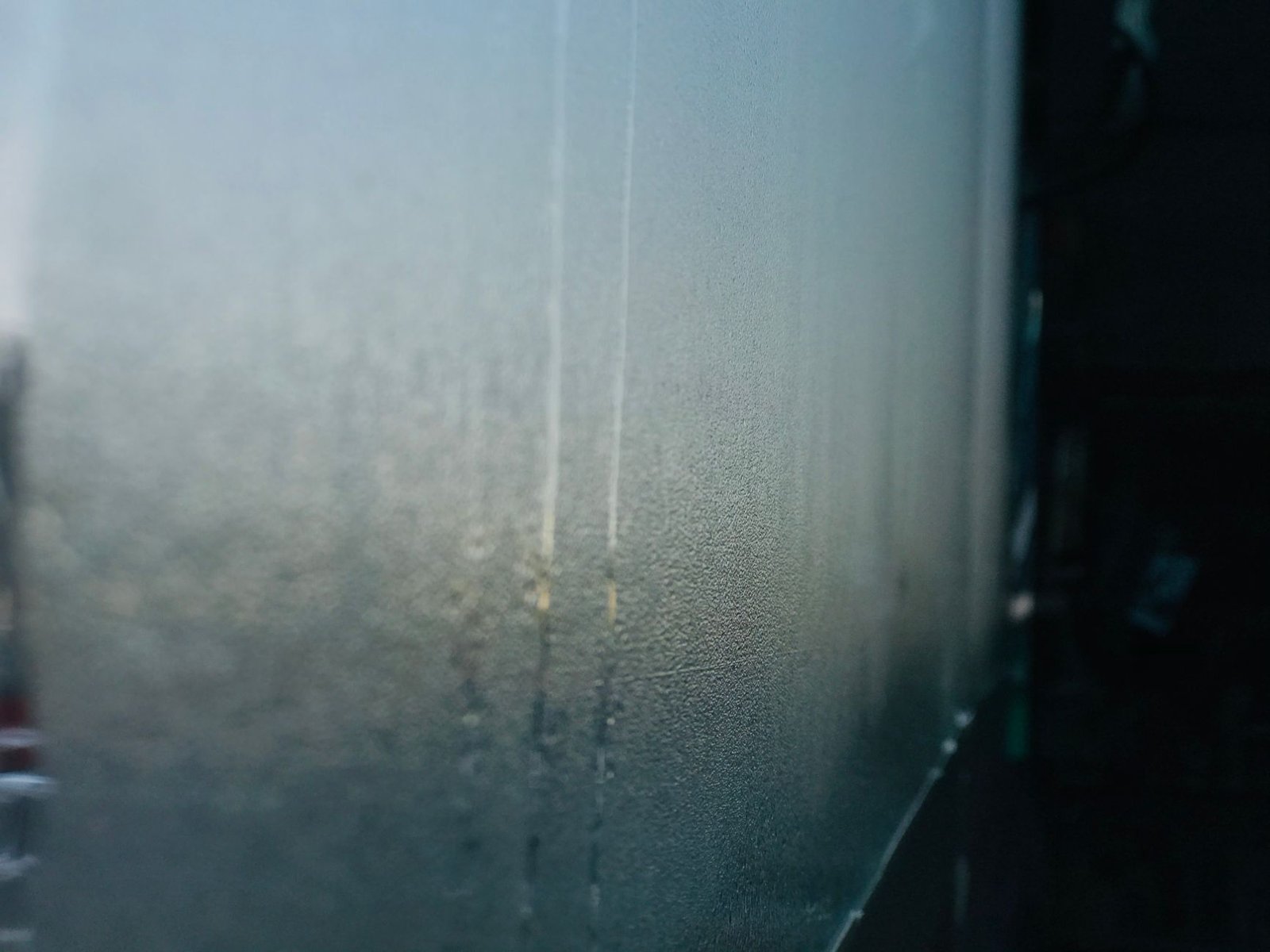
2. Closed curtains trap a pocket of still air. A drawn curtain can keep room heat off the glass, so the pane stays cold, and the air between cloth and glass has nowhere to go. Damp air, a cold surface and no airflow is the usual recipe for a wet window.
3. The curtains were damp before they went up. Curtains rehung slightly wet, or dried on a radiator in a room full of laundry steam, start the night already holding water. I cover the laundry side in how to dry clothes indoors without mould, and the same logic applies to curtains.
What the gap does
The diagram shows why the gap matters more than the cleaning.
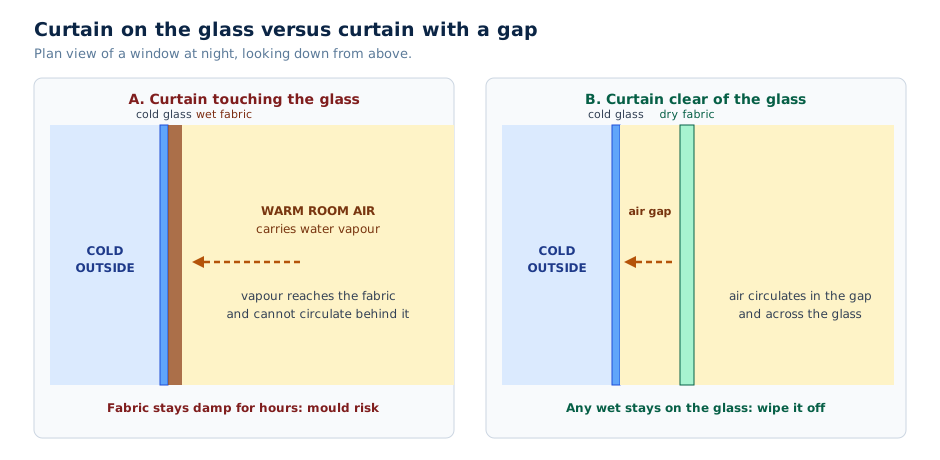
In picture B the glass is still cold and may still mist. The difference is that the water stays on the glass, where a cloth can remove it, rather than inside the fabric.
How to spot mould on curtains early
Black or grey speckles near the hem, along the edge nearest the glass, or in the folds are the usual sign, often with a musty smell. Staining that is even across the whole curtain is more likely dust or sun fade. If you are unsure whether it is mould or mildew, the practical difference is small, and I go through it in mould versus mildew.
One check that costs nothing: look at the back of the curtain, not the front. Growth often shows there first, on the side that touched the glass.
Wash it, treat it or bin it?
Take the curtains down and carry them outside before you shake or brush anything. Wear gloves, follow the care label for the fabric, and never mix cleaning products together.
Fabric is a porous material, which is where the guidance gets blunt. The EPA says absorbent or porous materials, such as ceiling tiles and carpet, may have to be thrown away if they become mouldy. Curtains are not named, so applying that to them is my reading, not a rule. Mould grows into the weave, and a cloth that looks clean can still be affected.
So the decision comes down to the curtain:
| Situation | Sensible call |
|---|---|
| Light spotting on a washable cotton or polyester curtain | Wash to the care label, dry completely, check again |
| Spots back after one wash | Replace it |
| Lined, blackout or dry-clean-only curtain with growth through the layers | Replace it, or send it for professional cleaning if it is valuable |
| Large areas of growth, or a musty smell that survives washing | Replace it |
The EPA also says that a mouldy area under about 10 square feet (roughly 1 square metre) can usually be handled yourself, and a pair of curtains sits around that size. The same page says to dry all items completely. For the wash method itself, see getting mould off fabric you are keeping, so I will not repeat it here.
One point is easy to miss: clean curtains hung back against the same wet window will go mouldy again. Washing is the cheap part. If the window still runs with water every morning, the curtain is simply the next victim.
Open them in the morning and leave a gap
This is the habit that prevents mould on curtains, and it costs nothing.
- Pull the curtains fully open each morning. Room air on the glass lets the pane warm up and the condensation start to clear.
- Wipe the pane before you close them. A dry glass cannot soak a curtain.
- Keep the fabric off the glass. Hang the curtain so the hem clears the sill and the cloth does not rest on the pane. Even a gap of a few centimetres lets air move. That figure is my rule of thumb, not a measured value.
- Do not trap them behind furniture or a shelf over a radiator. Air has to reach the cloth.
The fixes for the wet window itself are in how to stop condensation on windows. The short version is cut indoor moisture and let air move.
Check the room, not just the curtain
The EPA advises keeping indoor relative humidity below 60 per cent, ideally between 30 and 50 per cent. I do not know your reading, and the curtains cannot tell you, so a cheap hygrometer left in the room overnight is worth having before you spend anything bigger. If the window runs even with the room under 60 per cent, the glass itself is the cold spot, and the gap-and-wipe routine matters more.
If the mould is also on the frame and sealant, that is a separate job: see mould around windows. A new set of curtains will not change the underlying humidity.
A curtain that never sits in wet glass will not go mouldy
That is the whole answer. Fix the damp pane, keep air moving behind the cloth, dry anything you wash completely, and mould on curtains has nothing to grow on. If it comes back after one clean, replace the curtain and fix the window first.
FAQ
Why do my curtains get mouldy?
Because the fabric stays wet for long periods. The usual cause is condensation on a cold window soaking into curtains that touch the glass, plus still air behind them. Curtains hung up damp after washing can do it too.
Can you wash mouldy curtains?
Often yes, if the care label allows machine washing. Mould in a porous fabric can be hard to remove completely, so if spots return after one wash, or the curtain is lined or dry-clean-only with growth inside it, replacement is the safer call.
Should I throw away mouldy curtains?
The EPA says porous materials may have to be thrown away once they become mouldy. If the curtain is lightly spotted and washable, you can try washing it once. If it is badly affected or the mould returns, bin it.
How do I stop curtains getting mouldy?
Open them each morning, wipe the glass dry, keep the fabric off the pane, and cut the humidity that makes the window run. Always dry curtains completely after washing before you hang them.
Does mould on curtains mean there is damp in the walls?
Not necessarily. On a window, mould on curtains usually points to condensation, which is a humidity and cold-surface problem rather than rising or penetrating damp. If the wall itself is wet or stained away from the window, that needs a different look.

