
Last Updated on October 24, 2026 by Umar Farooq
Black spots on ceiling paint are usually one of four things: mould feeding on condensation, soot or dust stuck to cold strips of ceiling, a slow leak from the roof or a pipe, or dirt around fixings. You can usually tell which by looking at the pattern, wiping one spot and checking whether anything is wet above.
I would not reach for bleach or paint until you have done that, because each cause has a different fix and only one of them is a cleaning job.
Black spots on ceiling: stripes, clusters or a ringed patch?
Start by standing under the ceiling and asking what shape the marks make. Shape does more work than colour, because almost everything here looks black from a distance.
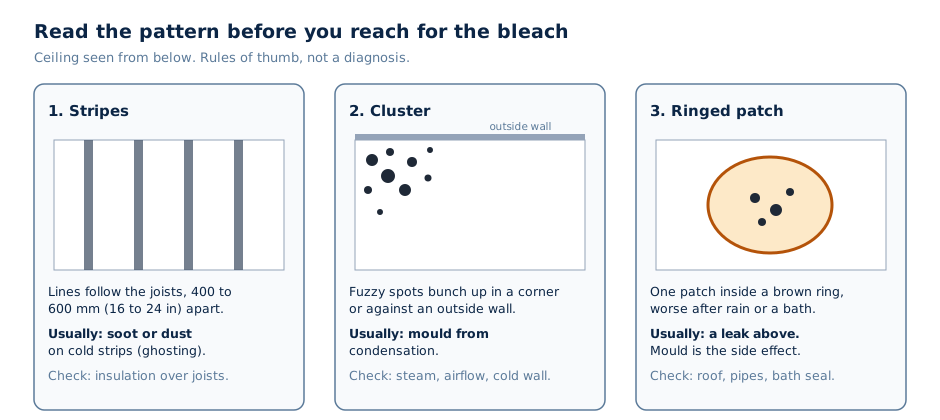
Stripes that follow the joists. Dark lines, often 400 to 600 mm (16 to 24 in) apart, are usually soot or dust sticking to the cooler strips of ceiling over the timbers. Inspectapedia describes this as thermal tracking or ghosting: wood framing conducts heat faster than insulation, so those strips run cooler and collect more condensation and airborne dust. Small round dots that line up with the heads of nails or screws are a close cousin.
A cluster in a corner or against an outside wall. Fuzzy spots that bunch up where the surface is coldest and the air stands still are the classic pattern for mould fed by condensation. If that is what you have, condensation on walls and ceilings explains why corners go first.
One patch, often inside a brown ring. A ring-shaped stain with spots in the middle points to water arriving from above, and mould is the side effect rather than the problem. Rain, a bath being filled upstairs or a leaking pipe are the usual suspects.
Four checks that separate mould, soot and a leak
None of these needs a tool. Together they give a better answer than any photo comparison, and I would rather you did these than guessed. (For a photo-style tour of what mould itself looks like, see what does black mold look like; I will not repeat it here.)
Wear gloves and eye protection, switch the room fan on or open a window, and never mix cleaning products. Do not dry-brush or scrape the spots, because that throws particles into the air.
- Pattern. Use the three shapes above. Stripes on a regular spacing point to soot and dust; a cluster in a cold corner points to mould; a single ringed patch points to a leak.
- The wipe test. Dab one spot with a cloth dampened with plain water. This is my own rule of thumb, not a lab test. Soot and dust tend to smear or lift grey; mould tends to leave a stain behind or look like it is part of the paint.
- Wet or dry, and the smell. Press the paint gently. Soft, bubbling or damp paint means water is present now. A musty smell next to the spots fits mould; no smell at all fits soot or dust.
- Look above. Check what sits over that part of the ceiling: a bathroom, a pipe run, the roof or a loft. Water stains on the upper side of the plasterboard, wet insulation, or timber that is dark and beaded with water point to a leak or loft condensation.
If checks 3 and 4 say there is water, treat it as a moisture problem first. If everything is dry and the marks follow the joists, you are most likely looking at dust and soot.
Where steam and cold air leave their marks
Mould needs moisture, and the ceiling collects it because warm, damp air rises and meets the coolest surface in the room. Showers, cooking and drying clothes indoors all add vapour, and the EPA’s brief guide to mould and moisture lists condensation as a sign of high humidity, with the remedy being less moisture, more airflow, insulating cold surfaces or warming the air.
Two places are worth special attention. A bathroom ceiling is the obvious one, and bathroom ceiling condensation covers the fan and duct checks. The less obvious one is the ceiling under the loft: if warm air leaks up through the hatch or light fittings, the damp lands on the timbers and plasterboard above you, which is the subject of condensation in loft. Marks along the joists plus damp insulation up there mean the loft needs the attention, not the paint.
Soot from candles and heaters
Not every black mark is wet. Candles, incense, open fires and smoky heaters release fine particles that settle on whatever is coolest, which is why a ceiling above a sofa or a bathroom candle can darken in stripes without any mould at all.

Candles are easy to deal with: trim the wick, keep flames away from draughts and burn fewer of them. Soot from a gas or oil appliance is a different matter. Inspectapedia warns that soot from fuel-burning heating equipment can indicate improper operation, so if the black marks are near a boiler, flue or fire, have the appliance checked by a qualified engineer rather than painting over it.
Fix the wet first, then clean a small patch
The order matters more than the product. Stop the water, dry the area, and only then clean.
- Leak: trace and repair it before doing anything cosmetic. A stain on the ceiling is the symptom, and the EPA’s advice for water-damaged materials is to dry them within 24 to 48 hours where you can.
- Condensation: run the fan during and after showers, keep furniture and curtains a little away from cold walls, and keep indoor humidity under control. The EPA suggests keeping it below 60 per cent, ideally 30 to 50. A dehumidifier helps when you cannot ventilate, but it treats the room, not a cold patch or a leaking pipe.
- Cleaning: the EPA says that if the mouldy area is under about 10 square feet (roughly 1 square metre), you can usually handle it yourself, with detergent and water on hard surfaces, dried completely. Ceiling plasterboard that is soaked, crumbling or soft is not a surface you can scrub back, and a bigger area calls for the EPA’s remediation guidance. The step-by-step is in how to get mould off walls, and it applies to a painted ceiling too.
Painting straight over the marks is the move I would skip. Fresh paint hides a stain for a few weeks, but if the ceiling is still getting cold and damp the spots will return through it.
A ceiling that stays dry stays clean
My conclusion: black spots on a ceiling are a message about where heat, moisture or smoke is going, not a surface problem. Read the pattern, do the wipe test, look above, and fix whichever of damp, cold or soot turns out to be the cause. If the checks point to a leak or a persistently wet loft, get it traced before you clean anything; wiping spots off a ceiling that keeps getting wet is just a regular chore.
FAQ
What are the little black dots on my ceiling?
If they sit in tidy rows at nail or screw positions, they are most likely dust or soot sticking to cooler spots over the fixings. If they are fuzzy and clustered in a corner or on a cold wall, think mould from condensation. A single patch with a ring around it suggests a leak.
Are black spots on the ceiling always mould?
No. Soot from candles or heaters, dust over cold joists and dirt around fixings can all look like mould from the floor. The wipe test, the pattern and whether anything is damp are the quickest ways to tell, though a persistent or spreading patch is worth treating as moisture.
Why do black spots keep coming back on my ceiling?
Because the cause is still there. Painting or wiping removes the marks but not the cold surface, the leak or the humidity behind them. Fix the moisture source, then clean, and check again after a few weeks of normal use.
What causes black spots on a bedroom ceiling?
Bedrooms collect moisture from breathing, drying clothes and closed windows overnight, and cold corners or ceilings under an uninsulated loft stay the coolest. I have not measured this in a particular home, but it fits how condensation behaves, so improve airflow and check the loft first.
Can I clean black spots off a ceiling myself?
For a small area on a hard, painted surface, the EPA says you usually can, with detergent and water and plenty of drying. Wear gloves and eye protection, ventilate, and fix the water source first. If the plasterboard is soft or the area is larger than about 1 square metre, follow the EPA’s remediation guidance instead.

