
Last Updated on October 24, 2026 by Umar Farooq
Does a fan reduce humidity? No: a fan moves air around, and it removes no water from it, so the humidity in the room stays the same. What it can do is dry wet things faster, push damp air outdoors, and make you feel cooler, which is easy to mistake for drier air.
That last one fools a lot of people, and I understand why. Stand in front of a fan on a muggy night and you feel better within seconds, though only you have changed, not the room.
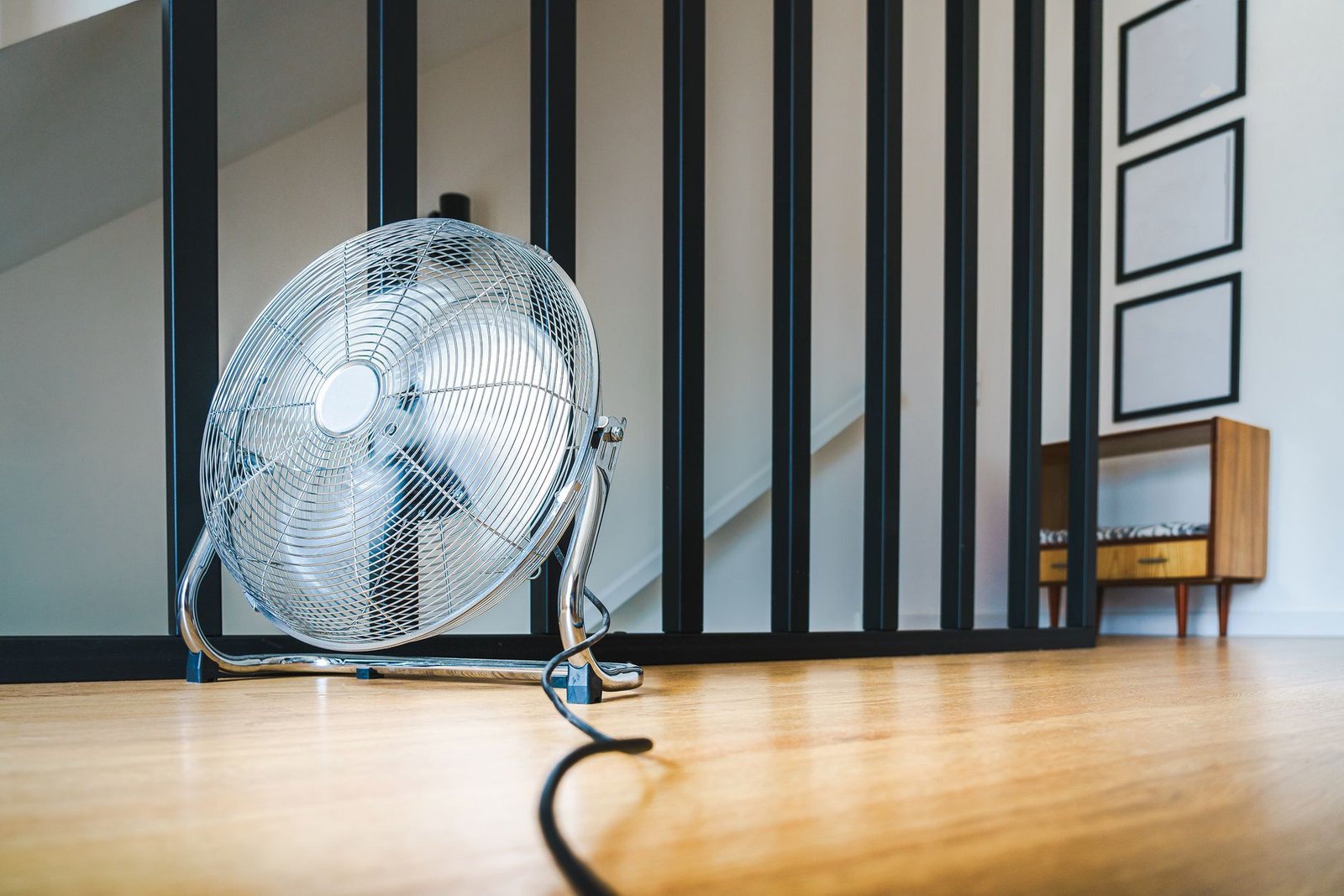
Does a fan reduce humidity? Not by a single drop
Relative humidity is a measure of how much water vapour the air holds compared with the most it could hold at that temperature (Energy Star explains the measure). A fan has no way to take vapour out of the air. There is no cold coil, no desiccant wheel and no drain: the same air, with the same water in it, comes out as went in.
Meaco’s chief product officer puts it plainly in an Ideal Home interview: a fan “does not remove humidity from the air, so it will not reduce humidity readings in a meaningful way.”
The honest summary is this table.
| Situation | Does the fan lower the room’s humidity? |
|---|---|
| Fan alone, windows shut, nothing wet | No |
| Fan blowing at wet laundry or a damp wall | It dries the item faster, but the water ends up in the air |
| Extractor fan vented outside | Yes, because the moist air leaves the building |
| Fan plus an open window when outside air is drier | Yes, gradually |
| Fan beside a running dehumidifier | The machine does the drying; the fan spreads the benefit |
Why a fan feels cooler while the hygrometer stays put
A fan cools people, not rooms. Moving air carries away the thin damp layer next to your skin, so sweat evaporates faster and heat leaves your body. The Center for the Built Environment at Berkeley quotes thermal researcher Ollie Jay: fans cool by “increasing the efficiency with which sweat evaporates from the skin”.
That is the myth in one sentence. The relief is real, and the humidity has not moved. In very muggy air the effect fades, because sweat cannot evaporate into air that is nearly full already. The same article warns that in hot, dry conditions a fan can add heat load rather than remove it.
A fan running in an empty room is doing nothing for you, so switch it off when you leave.
Job one: drying wet laundry and damp surfaces
Here a fan earns its keep. Wet fabric dries when water evaporates, and evaporation stalls once the air touching the cloth is saturated. A fan sweeps that damp layer away and brings fresh, drier air in.

The catch is that the water has not vanished. It has moved from the clothes into the room, and the humidity goes up unless that moist air leaves or gets condensed. EPA’s guidance is to dry water-damaged areas and items within 24-48 hours, and to “use fans as needed” while doing it. So a fan on a wet carpet or a flooded skirting board is good advice, provided a window is open or a dehumidifier is working in the same room.
For a normal wash day, drying clothes indoors without mould goes through the routine properly: spin hard, one room, one open vent.
Job two: an extractor fan that vents outside
An extractor fan is the one kind of fan that does lower humidity, and only because it ends in a hole in the wall. EPA tells you to use exhaust fans or open windows when cooking, dishwashing and showering, and to vent moisture-producing appliances outside where possible. Energy Star says the same: bathroom and kitchen vent fans “remove humidity at the source.”
The words that matter are “to the outside”. A recirculating cooker hood or a fan that discharges into a loft just relocates the steam. The full comparison is in dehumidifier vs extractor fan.
Job three: a fan and an open window on a dry day
The idea in the Ideal Home piece is simple. With a window open on a dry day, a fan speeds up air exchange, pushing damp indoor air out and drawing drier outdoor air in. This only works when the outdoor air is genuinely drier than the indoor air. In a humid British summer, or on a drizzly evening, you are importing water.
Check outside against inside with a cheap hygrometer rather than guess: open up only if the outdoor number is lower. Our guide to lowering humidity in the house covers when ventilating helps and when it makes things worse, and whether air conditioning removes humidity is the other half of that decision.
Job four: a fan beside a dehumidifier
This is the pairing that makes sense, with one rule: the fan helps the machine, it does not replace it. A dehumidifier dries only the air that reaches it. A fan in the doorway or across the room pushes damp air from the far corner towards the intake and spreads the dried air back out. Energy Star makes a related point about air circulation, suggesting an A/C vent to improve airflow between humid parts of your home and drier ones.
Two things keep it sensible.
- Keep the doors and windows shut. Energy Star’s guidance for the machine is to shut the space it is drying.
- Point the fan at the wet thing, not at the dehumidifier’s intake. Blowing straight into it can make its sensor read the wrong air, and the machine stops early.
A fan cannot give you a bigger machine. If a room keeps climbing above the 30-50% range Energy Star calls optimal, what size dehumidifier you need is the question to answer, not which fan to buy.
Use the fan for wet things and moving air, and a machine for the drying
My view, and I will stand by it: a fan is a brilliant tool and a terrible dehumidifier. Use it where there is a wet surface to dry or a path for damp air to escape. If neither exists, a fan is a way of feeling better about a problem that is still there.
So does a fan reduce humidity? On its own, no. With an open window on a dry day, an outside-venting extractor or a dehumidifier next to it, yes, because something else is doing the removing.
FAQ
Does a fan reduce humidity in a room?
Not directly. A fan only moves air, so the amount of water vapour in the room does not change. It lowers humidity only when it pushes damp air out of the building, such as through an extractor or an open window when the outside air is drier.
Does a fan help with humidity and mould?
It helps by drying wet surfaces faster, which matters because EPA advises drying water-damaged items within 24-48 hours. It does not fix the moisture source, and it will not keep indoor humidity below the EPA’s recommended 60% by itself.
Is it better to have a fan blowing in or out of a window?
Blowing out is the better default for removing damp air, because it exhausts indoor moisture and lets drier air replace it through other gaps. Only do it when the air outside is drier than the air inside.
Can a fan replace a dehumidifier?
No. A dehumidifier removes water and collects it, and a fan does not. A fan can improve a dehumidifier’s reach by circulating air, but it cannot do the same job in a damp basement or a steamy flat.
Does a ceiling fan lower humidity?
No. It makes you feel cooler by speeding evaporation from your skin, which does nothing to the humidity reading. Turn it off when nobody is in the room.

