
Last Updated on October 23, 2026 by Umar Farooq
How is humidity measured? With a hygrometer, an instrument that senses the water vapour in the air and, most often, reports it as relative humidity (RH): a percentage of the most vapour the air could hold at its current temperature. Everything else is a variation on how the sensing is done.
The part nobody mentions is that the number only means something if you know how, and where, it was taken. Every reading carries a margin of error, and it is bigger than most people assume.
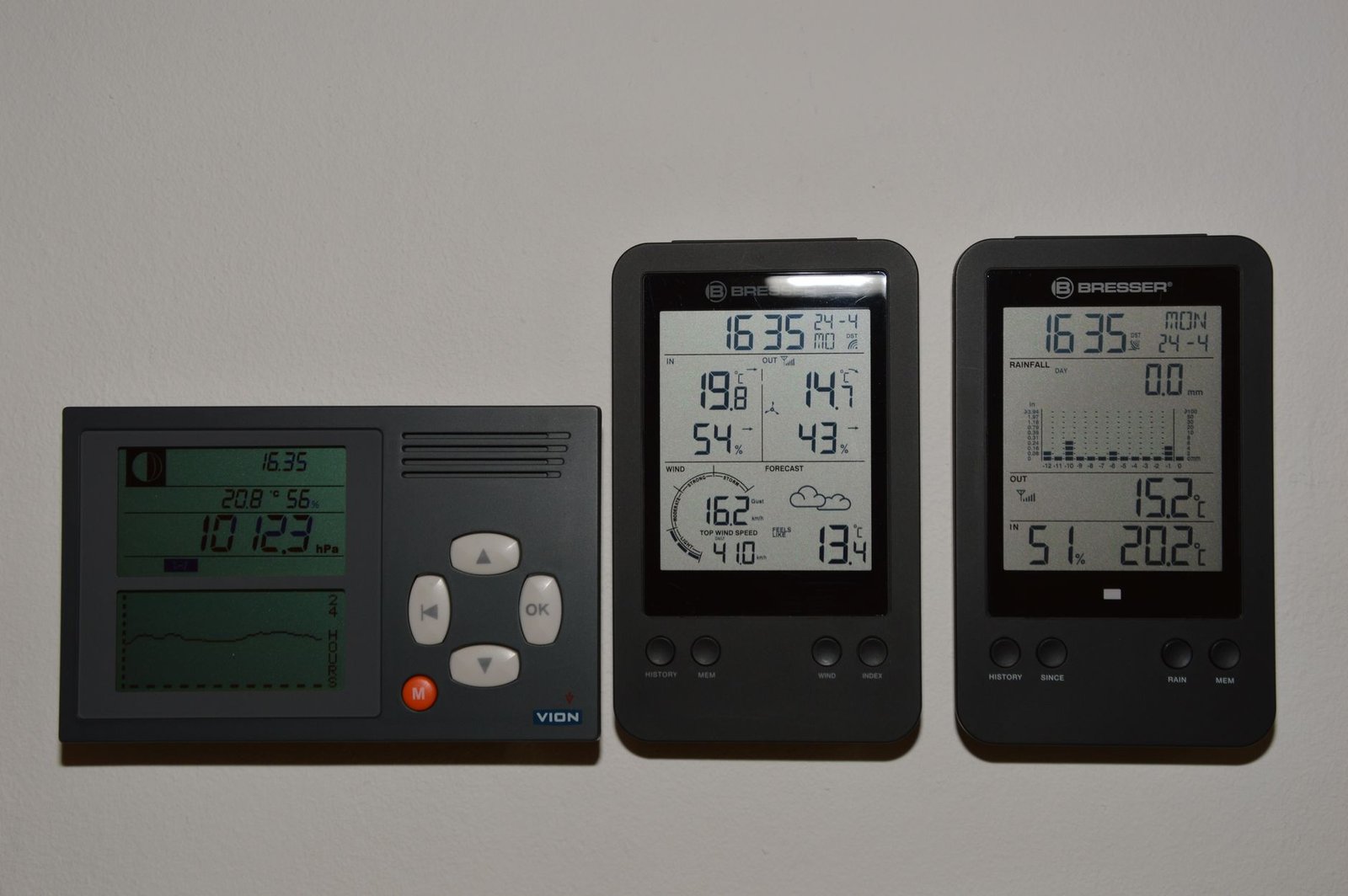
Three ways to say how damp the air is
Instruments report humidity in one of three currencies, and mixing them up is the commonest mistake.
- Relative humidity is the one on every home hygrometer. The UK’s National Physical Laboratory (NPL) calls it how saturated the air is with water vapour, written as a percentage such as 51 %rh.
- Dew point is the temperature at which condensation would start if the air were cooled. It is a measure of the actual vapour present, whatever the room temperature.
- Absolute humidity is grams of water vapour per cubic metre. NPL says ordinary room air holds about 10 g/m³ (about 0.27 oz per cubic yard), roughly 1% of the air by volume.
Relative humidity is the one that matters at home, because mould and condensation respond to it. It is also the slippery one, because it is relative to temperature.
How is humidity measured in practice? Five instruments, from hair to mirror
NPL’s guide lists dozens of sensing principles. Five cover everything you are likely to meet.
| Instrument | How it senses humidity | Where you will meet it |
|---|---|---|
| Electronic sensor | A polymer film absorbs vapour and changes its electrical resistance or capacitance | Nearly every digital hygrometer, smart sensor and dehumidifier display |
| Mechanical (hair) | A hair or other organic fibre changes length with humidity | Dial hygrometers on the wall; NPL notes many remain in use for room monitoring |
| Psychrometer | Evaporation cools a wet-wicked thermometer below a dry one | Weather stations, HVAC testing, hand-held “sling” instruments |
| Chilled mirror | A mirror is cooled until dew forms; that temperature is the dew point | Laboratories, as the high-accuracy reference |
| Colour change | Chemicals change colour as they take up moisture | Humidity indicator cards in packaging |
The £10 digital hygrometer on your shelf and a laboratory electronic probe use the same basic idea. The difference is calibration.
How a wet-bulb and dry-bulb psychrometer gets a number from evaporation

The psychrometer is the oldest trick that still works, and it is the easiest to understand. One thermometer reads the air. The other has a wet wick over its bulb, and as the water evaporates it takes heat with it, so that thermometer reads lower. NPL describes the pair being compared in moving air, with the humidity found from tables or a calculation.
Dry air lets water evaporate quickly, so the gap is wide. Air at 100% RH cannot take any more water, so nothing evaporates and the two thermometers agree.
Why the reading changes when the temperature does
Warm air holds more vapour, so the same water in the air reads as a lower percentage when it is warm. NPL puts a figure on it: at 50 %rh, a rise of just 1°C (1.8°F) lowers the reading by about 3 %rh.
That is why a room can read 60% at 6 am and 45% at 3 pm with no change in the water in the air. It is also why a hygrometer on a cold outside wall over-reads: NPL warns that measuring at a cold spot can over-estimate the typical RH of the room even though the vapour is spread evenly.
Where to put a hygrometer so it tells the truth

Weather stations shield their sensors from sun, rain and stray heat. Indoors the same logic applies.
- Mid-room, at chest height, away from the walls. A common retail guide is about 1 m (3 ft) from vents, windows, outside walls and radiators.
- Away from water sources: NPL’s advice is not to measure near pooled water, which means the kettle, a bathroom door or a drying rack.
- Give it time. NPL says to let the instrument reach the temperature of the location and the reading stabilise. Half an hour is the usual guidance, and I would allow longer after carrying it from another room.
- Take repeated readings. NPL recommends them where conditions vary. Morning and evening for a week beats one number.
How accurate is a home hygrometer, really?
Not very, and the maker’s decimal point is not evidence otherwise. NPL says there is no “typical uncertainty”, but very broadly, good conditions might achieve ±2 to ±3 %rh and difficult ones ±5 to ±10 %rh or worse, with drift as the sensor ages. I have not tested a batch of consumer units, so treat those as the best case for a cheap one.
What follows in practice is this: trust trends, not decimals. A reading that climbs from 45% to 62% over a week is real. A difference between 49% and 51% is noise.
Check yours against a pinch of salt
You can test a hygrometer for the price of table salt. A saturated salt solution holds the air above it at about 75% RH, and it is a standard reference for checking relative humidity probes. NPL also lists salt solutions as a field calibration method.
- Put a little salt in a bottle cap and add just enough water to make a wet slurry. Some crystals must stay undissolved.
- Seal the cap and the hygrometer in a zip bag.
- Leave it overnight, away from sunlight.
- Read it. About 75% means it is honest at that point; 70% means it reads about five points low.
One caveat of my own: this checks one point. A unit that is right at 75% can still be off at 40%, so do not apply the difference as a correction everywhere.
No hygrometer? The cold-glass test, with its limits
Fill a glass with ice and water, stand it away from draughts, and watch the outside for five minutes. Beading means the glass is colder than the room’s dew point. It is a rough sign that the air is damp, not a measurement. Condensation on windows says the same, as the EPA notes, and the EPA adds that a humidity meter is a small instrument costing about US$10 to 50 at a hardware store.
What your dehumidifier’s display is actually telling you
Most dehumidifiers have a built-in humidity sensor, which makes them hygrometers too. I would treat that figure as the machine’s own reference for cycling on and off, not a verdict on the whole house: it sits inside a machine moving air past a cold coil, and I have not measured how far that shifts the reading. A separate hygrometer mid-room is the check, and if the two disagree, the settings guide explains why you adjust the target rather than argue with the display.
Buy two cheap hygrometers, and let them argue
NPL’s troubleshooting advice includes comparing against another hygrometer as a check. Two cheap units cost less than one expensive one and give you that check for free. If they sit within a few points, believe them. If they are ten apart, you have learned something useful about cheap hygrometers.
That is how humidity is measured at home: a hygrometer mid-room, away from the kettle and the window, read at the same times each day and trusted for its direction rather than its decimals. Once you have the number, what indoor humidity should be covers where it ought to sit, and what size dehumidifier you need begins with exactly this kind of measurement. In a cellar, the basement humidity guide is the one to read next.
FAQ
What instrument is used to measure humidity?
A hygrometer. Home versions are usually electronic, with a sensor whose electrical properties change as it absorbs water vapour, or mechanical dials that use a hair or similar fibre. A psychrometer, built from wet and dry thermometers, is the traditional reference in weather and HVAC work.
What is the difference between a hygrometer and a hydrometer?
A hygrometer measures moisture in air. A hydrometer measures the density of a liquid, such as the sugar in brewing or the acid in a battery.
How accurate are home hygrometers?
Treat them as good to a few points at best. NPL says relative humidity readings might reach ±2 to ±3 %rh in ideal conditions and ±5 to ±10 %rh in difficult ones, and that sensors drift with age. Compare two units, or run the salt test above.
How long does a hygrometer take to settle?
Allow at least half an hour after placing it, longer if you have carried it between rooms with different temperatures. NPL says to let the instrument reach the temperature of the location and let the reading stabilise before you trust it.
Can you measure humidity without a hygrometer?
Roughly. A glass of ice water that beads on the outside, or condensation on windows, shows the air is damp. Neither gives a percentage, so for anything you plan to act on, buy a proper instrument.

