
Last Updated on October 23, 2026 by Umar Farooq
Does a dehumidifier help with dust? Not directly: it removes water vapour, not dust, so the dust already on your shelves and in the air stays exactly where it is. What it can do is hold humidity low enough that the damp-loving things that live in household dust, mainly dust mites and mould, find it harder to thrive.
That is a narrower claim than the one on most product pages, and I would rather you bought a dehumidifier for the right reason. If the complaint is a film on the telly every Tuesday, a dehumidifier is the wrong tool. If the room is also damp, it is half of the right one.
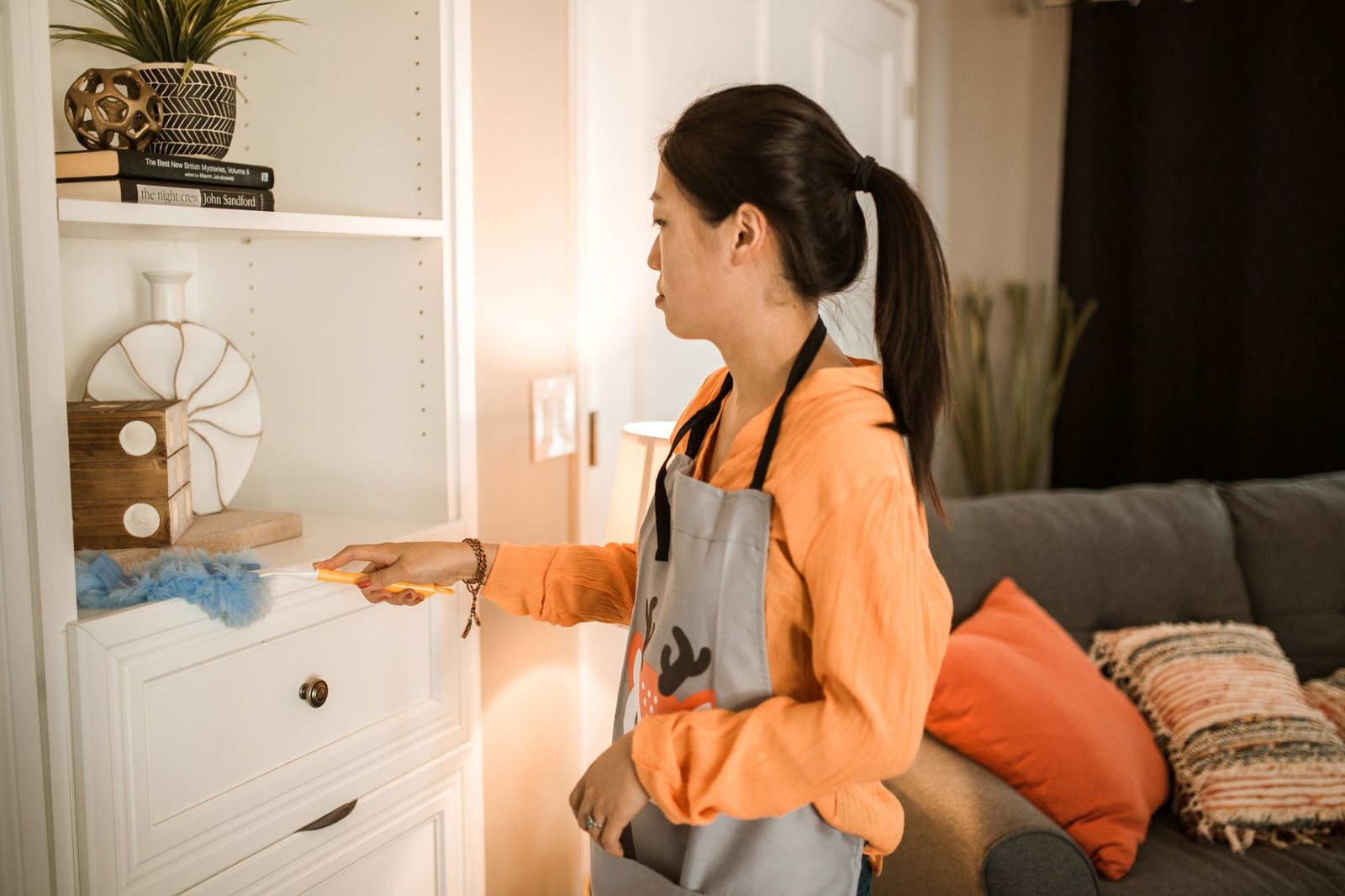
Why damp air and household dust get mentioned together
Household dust is a mixture, and one of the things in it is dust mites, tiny creatures that need humid air to survive. Berkeley Lab’s review of the research on building dampness and indoor air quality calls the evidence that mite numbers rise with humidity “compelling”. That link is the whole case for a dehumidifier and dust. It is a case about what grows in the dust, not about how much dust there is.
I cannot find a good source showing that humidity changes how much dust a home produces, so I will not pretend it does. Skin, fabric fibres, soil from outside and pet hair arrive at the same rate whether the room reads 40% or 70%. That last part is my reasoning, not a measurement.
Does a dehumidifier help with dust you can already see?
Nothing, and it is worth being blunt about that. A dehumidifier pulls room air across a cold coil, the water in it condenses into the bucket, and the air goes back out drier. Particles are not part of that process. Settled dust stays on the surface; airborne dust mostly passes through and out again.
The mesh at the front is not a clean-air filter either. It is there to stop fluff clogging the coil, which is why cleaning the dehumidifier filter is a maintenance job and not an air-quality feature. Any dust it does catch ends up in the machine, which is a reason to wash it, not a reason to buy one.

The EPA makes the same distinction about the machines that are meant for airborne particles. Its guide to air cleaners says most portable air cleaners and HVAC filters can filter particles from the air, and that the most effective step is reducing the sources of pollutants in the first place. A dehumidifier appears nowhere in that guide because it is not in that category. If you are weighing the two jobs in one box, see the air purifier dehumidifier guide.
Three jobs, three different tools
Most of the confusion goes away once you split “dust” into three problems and match each to a tool.

| Problem | What actually works | Dehumidifier’s role |
|---|---|---|
| Settled dust on surfaces | Vacuuming, damp wiping, washing fabrics | None |
| Airborne dust | Fewer sources, ventilation, a filter or air cleaner | None, it does not capture particles |
| Mite numbers and mould | Holding humidity at 30-50% and fixing the water source | The main tool, indirectly |
Will it reduce dust mites? Mixed evidence, honestly
Here the research is less tidy than the product pages suggest. The Berkeley Lab review reports that in Canary Islands homes, dehumidifiers reduced two mite allergens by 78% on average but did not significantly reduce a third. In six English houses, portable dehumidifiers were ineffective at reducing humidity or mite levels. In a US study where humidity was controlled, mite and mite allergen levels fell by 98% and 78%.
My reading, and it is a reading, not a measurement: the machine works when it genuinely holds the home below the humidity mites need, and fails when it is too small, in the wrong place or fighting a house that keeps making water. Size and placement decide it, which is why what size dehumidifier you need matters more here than the brand. This is a statement about mechanism only. I am not saying any of it will change how you feel; that is a question for a doctor.
Aim for 50% or below, and measure it
The target is the same as for mould. The EPA’s guide to mould and moisture in the home says to keep indoor humidity below 60%, ideally between 30% and 50%. For mites, the lower half of that band is the one that matters. If your machine has a humidistat, a sensible setting is around 45-50%; the dehumidifier settings guide covers the dial in detail.
Two practical points:
- Buy a hygrometer. A cheap one tells you what the room really reads, and the dehumidifier’s own display is a guess taken next to its own intake.
- Do not over-dry. Below about 30% you trade one problem for another, and dust does not care.
A dehumidifier in a room that already sits at 45% will not do much for anyone. It earns its keep in the damp basement, the north-facing bedroom or the house that steams up every winter, and I would not run one anywhere else for the sake of dust.
Buy a dehumidifier for the damp, and a duster for the dust
My honest answer to does a dehumidifier help with dust is: only the part of the dust problem that depends on damp, and only if it actually brings the humidity down. Clean with a cloth and vacuum, cut the sources, ventilate, and add a filter or air cleaner if airborne dust is the real complaint. Add a dehumidifier when the hygrometer says the room is above 50-60%, because then it is solving something real, and the quieter dust is a side effect.
FAQ
Does a dehumidifier reduce dust in the air?
No. A dehumidifier removes moisture, not particles, and its mesh filter is there to protect the coil. Dust in the air is dealt with by reducing sources, ventilating, or using a filter or air cleaner designed to capture particles.
Will a dehumidifier stop my house getting dusty?
No, because dust comes from skin, fibres, soil and pet hair, which arrive regardless of humidity. A dehumidifier does not slow that supply. It only changes how hospitable damp conditions are for mites and mould living in the dust.
Does a dehumidifier help with dust mites?
It can, if it lowers humidity below what mites need, ideally 50% or less. Research summarised by Berkeley Lab is mixed: some homes saw large drops, and in others portable units made no difference. An undersized unit in a damp house often fails.
Which is better for dust, a dehumidifier or an air purifier?
For airborne dust, a filter or air cleaner, since it is built to capture particles. A dehumidifier is better when the real problem is damp. They solve different problems, and some rooms need both.
What humidity level should I aim for?
Keep it below 60%, ideally between 30% and 50%, per the EPA. For mites the lower half of that range is the useful part. Measure with a hygrometer rather than trusting the machine’s display.
Should I run a dehumidifier in a dusty room that is not damp?
No. If the room already reads 40-50%, a dehumidifier has little to remove and will not clear dust. Clean the surfaces and cut the dust sources instead, and keep the humidity above about 30%.

