
Last Updated on September 7, 2026 by Umar Farooq
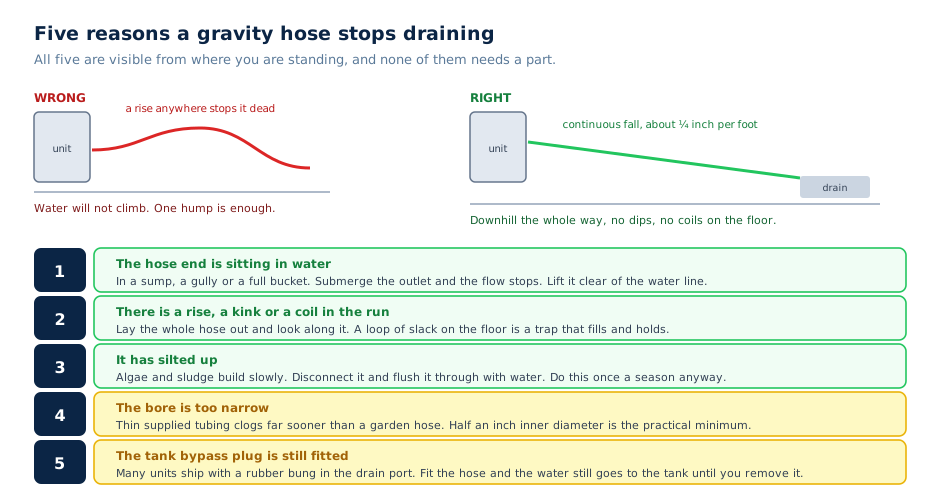
A dehumidifier not draining through hose almost always comes down to one of five things, and none of them needs a part. Water will not climb, it will not push past silt, and it will not flow out of a hose whose end is sitting in a puddle. Everything below is visible from where you are standing.
Work down the list in order. A dehumidifier not draining through hose problems nearly always stops at one of the first two. The first two account for most of these, and both take about a minute to rule out.
Dehumidifier not draining through hose: the five, in order
1. The hose end is sitting in water
The most common and the least suspected. If the outlet is submerged in a sump, a gully or a full bucket, the water in the hose has nowhere to go and flow stops dead.
Fix: pull the hose out until the end is clear above the water line. Free, and instant.
2. There is a rise, a kink or a coil in the run
A gravity drain needs a continuous fall of about ¼ inch per foot, the whole way, with no dips. One loop of slack lying on the floor is a trap: it fills with water, holds it, and the flow stops until the trap clears — which, since the water has nowhere to go, it never does.
This is worth being precise about, because a lot of published advice gets it wrong. I have seen “¼ inch per 10 feet” quoted more than once. That is a tenfold error and at that slope the hose simply will not run.
Fix: lay the whole hose out flat and sight along it. No humps, no coils, no slack. If you cannot get a fall the whole way, stand the machine on a concrete block or a small stand — raising the unit fixes more of these than re-routing the hose does.
3. It has silted up
Algae, dust and mineral sludge build up slowly inside the bore. The flow drops off gradually rather than stopping suddenly, which is why people notice it as “draining slowly” before it stops.
Fix: disconnect the hose and flush it through with water from a tap. Do it once a season whether it needs it or not — it is on the maintenance list for exactly this reason.
4. The bore is too narrow
The thin tubing supplied in the box is the usual culprit. It clogs far sooner than a garden hose and kinks more easily.
Fix: use ½ inch inner diameter as the practical minimum, ⅝ inch is better. A garden hose is the right answer here — most portable units have a ¾-inch female garden hose thread on the drain port, so it screws straight on. The full drain hose setup covers thread sizes and fittings.
5. The tank bypass plug is still fitted
The one that makes people feel silly, and it catches a lot of first-time setups.
Many units ship with a rubber bung in the drain port. Fit the hose over the outside of it and everything looks right, but the water still goes to the tank because the port itself is blocked. The machine works perfectly, the tank fills, and not a drop reaches the hose.
Fix: pull the bung out. It is usually a small grey or black plug, sometimes hidden behind a removable panel. Check the manual for where yours lives — and keep the bung, because you will want it if you ever go back to the tank.
How to tell which one you have
Two observations narrow it fast.
Does the tank still fill? If yes, water is not reaching the hose at all — that is the bypass plug (5) or a completely blocked port. If the tank stays empty and there is water on the floor instead, the hose is taking water and then failing to deliver it, which points at 1, 2 or 3.
Does it drain at all, just slowly? Slow means silt (3) or a bore too narrow (4). Stopped completely means submerged end (1) or a trap in the run (2).
If water is coming out of the machine rather than the hose, that is a leak with its own causes, and a backed-up hose is one of them.
When gravity is not available at all
Sometimes there is genuinely no fall to be had — the only drain is a sink above the machine, or the run is too long across a level basement floor.
Two answers, in order of cost:
Raise the machine. A concrete block, a paving slab or a small stand often converts an impossible run into a straightforward gravity one. Try this before spending anything.
Fit a pump. Either a machine with one built in, or a separate condensate pump that sits underneath and lifts from its own reservoir. A separate pump is usually cheaper than the premium on a pump-equipped machine and replaceable on its own. When a pump is genuinely worth it.
Keeping a dehumidifier draining through the hose
- Flush the hose once a season. Ten minutes, prevents most of these.
- Keep the outlet clear of standing water, and check it after anyone has been near the sump.
- Use a garden hose rather than the thin supplied tubing.
- Secure the discharge end. A light hose in a sink moves, and one that jumps out overnight ruins a floor.
- If it runs out of a window, make sure it cannot freeze. A frozen discharge line backs water straight up into the machine.
- Clean the filter. Not obviously related, but a starved coil ices and then melts all at once, which overwhelms a slow drain and puts water on the floor.
Frequently asked questions
Why is my dehumidifier not draining through the hose?
Most often the hose end is sitting in water, or there is a rise or kink somewhere in the run. After that: silt inside the bore, tubing too narrow, or the rubber bypass plug still fitted in the drain port.
How much fall does a dehumidifier drain hose need?
About ¼ inch per foot, continuously, with no dips. Some guides quote ¼ inch per 10 feet — that is a tenfold error and the hose will not run at that slope.
Why does my dehumidifier tank still fill when the hose is connected?
Because the water is not reaching the hose. Almost always the rubber bypass plug is still in the drain port, so the port is blocked and everything goes to the tank as normal.
Can I use a garden hose on a dehumidifier?
Yes, and it is usually the better choice. Most portable units have a ¾-inch female garden hose thread on the drain port, and a garden hose has a wider bore than the supplied tubing so it silts up far less.
How do I unblock a dehumidifier drain hose?
Disconnect it and flush it through with water from a tap. If it is badly silted, a length of garden hose is cheaper and faster than trying to clear the original.
Why does my dehumidifier drain slowly rather than not at all?
Slow flow points at silt narrowing the bore, or tubing that was too narrow to begin with. A completely stopped hose is more likely a submerged end or a trap in the run.
Should the drain hose go into a sump pump?
It can, provided the outlet sits above the water line rather than in it. A hose end submerged in the sump is one of the most common reasons drainage stops.
Related guides: Dehumidifier drain hose setup · Dehumidifier leaking water · Dehumidifier with a built in pump · Dehumidifier for basement
Sources
- GE Appliances — Dehumidifier: Drain Hose Issues — the fall requirement, hose routing and the bypass plug.
- Frigidaire — Dehumidifier: Not Draining — a second manufacturer on blocked lines and submerged outlets.
- GE Appliances — Dehumidifier: Cleaning and Maintenance — seasonal flushing and filter intervals.
Where this guide and your appliance’s own manual disagree, follow the manual. And if the tank is still filling with the hose connected — go and look for a little rubber bung before you do anything else. It has caught more people than every other cause on this page put together.

