
Last Updated on September 7, 2026 by Umar Farooq
A dehumidifier making loud noise is telling you which part has gone wrong — but only if you listen to what kind of noise it is. A rattle is not a whine, and a whine is not a knock. Each points at a different component, and four of the seven below cost nothing to fix.
Stand next to the dehumidifier making the noise for a minute, with the room quiet, and work out which of these you actually have. That beats any list of nine causes in no particular order, which is what most guides on this offer.
A dehumidifier making loud noise: seven sounds, seven parts
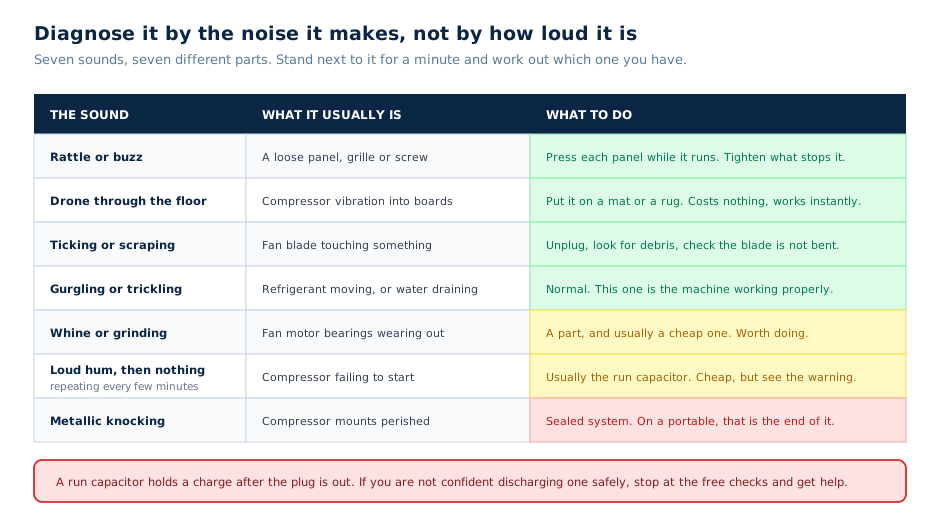
| The sound | What it usually is | What to do |
|---|---|---|
| Rattle or buzz | A loose panel, grille or screw | Press each panel while it runs; tighten what stops it |
| Drone through the floor | Compressor vibration into boards | Put it on a mat or rug |
| Ticking or scraping | Fan blade touching something | Unplug, look for debris, check the blade is straight |
| Gurgling or trickling | Refrigerant moving, or water draining | Nothing — this one is normal |
| Whine or grinding | Fan motor bearings wearing | A part, usually cheap |
| Loud hum then nothing, repeating | Compressor failing to start | Usually the run capacitor |
| Metallic knocking | Compressor mounts perished | Sealed system — the end of a portable |
The four that cost nothing
1. Rattle or buzz — a loose panel. After a season of vibration, housing panels work loose and buzz against the chassis. So does a filter cover that has not clipped back properly, or a tank sitting a few millimetres proud.
Press each panel in turn with the flat of your hand while it runs. When the noise stops, you have found it. Tighten the screws, or refit whatever was not seated.
2. Drone through the floor — it is the floor, not the machine. A compressor’s vibration couples straight into floorboards or tiles, and the floor becomes a soundboard that is louder than the unit itself.
A rug, a rubber mat or even a folded towel underneath makes a startling difference. This is the single most effective free fix on the list and almost nobody tries it, because it does not feel like fixing anything.
3. Ticking or scraping — something is touching the fan. Unplug it, take the grille off, and look. Usually a bit of debris drawn in, occasionally a bent blade after the machine has been knocked over.
4. Gurgling or trickling — not a fault at all. Refrigerant moving through the capillary tube gurgles, and condensate running into the tank trickles. Both are the machine working properly. If yours has just started doing this after you fitted a drain hose, it is water finding its way down the pipe.
The three that need a part
5. Whine or grinding — fan motor bearings. Bearings dry out and the motor announces it long before it seizes. A fan motor is a moderate part and a straightforward job on most units, and it is worth doing on a machine under about five years old.
Do not ignore it. A fan that slows down starves the coil of air, which makes it ice over instead of dripping — so a noise problem quietly becomes a performance problem.
6. Loud hum, then silence, repeating every few minutes. The compressor is trying to start and failing. That is usually the run capacitor, which is a cheap part about the size of a film canister — and throwing away an otherwise sound machine over one is the more common mistake, not the rarer one.
The related symptom is a machine that keeps shutting off after a minute or two, because repeated failed starts trip the overload protector.
7. Metallic knocking — compressor mounts. The compressor sits on rubber mounts that perish with age, and once they have gone it knocks against the chassis. On a domestic portable this is effectively the end: the labour to get in there exceeds what the machine is worth, and everything else in it is exactly as old as the part that failed.
A run capacitor holds a charge after the plug is out and can give you a serious shock. Do not open the case unless you know how to discharge one safely. Sealed refrigerant work requires a licence in most countries and is not a home repair. And if the noise arrived alongside a burning smell, unplug it at the wall and stop — do not carry on diagnosing.
The noise that is not a fault: it is just how loud they are
Worth separating out, because a lot of “my dehumidifier is loud” is really “I did not expect it to be this loud”.
Compressor units run at roughly 45–60 dB in normal use — about the level of a quiet conversation. The WHO’s guidance for a bedroom at night is below 30 dB, and no mains dehumidifier on sale meets that. So a machine that has always been this loud is not broken; it is a dehumidifier.
What matters is whether a dehumidifier making loud noise has changed, not how loud it has always been. A machine that has got louder has a fault. A machine that has always hummed at 50 dB has not. If it is a bedroom you are trying to keep quiet, the placement and sleep-mode guide is more use than a repair.
Keeping a dehumidifier from making loud noise
- Put it on something soft. Mat, rug, carpet tile. Free, and it beats buying a quieter model.
- Away from walls and corners. Hard surfaces reflect sound straight back at you, and cornering it also starves the intake.
- Check panels and screws once a season, when you clean the filter.
- Keep the filter clean. A starved fan works harder and gets louder.
- Use sleep or low-fan mode overnight, and accept the lower output.
- Level it. A unit rocking on an uneven floor amplifies every vibration it makes.
Frequently asked questions
Why is my dehumidifier suddenly so loud?
A change in noise is the signal, not the level. Sudden rattling is usually a loose panel or debris in the fan; a new whine points at fan bearings; a hum that repeats every few minutes points at the compressor failing to start.
Is it normal for a dehumidifier to be noisy?
Compressor models normally run around 45–60 dB, roughly the level of a quiet conversation. That is not a fault. Nothing mains-powered reaches the WHO’s 30 dB bedroom guidance.
Why does my dehumidifier make a rattling noise?
Almost always a loose panel, grille or filter cover vibrating against the chassis. Press each panel in turn while it runs and the rattle will stop when you find it.
What does a buzzing dehumidifier mean?
Two very different things. A steady buzz from the casing is usually a loose panel. A loud hum lasting a few seconds and then stopping, over and over, is the compressor failing to start — often the run capacitor.
Why does my dehumidifier gurgle?
Refrigerant moving through the system and water running into the tank both gurgle. It is normal operation, and often more noticeable after fitting a drain hose.
Is a loud dehumidifier dangerous?
Noise on its own is not, but a metallic knock means compressor mounts have failed, and a hum with repeated failed starts stresses the electrics. A burning smell alongside any noise means unplug it at the wall and stop.
How can I make my dehumidifier quieter without buying a new one?
Stand it on a mat or rug, move it away from walls, level it, keep the filter clean, and use sleep mode overnight. Getting it off a hard floor is the single biggest improvement and costs nothing.
Related guides: Quiet dehumidifier for a bedroom · Dehumidifier keeps shutting off · Dehumidifier fan runs but the compressor doesn’t · How long do dehumidifiers last?
Sources
- Frigidaire — Dehumidifier Noise Guide — the manufacturer’s own list of which sounds are normal operation and which are not.
- World Health Organization — Noise — the 30 dB bedroom guidance used for context above.
- GE Appliances — Dehumidifier: Ideal Operating Conditions — clearance and placement guidance behind the vibration advice.
Where this guide and your appliance’s own manual disagree, follow the manual. And before you shop for a quieter machine — slide a rug under the one you have and listen again. It is a disappointing fix in that it costs nothing, and it works more often than it has any right to.

