
Last Updated on October 25, 2026 by Umar Farooq
Hygrometer vs moisture meter in one line: a hygrometer measures the humidity of the air as a percentage; a moisture meter measures how wet a solid material such as a wall, floor or timber is. They answer different questions, and neither can stand in for the other. Most damp mysteries need both.
The confusion is understandable, since both have a screen, a number and the word “meter” in the vicinity. But pointing a moisture meter at the room’s air gets you a reading of nothing in particular, and leaving a hygrometer on the sideboard will never tell you whether a wall is wet.
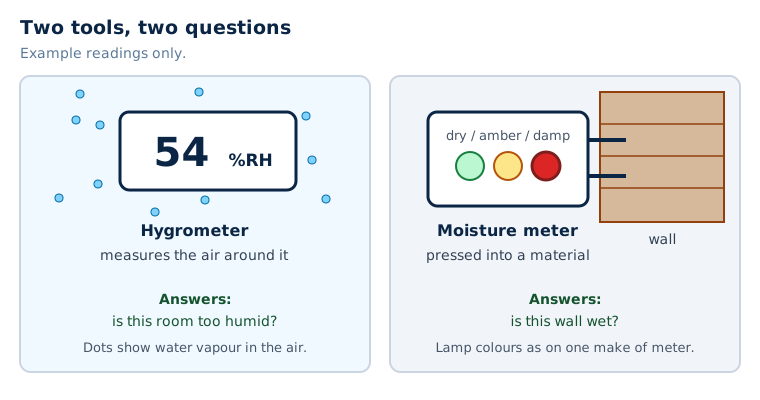
Hygrometer vs moisture meter: what each one actually measures
The hygrometer reports relative humidity (RH): how much water vapour the air holds compared with the most it could hold at that temperature. The National Physical Laboratory’s Beginner’s Guide to Humidity Measurement notes that relative humidity changes with temperature: at 50 %rh, a rise from 20 °C to 21 °C drops it by about 3 %rh. The reading is about the air, and it moves with the heating.
A moisture meter reports how wet a material is. Protimeter’s guide to using their meters says a meter can detect moisture below the levels that are visible or can be felt, and that readings show relative dampness rather than an absolute measurement. The number depends on what is being tested, which makes a moisture meter a comparing tool more than a measuring one.
| Hygrometer | Moisture meter | |
|---|---|---|
| Tests | Air | Walls, floors, timber, plaster |
| Reports | Relative humidity, %RH | A material scale (for example %WME or a relative number) |
| Moves with | Temperature and weather | Water inside the material |
| Typical question | Is the room too humid? | Is this wall wet? |
When the question is “is this room too humid?”
Use the hygrometer. The EPA’s brief guide to mould, moisture and your home says to keep indoor humidity below 60 per cent, ideally between 30 and 50 per cent, so a few days of readings answer the question. How to read a hygrometer covers the practicalities.
A moisture meter held up to the air is not the right instrument: it is calibrated to be pressed against something solid.
When the question is “is this wall actually wet?”
Use the moisture meter. Protimeter describes two types. A pin type pushes pins into the surface, which can leave marks on gloss paint, veneers and laminates. A pinless type uses radio waves and reads to a depth of about 20 mm through paint, wallpaper and tiles. Those are the manufacturer’s figures for its own meters, so another make will differ.
Be careful with the number itself. Protimeter notes that a 12 per cent reading can mean dry for wood but saturated for brick, so a reading is only meaningful for the material the scale was designed for. Damp meter readings explained goes through that, and how to use a damp meter covers the technique.
Use both, and the leak vs condensation question gets easier
This is the pairing most guides skip. A patch of wall that reads wet on the meter and sits in a room where the hygrometer is steadily above 60 per cent points to condensation as a possible cause. A wet patch in a room with a normal hygrometer reading suggests the moisture is arriving some other way. That is a pointer, not a diagnosis; a persistent wet patch is worth a surveyor’s opinion.
For the next step, how to tell if a wall is damp and whether mould on a wall is a leak or condensation take over.
Buy the hygrometer first, and the meter when a wall worries you
For most households, the hygrometer is the better first purchase. It is cheap, it runs all the time, and it tells you whether your habits are working. The EPA’s guide puts instruments of that kind at around $10 to $50.
A moisture meter earns its place when a specific wall, floor or window frame looks suspect. Do not use one in place of the other, and do not trust either on its own.
FAQ
Is a moisture meter the same as a hygrometer?
No. A hygrometer measures humidity in the air, while a moisture meter measures dampness in a solid material. Some products are called “humidity meters”, so check whether the box says air or materials.
Can a hygrometer detect damp walls?
Not directly. It measures the air, and a damp wall can sit in a room with normal humidity. A persistently high reading suggests conditions where condensation is likely, but only a moisture meter or inspection looks at the wall itself.
Can a moisture meter measure humidity in the air?
Not in any useful way. It is built to be pressed against a material, and its scale is relative to that material.
Which is better for finding damp?
The moisture meter for locating a wet surface, the hygrometer for understanding the conditions that may have caused it. Together they are better than either alone.
Do I need a hygrometer if I already have a moisture meter?
Yes, if you suspect condensation. A meter shows that a wall is wet, but not whether the room’s air is damp enough to be the cause.

