
Last Updated on October 25, 2026 by Umar Farooq
Damp meter readings explained: the number on the display is how easily the surface passes a small electrical signal, which is a true moisture percentage only on timber; on plaster and brick it is a wood-equivalent or relative figure you compare, not a measure of water. Read it as “wetter or drier than the dry spot next to it” and most of the confusion disappears.
I have watched a perfectly dry chimney breast read 40 and ruin someone’s weekend. The meter was not broken. It was doing exactly what it is built to do, and nobody had told its owner what that was.
Check which scale your meter is showing
Three different things can appear on the same little screen, and they are not interchangeable.
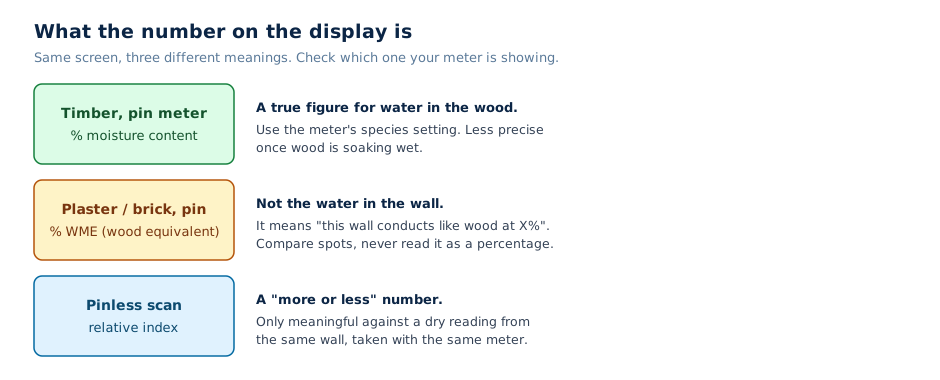
- %MC (moisture content). A percentage of the wood’s weight that is water. It is a real figure, but only for timber, and only with the meter set to the right species. Where decay is concerned, the figure people use is 20%, which I have set out with its source in the wood moisture-content chart on the mould-on-wood page, so I will not repeat it here.
- %WME (wood moisture equivalent). What a pin meter shows on plaster, brick or mortar. It says “this wall conducts like wood at that moisture”. It does not say the wall holds that much water.
- Relative or index scales. A pinless scan, or a coloured bar, gives a number that only ranks one spot against another. Protimeter’s own guide says it plainly: readings are taken on a reference scale “as it is only a relative degree of dampness”.
Quick test: if the meter has a “material” or “species” setting, you are on a wood-calibrated scale and anything you measure that is not wood is WME. If it only has a bar or a 0 to something-big number, it is relative. Your manual will say which.
Do not push pins into a wall where you know or suspect cables or pipes run. Pin holes are small, but pins and live wiring are a bad combination, and a pinless scan is the safer way to start.
Why plaster and brick only ever give relative values
Wood is the reference material because a meter can be calibrated against it. Plaster, brick and mortar have no such neat relationship between electrical behaviour and water content, and they vary from one wall to the next. A reading on them is therefore a comparison tool.
The practical consequence is the single most useful habit in the whole subject: take a reading on a part of the wall you are confident is dry, then measure the suspect area with the same meter, same mode, same pressure. The gap between the two is information. The absolute number is not.
That is also why a reading of, say, 30 on one meter and 60 on another can both be “right” about the same wall. Different scales, different circuitry.
Dry, borderline or wet: what the bands really say
Many pinless meters colour-code the result. Protimeter’s guide labels green as dry, amber as borderline and red as damp, and I could not find numeric thresholds for those colours on that page. I looked, because that is the question everyone asks.
Trade guides do publish figures, and they disagree with each other. One damp-survey firm gives a “normal” range for plaster of 0 to 17 on its calculator, while stressing that there is no universal safe number for plaster and brick and that patterns matter more (Sussex Damp Experts). I would treat any chart of fixed “dry, at risk, wet” bands for masonry as one company’s rule of thumb, and your own meter’s manual as the only authority for your model.
So here is what I would do instead of a chart. The right-hand column is my judgement, labelled as such, not a standard.
Damp meter readings explained: a decision table
| What you see | What it most likely means | What I would do next |
|---|---|---|
| Reading close to your dry reference spot | That area is probably as dry as the rest of the wall | Nothing to treat. Re-check in a week if you are chasing a smell or a stain |
| Moderately above the dry reference, even and low on the wall | Possibly moisture, possibly salts or just a cold surface | Re-test on a different day, then compare with a hygrometer reading near the wall |
| High and patchy, near a window, ceiling or outside defect | A local source such as a leak or failed seal | Look for the source and fix it. The guide to rising, penetrating and condensation damp shows how the patterns differ |
| High on the wall surface and not much further in, worse in cold weather | Condensation is a strong candidate | Read condensation on walls and ceilings and fix humidity and ventilation first |
| High only at one odd spot (pipe line, corner, switch) | Probably metal fooling the meter | Move the meter a hand-width and re-read before believing it |
| High everywhere in an old building, but the wall looks and feels dry | Salts are a strong suspect | Do not buy treatment on this alone, see below |
On timber, the same rule applies, with a real percentage: above about 20% is the zone to take seriously, and the water source comes before any cleaning.
Five false highs that make a dry wall look wet
My opinion, and I will stand behind it: nobody should spend money on damp treatment because of a handheld meter reading alone. The Society for the Protection of Ancient Buildings says rising damp is “widely misdiagnosed on the basis of high electrical moisture meter readings alone”, and that high readings “occur not infrequently in old buildings that are virtually dry” (SPAB). These are the usual culprits.
- Salts. Left behind by old leaks or evaporating moisture, hygroscopic salts conduct electricity, so a dry wall reads as damp. Chimney breasts are the classic case.
- Foil-backed plasterboard and vapour layers. A pinless meter can read the foil as a very high result.
- Metal. Corner beads, lath, pipes, cables and fixings under the plaster produce sharp spikes at one spot.
- Recent wet work and surface coverings. Fresh plaster, new screed, heavy cleaning, thick paint films and vinyl wallpaper all add moisture or distort the signal, per the damp-survey firm’s guide linked above.
- Condensation. A cold surface that is wet from room air will read high, even if the wall behind it is fine. That is a humidity problem, not a leak, and a hygrometer settles it faster than the meter.
A reading that is high everywhere, in the same way, on a wall that looks and feels dry, is far more likely to be salts, foil or condensation than a flooded wall.
What to do with each result
If the reading is low or matches your dry reference: stop worrying about that spot. A stain or smell has another cause.
If it is borderline or moderately high: do not act yet. Repeat on a different day, in a different spot at the same height, and note whether it changes with the weather or the heating. A wall that reads the same on a dry week as after rain is not usually leaking.
If it is high and the pattern points to a source: find and fix the water first. Drying equipment is wasted on a wall that is still being fed. If you are drying a space afterwards, keep indoor humidity within the 30 to 50% range the EPA recommends, and see how to prevent damp in winter for the day-to-day routine.
If it is high and you suspect salts, metal or foil: that is the point to bring in an independent surveyor, one who is not selling the cure. Ask what they will test besides the meter.
Trust the pattern and the retest, not any single number
The short version of damp meter readings explained: know which scale you are on, take a dry reference reading first, treat plaster and brick numbers as comparisons, and never decide on one reading. A meter finds where to look. It does not tell you what you are looking at.
FAQ
What is a normal damp meter reading?
It depends on the material and the scale. On timber, a true moisture percentage in the low-to-mid teens is typical in a heated home, per the Sussex Damp Experts guide. On plaster and brick there is no universal normal, so compare against a dry area of the same wall.
Why does my damp meter read high on a dry wall?
Usually because something other than water is conducting the signal: salts, foil-backed plasterboard, metal under the plaster, fresh plaster or paint, or condensation on a cold surface. A high reading is a reason to investigate, not proof of water.
What does WME mean on a damp meter?
Wood moisture equivalent. Pin meters are calibrated on wood, so on plaster or brick they show the moisture a piece of wood would have at the same electrical resistance. It is a comparison figure, not the wall’s actual water content.
Can condensation make a damp meter read high?
Yes. Water on or just under a cold surface is conductive, so the meter reads high there even when the wall behind is dry. If the reading is highest at the surface and the wall is coldest on winter mornings, look at humidity and ventilation first.
Should I call a surveyor if my damp meter reading is high?
Call one if the reading stays high after you have re-tested, the pattern does not match a clear source, or you suspect salts. Choose an independent surveyor who will test beyond the meter, rather than a firm that quotes for treatment from one reading.

