
Last Updated on October 24, 2026 by Umar Farooq
A dehumidifier tripping breaker is either a circuit carrying too much, or the machine, its cord or a socket leaking current: you can sort out which with a few safe checks, and if it trips a second time you stop using it. The breaker is doing its job, so find what it is protecting you from. Everything here stays outside the wiring, the panel and the machine.
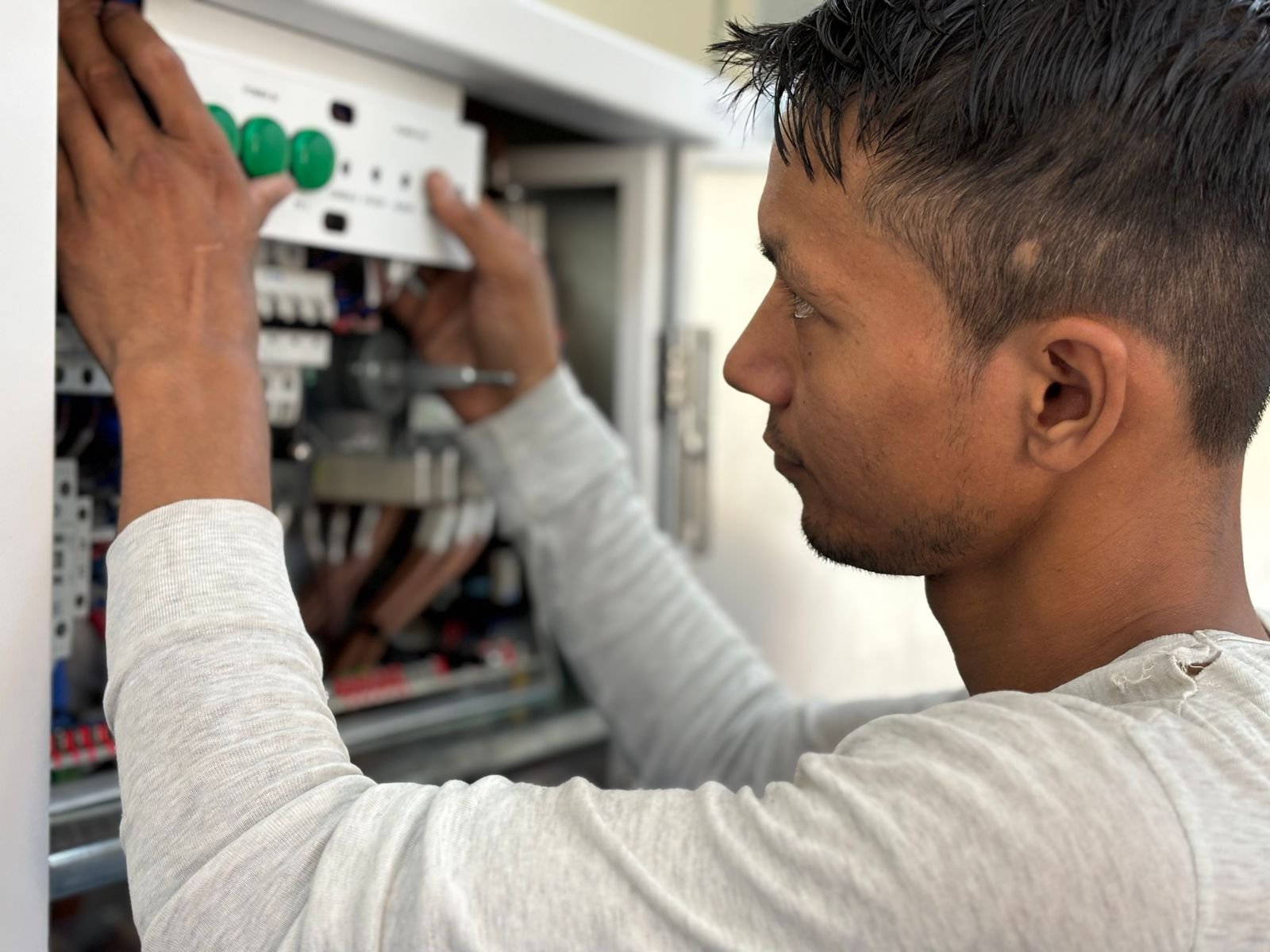
Never hold a breaker on, tape it, swap it for a bigger one or reset it again and again to get the unit running. Stop and unplug the dehumidifier if the plug, cord or socket is hot, smells burnt or hot plastic, is scorched or melted, or if water has reached the machine’s electrics or the socket. A breaker that keeps tripping is a warning, not a nuisance.
Why does a dehumidifier trip the breaker?
There are really only a few culprits, and they split into “the circuit” and “the machine”:
- A shared, busy circuit. A dehumidifier is a motor and a compressor that runs for hours. Put it on the same circuit as a heater, kettle or tumble dryer and the total can pass what the breaker allows. Electrical Safety First says that overloading can make the lead, adaptor or the plug in the wall socket overheat and cause a fire, which is the reason the breaker exists.
- An extension lead or multi-plug. It adds joints and another place for heat to build. GE’s support page says a dehumidifier must be plugged directly into a properly grounded 3-prong wall outlet and that an extension cord or surge protector is not recommended.
- A start-up surge on a weak circuit. Motors and compressors pull more current for a moment when they start than when they are running. On a healthy circuit you never notice. On a loaded or tired one it can be enough. I have not measured this and I will not quote a number, because it varies with the machine.
- A damp or damaged socket, plug or cord. A wet socket in a cellar or garage, a crushed cord or a plug with darkened pins can leak current to earth.
- An internal fault. Water where it should not be, or a failing motor or part inside the unit. This is the one you cannot fix yourself.
- Earth leakage. In the UK an RCD in the consumer unit watches for current escaping to earth, and Electrical Safety First says it protects against electric shock from faulty products. It can trip on a leak that a normal breaker would ignore.
The six safe checks, in this order
Do these in sequence and stop the moment something looks wrong. Each one rules out a cause.
- Unplug the dehumidifier and look at it. Check the whole cord for cuts, crushing or kinks, and the plug for melted, darkened or bent pins and any scorch mark. Check the socket face for the same. If you find any of it, the check ends here: leave it unplugged. CPSC’s advice on damaged cords is blunt: a frayed or cracked cord could cause a shock or fire.
- Reset the breaker once, with the dehumidifier still unplugged. Dry hands, stand to the side, switch it fully off and then on. If it trips with nothing of yours plugged into that circuit, the fault is in the house, and that is an electrician’s job.
- Plug the unit into a different wall socket, straight in. Pick a socket on another circuit if you can tell which is which, never through an extension lead, adaptor or surge strip. No lead, ever, for this test.
- Make it the only thing running on that circuit. Unplug the heater, the kettle, the other appliances you know share it. If you do not know what shares the circuit, the labels in the panel are a clue, not proof.
- Switch it on and note the timing. Trips the moment you press the button, or the instant the compressor kicks in: that points at the machine or a surge. Trips after an hour or two of running: that points at a sustained load or heat in a cord, plug or socket.
- If it trips again, stop. Leave it unplugged. Do not try it a third time.
That last line is the important one. CPSC’s advice is that an appliance which repeatedly trips a circuit breaker should be unplugged and then repaired or replaced, and Electrical Safety First lists breakers that operate for no obvious reason as a danger sign and says to unplug the item and contact the retailer, manufacturer or a qualified repair technician.
What each result tells you
| What happened | Most likely meaning | What to do |
|---|---|---|
| Trips with the dehumidifier unplugged | A fault on the circuit | Leave it, call an electrician |
| Runs fine in another socket, trips in the first | That circuit or socket is the problem | Keep it on the working socket, have the first one looked at |
| Trips in every socket, straight away | The dehumidifier | Stop using it, contact the maker or replace |
| Trips only after a long run, plug or cord warm | Heat in a cord, plug or socket | Unplug, do not reuse that cord or socket until checked |
| Trips only when a heater or other load is also on | Shared overloaded circuit | Run the dehumidifier alone on that circuit |
Dehumidifier tripping breaker only when it starts
If it runs for hours and only trips as it kicks on, a weak or busy circuit is a likelier suspect than a dead machine, though I cannot prove that from my chair. Try it alone on a different circuit; if it still trips as the compressor starts, treat the machine as faulty. The related symptom of a unit that cuts out by itself, with no breaker involved, is a different problem covered in why a dehumidifier keeps shutting off. Also see using an extension cord with a dehumidifier for why the lead is out.
When water is the reason
A wet socket or a machine that has leaked inside is the combination I would never experiment with. If the tank has overflowed or the base is wet, keep it unplugged and dry before any test, and read why a dehumidifier leaks water. If the socket itself is damp, leave it alone and ask an electrician. If nothing trips but the unit is simply dead, that is a different list: dehumidifier not turning on.
A breaker that trips twice means the dehumidifier stays unplugged
My one firm opinion: a second trip is the end of the experiment. One trip can be a busy circuit. Two, on a clear circuit and a direct socket, means the machine or the supply has a fault, and no manual, forum thread or clever workaround makes it safe to keep resetting. Test it on another circuit once, then replace the unit or book an electrician. Once it is behaving, running it overnight on a good direct socket is fine.
FAQ
Why does my dehumidifier keep tripping the breaker?
Most often because the circuit is shared and overloaded, because of an extension lead, or because the machine, its cord or a damp socket has a fault. Work through the six checks above, and treat a repeat trip on a clear circuit as a fault.
Can a dehumidifier trip a breaker on its own?
Yes. A dehumidifier alone can trip a weak or damaged circuit, or trip itself because of an internal fault or earth leakage. That is why I test it alone on a different socket before deciding which one is at fault.
Is it safe to keep resetting the breaker?
No. Reset it once to see whether it holds. If it trips again, leave the dehumidifier unplugged. Never hold a breaker on or fit a larger one.
Should I use an extension cord to get away from the tripping circuit?
No. The manufacturer page I opened says to plug straight into a grounded wall outlet, and a lead adds a joint to the problem. Move the machine to a better socket instead.
When should I call an electrician?
When the breaker trips with the dehumidifier unplugged, when a socket is hot, scorched or damp, when it smells burnt, or when it trips on every socket you try. If it is only the dehumidifier tripping everywhere, the maker or a replacement is the answer.

