
Last Updated on October 24, 2026 by Umar Farooq
Can you use an extension cord with a dehumidifier? Usually not: the manufacturer pages I opened tell you to plug the unit straight into a grounded wall socket, and a cord is only worth considering if your own manual allows it. The reason is dull and sensible: you are adding a weak link to a machine that works hard.
I get this question from people whose only socket is on the wrong side of the room. It feels like a trivial problem for a trivial piece of kit. It is neither, and the fix is nearly always to move the machine, not to buy a longer lead.
Can you use an extension cord with a dehumidifier if the manual says nothing?
Start with the paperwork, because the manufacturer’s word beats any blog, including this one. Here is what I could confirm by opening the pages:
| Source | What it says |
|---|---|
| Honeywell dehumidifier manual | “DO NOT use an extension cord with this appliance.” |
| GE Appliances support page | Not recommended to use an extension cord or surge protector; plug directly into a properly grounded 3-prong wall outlet. |
Notice what is missing: a reason. GE’s page does not explain itself, and Honeywell’s safety list simply states the rule. I also could not open Haier’s electrical page (it blocked me), so I am not quoting it.
If your manual says nothing at all, that is not permission. Look for a line about plugging in directly or the electrical requirements near the grounding warning. If there is still nothing, treat the silence as a no and ask the maker’s helpline. They will answer in one sentence.
Why a compressor appliance is hard on a cord
I have not measured any of this, and the pages above do not give a reason, so this is the general electrical picture rather than a tested result.
- It runs for hours. A compressor dehumidifier is not a lamp you switch on for a minute. Whatever heat a joint or a thin conductor makes, it keeps making. I have deliberately not quoted an amp figure: it varies by model, and the rating plate on your unit is the number that counts.
- Longer, thinner cable resists more. A cord that is long or light on conductor loses some voltage on the way, and a motor that starts on a sagging supply can struggle. That is my own reasoning from how cables behave, which is why I will not put a number on it.
- Every cord adds a joint. The diagram below is the whole argument in one picture.
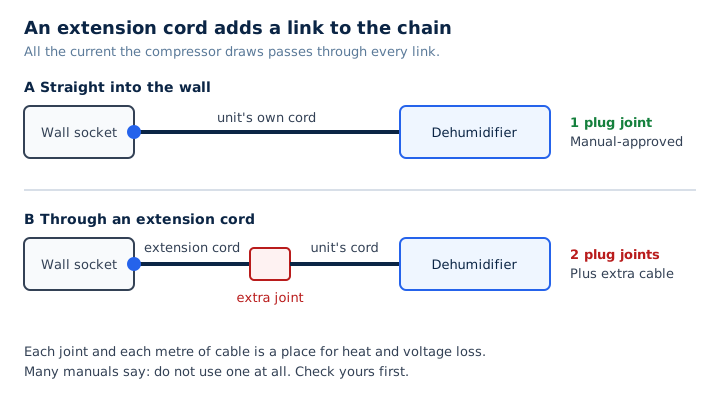
Independent safety bodies say the same thing from the other side. Electrical Safety First says: “Overloading can make the extension lead, cable reel, adaptor, or the plug in the wall socket overheat and cause a fire.” It also notes that extension leads are rated at 13A apart from some older ones that may be 10A, and that a cable reel must be unwound to reach its rating. A reel left wound up while it runs is its own fire risk.
If a unit has already been cutting out, a long cord is one of the first things I check. The symptoms are in why a dehumidifier keeps shutting off and what to check when it will not turn on.
Stop and unplug the dehumidifier if the plug, socket or any cord feels hot, smells of burning or hot plastic, or shows scorch marks, melted plastic or frayed cable. Do not reuse that cord or that socket until a qualified electrician has looked at it. Never run a cord under a rug, never leave a reel coiled while the unit runs, and never daisy-chain two cords.
Get the dehumidifier to the socket instead
This is what I would do, in order. None of it needs a tool.
- Unplug the unit and read the label on the back. Note the model and any electrical rating printed there. You may need it later.
- Move the machine to the nearest grounded wall socket. A dehumidifier treats the air around it, so the socket you can reach is often a better spot than you think. Where to put a dehumidifier covers how much position matters.
- Use the unit’s own cord and nothing else. No power strip, no multi-way adaptor, no surge protector. GE’s page names those too.
- Check the plug fits snugly and the cord is undamaged. A loose plug in a worn socket is a heat source on its own.
- If the socket is still in the wrong place, move the socket, not the cable. My one firm opinion: have an electrician fit a socket where the dehumidifier lives. For anything running for weeks, that is the sensible answer, and it is the same logic as the next quote.
The US Consumer Product Safety Commission agrees with the instinct. Its release on electrical safety says extension cords “should only be used on a temporary basis and are not intended as permanent household wiring” and that overloaded ones can cause fires. A dehumidifier in a damp cellar is the opposite of temporary.

When a rated cord is the only option
Only if the manual permits it. If it forbids cords, there is no “safe version”, and you are back to moving the unit. If it allows one, the CPSC release gives you the test: the cord must not be overloaded, as indicated by the ratings labelled on the cord and the appliance, and if it falls short you change it for a higher-rated one.
In practice, and only where your manual allows it:
- Match the labels. The cord’s rating must clear the rating on the dehumidifier. If you cannot find either number, stop here.
- Short beats long. Buy the shortest that reaches, and never leave spare length coiled.
- Three pins, grounded. The unit’s plug is three-pin for a reason; the cord must be too. A cord that drops the earth is wrong.
- One appliance on it. Nothing else shares the cord or the socket it plugs into.
- Check it by hand after the first hour. Warm is a warning, not a pass.
- Treat it as temporary. Fit a proper socket for anything long-term.
I am deliberately not giving you a gauge chart. Competitor pages do, but I could not trace their figures to a manual or a standard, and I would rather you read your own rating plate than trust my table. Choosing the machine in the first place is a separate question, covered in the what size dehumidifier do I need guide, and for night-time running the overnight checklist lands on the same rule: wall socket, no cord.
Move the dehumidifier, not the electrics
The short version is the one the manufacturers give. Plug it into a grounded wall socket, use the cord it came with, and treat a rated extension cord as a last, temporary resort that only your manual can approve. If the socket is in the wrong place, an electrician fitting a new one is the real fix, and a better use of money than a heavy-duty cord that still adds a joint.
FAQ
Can I use a heavy-duty extension cord with a dehumidifier?
Only if your manual says a cord is allowed. A heavy-duty cord does not override a “do not use an extension cord” line, and Honeywell’s manual has exactly that line. If a cord is permitted, its rating must clear the rating on the dehumidifier.
Can a dehumidifier be plugged into a power strip or surge protector?
Not according to GE’s support page, which says not to use a surge protector or multi-outlet adaptor and to plug into a grounded 3-prong wall outlet. A strip also invites sharing the socket with other appliances.
What happens if the extension cord is not strong enough?
Electrical Safety First says an overloaded lead, adaptor or wall plug can overheat and cause a fire. Its warning signs include a smell of hot plastic, scorch marks, melted plastic and fuses that blow for no obvious reason. Unplug and stop using it.
How long can an extension cord be for a dehumidifier?
I could not find a manual that gives a length limit, so I will not invent one. The honest rule is the shortest possible, fully uncoiled, and only where the manual allows a cord at all.
Can I plug a dehumidifier into a garage or outdoor socket?
The same rule applies: a grounded wall socket, no cord. If the socket is in a damp garage, shed or cellar, have an electrician check that it is suitable and protected, because water near mains power is a separate danger from the cord.

