
Last Updated on October 23, 2026 by Umar Farooq
Why is my house so humid in winter? Because you are adding water to the air all day (breathing, showers, cooking, washing on airers) in a house that is shut and heated, so the vapour has nowhere to go and lands on the coldest surface it can find. The weather is not the culprit; the shut front door is.
It is a slightly unfair design. The one season you want the windows closed is the one season the house most needs them open.

Why is my house so humid in winter when the air outside is dry?
Cold air can hold very little water. Bring it indoors, heat it, and it reads as dry. So winter humidity is not imported; it is made indoors. What your house holds is simply water in minus water out, and in winter the “out” has been closed.
There is a second trick, and it explains why a room can read a sensible 50% and still feel clammy. Relative humidity depends on temperature, so the same air reads far higher right next to a cold surface. The diagram shows the arithmetic (mine, using the Magnus formula, not a measurement) for room air at 20°C (68°F) and 50% RH.
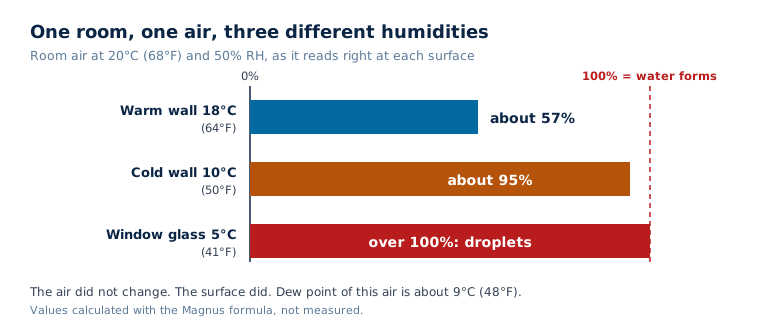
That is why Natural Resources Canada says condensation often occurs in colder weather when moist indoor air meets cooler surfaces, and why the damp turns up on glass, external walls and behind wardrobes first. What reading is acceptable at which temperature is covered in the ideal home humidity level in winter.
Five winter habits that fill the air
- Draught-proofing without replacing the ventilation. Taped-up gaps used to be your free extractor fan. I am not against sealing; I am against sealing and forgetting.
- Washing dried indoors. An airer is a slow kettle with no lid. How much it releases depends on the load and the spin, and I will not put a figure on your house, because nobody has measured it. Which? notes that the moisture does not just disappear and can collect in ceiling corners.
- Showers and cooking with no extraction. Steam from a bathroom with the door open goes straight into the hallway and the bedrooms.
- Heating in bursts. Walls that go cold between heating periods are exactly the cold surfaces in the diagram. Steady and low tends to beat off-and-blast for this, though the bill difference is yours to check.
- Sleeping in a shut bedroom. Breathing adds vapour all night with the window closed. Nothing dramatic, but it is why bedroom glass is wettest at 7 a.m.
The broader list, including leaks and bare soil, is in what causes high humidity in a house. This page is only the winter version.
| What you notice | Usually means | First thing to try |
|---|---|---|
| Wet windows every morning | Moist air meeting a cold pane | Wipe it, then extract steam at source |
| Damp smell in the bedroom | Shut room, no air exchange | Door ajar, window open a crack by day |
| Mould spots on an outside wall | A cold wall, or a leak | Rule out a leak, then warm the wall |
| Whole house clammy | More water in than out | Work through the order below |
Fix it in this order, cheapest first
Most houses never get past step four.
- Stop adding water you do not need. Lids on pans. A tumble dryer vented outside. The EPA advises venting moisture-producing appliances, such as dryers and stoves, to the outside where possible.
- Extract at the source. Run the bathroom fan during the shower and leave it on until the mirror clears. Cooker hood on while you boil.
- Dry washing in one room, door shut, window open a crack. Not the lounge, not the bedroom.
- Purge briefly. Open windows wide for a few minutes in the morning, then close them. Cold winter air carries little water, so a short purge swaps wet air for dry without chilling the walls. “A few minutes” is my rule of thumb, not a tested figure.
- Keep the cold surfaces warm. Do not push furniture against external walls or block the heat under windows; NRCan notes that deep sills, closed drapes and furniture let cool air collect at the glass.
- Buy a hygrometer, then a machine if the number stays high. If it is still above range after steps one to five, a dehumidifier is the right tool. How it behaves in the cold is in dehumidifier in winter, and sizing is in what size dehumidifier do I need.
Draught-proofing did not cause this, the missing fan did
My honest opinion: do not rip out the sealing. A leaky house is a cold house, and it only dries itself by accident. The sealed house is better; it just needs ventilation on purpose. That means working extractor fans, a few minutes of purge, trickle vents if you have them, and a hygrometer to confirm it worked.
When it is a leak and not humidity
Humid-air damp moves with the weather and the washing. A leak does not. If one patch is stained and stays stained, check the roof, the pipes and the guttering before you blame the air. The EPA’s line is to dry water-damaged areas and items within 24 to 48 hours, so fix the water first. Window-specific patterns are in condensation on windows.
Winter damp is a bookkeeping problem: water in, water out
If you are still asking why is my house so humid in winter, treat it as accounts. Water comes in from people, pans, showers and washing. It leaves through fans, a short purge and, as a last resort, a dehumidifier. Reduce the first, raise the second, warm the cold surfaces, and keep a hygrometer on the wall to prove it.
FAQ
Is it normal for a house to be humid in winter?
Yes, especially a well-sealed one. Cold outdoor air is dry, but the water you add indoors has fewer exits when the windows are shut, so it builds up. It is common, not a fault, until it shows as condensation or mould.
Does heating the house reduce humidity?
It lowers relative humidity because warm air reads drier, but it removes no water. If you keep adding vapour, it reappears as condensation on the next cold surface.
Should I open windows in winter to reduce humidity?
Briefly, yes. A few minutes with the windows wide, then shut, replaces damp indoor air with colder, drier outdoor air. Leaving them open all day just wastes heat and cools the walls.
Why does my house feel damp when the hygrometer reads normal?
Meters read the air, not the cold wall. Air next to a cold surface sits at a much higher relative humidity than the room average, so the wall can be wet while the room reads fine. Check the coldest corner too.
Will a dehumidifier help in winter?
It will, if you are still above range after fixing sources and ventilation and the room is warm enough for it to work. In a cold room, a compressor model collects less.

