
Last Updated on October 24, 2026 by Umar Farooq
Toilet cistern condensation happens when warm, humid bathroom air touches a tank full of cold mains water: the ceramic drops below the air’s dew point, so moisture condenses on the outside and drips to the floor. It is the same thing as a cold glass sweating on a summer day, only with a more awkward cleaning job.
The good news is that it is usually harmless to the toilet and fixable without a plumber. The less good news is that the cistern is only the messenger: the real problem is how much steam your bathroom is holding on to.
Why a toilet cistern sweats after a flush
Three things decide whether water forms on any surface: how much moisture is in the air, how warm the air is, and how cold the surface is. Homebuilding quotes Meaco’s managing director making exactly that point, and notes that the cistern turns into a very cold surface every time the toilet is flushed and refilled with cold water.
That is the whole mechanism. Mains water arrives cold, the tank holds a few litres of it, and ceramic is a poor insulator, so the outside wall chills down towards the water temperature. If the air around it carries enough moisture, the wall sits below the dew point and droplets appear. I explain the dew point idea with a pipe in how to stop condensation on pipes, so I will not redraw it here. The cistern just adds a twist: its temperature changes through the day.
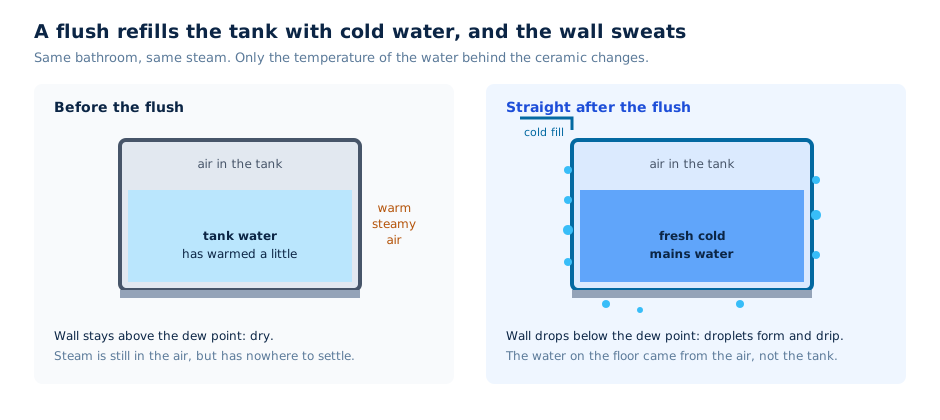
The diagram is qualitative: I have not measured wall temperatures, and they will vary with your water, season and tank size. What it explains is the pattern most people notice. The cistern is dry first thing, gets a fresh dose of cold water, and then sweats the moment the bathroom steams up.
It also explains why it is worst in winter, when the incoming water is at its coldest, and worst in a small bathroom with a shower a few steps away.
Toilet cistern condensation or a leak? Two quick checks
A wet floor around a toilet does not have to mean condensation, and it does not have to mean a leak. Tell them apart before you spend money on either.
Check 1: the dye test for the bowl. Add a few drops of food colouring to the tank and wait. The US EPA’s WaterSense page says that if any colour shows up in the bowl after 10 minutes, you have a leak, and advises flushing right afterwards so the dye does not stain the tank. A coloured bowl points at the flush valve or flapper inside the tank, not at condensation on the outside.
Check 2: the tissue test for the bolts. Water that runs down from where the tank bolts to the bowl is easily mistaken for sweat. A plumbing firm describes the check: put dye in the tank, hold a piece of white tissue against the tips of the two tank bolts, and see whether it picks up the colour. Coloured tissue means water is escaping at the bolts. If it stays white, that points to condensation.
Two honest caveats. A clean result on one test does not rule out an intermittent fault, and I have not run either test on every make of cistern. And if the dye does show a leak, the repair (replacing a flapper, washers or bolts) is a plumbing job I would leave to whoever you trust, rather than something this page will walk you through.
A rough field guide that needs no dye:
| What you see | More likely |
|---|---|
| Fine beads over the whole tank, worse after a shower | Condensation |
| Wet only at the bolts or the join with the bowl | Leak at the tank fittings |
| Drips from the supply pipe joint | Leak, not condensation |
| Water appears when the bathroom is cold and dry | Leak |
| Wipe it dry and it returns within minutes of a steamy shower | Condensation |
The table is my own rule of thumb, not a measured result. The dye and tissue tests are the confirmation.

Five ways to cut toilet cistern condensation
Start at the top. The first two attack the steam. The last three deal with the cistern itself or the symptoms.
- Extract the steam while it is still hot. A bathroom fan does more for a sweating cistern than anything you can stick on the tank. Homebuilding’s experts put ventilation first. If you are not sure the fan you have is up to it, see do I need a bathroom extractor fan, and for run times how long to run a bathroom extractor fan.
- Shorter, cooler showers with the door shut. Less hot water means less steam in the first place, and closing the door keeps it in the room with the fan rather than spreading through the house. Slightly cooler bathrooms hold less moisture, so a programmable radiator valve is one tip Homebuilding passes on.
- Flush after the shower, not during it. Water that sits in the tank warms a little, which means the next refill is a smaller shock. Homebuilding lists waiting until after bathing as a cheap trick. It is free, and it helps at the margin.
- Use a dehumidifier as one option, not the first. In a small bathroom with no good extraction, a unit just outside the door, or a small desiccant one, can pull the humidity down between showers. Mains-powered machines and splashes do not mix: read using a dehumidifier in a bathroom before you place one.
- Insulate or warm the tank. A liner inside the cistern reduces how cold the outer wall gets, and Homebuilding notes it is not a common job in the UK and is often unnecessary if ventilation is good. An anti-sweat valve is another option, and the same article says you may want a professional to fit it. Treat both as the last step, not the first.
A drip tray under the cistern catches water but does not stop it forming. That is useful while you work on the cause, and it is not a fix on its own.
Does the water on the floor matter?
Occasionally, yes. If it is wiped away daily it does little. If it keeps running behind the pan or into a flooring edge, it keeps one spot damp, and a persistently damp spot is where staining and mould start. The EPA’s guide to mould and moisture is blunt that moisture control is the key to mould control. My advice: wipe the tank dry, check the floor edge, and fix the water first.
If the ceiling and walls are also beading, the cistern is only one symptom, and bathroom ceiling condensation covers the fan and loft-duct side of the same problem.

A sweating cistern is a ventilation problem wearing a toilet costume
If the mirror fogs and the cistern sweats, your bathroom is keeping steam longer than it should. Get the extraction right, shorten the steam, and toilet cistern condensation usually fades by itself. Liners, valves and trays are for the stubborn cases, and a dye test comes first, in case it was a leak all along.
FAQ
Why is my toilet cistern sweating?
Warm, humid air is meeting a tank full of cold mains water. The ceramic gets cold, drops below the dew point of the bathroom air, and moisture condenses on the outside. It is worse after showers, in winter and in small bathrooms.
How do I know if my toilet is leaking or just condensation?
Put a few drops of food colouring in the tank, wait about 10 minutes without flushing and see if colour reaches the bowl. For water at the bolts, hold white tissue against them. Coloured means a leak; clean means condensation.
Is toilet condensation harmful?
Not to the toilet. The risk is the water that runs onto the floor or behind the pan, which can keep one patch damp. Wipe the cistern dry and check the floor edge. Moisture left to sit is what encourages mould.
Will a dehumidifier stop my toilet tank sweating?
It can help by lowering the humidity so the cold wall is less likely to fall below the dew point, but it is not the first step. Fix extraction and shower habits first, and follow the safety advice for bathrooms.
Does insulating a toilet cistern work?
An internal liner warms the outer wall, so less condensation forms. In the UK it is not a common job and is often unnecessary with good ventilation, so I would try the free changes first.

