
Last Updated on October 23, 2026 by Umar Farooq
How to stop condensation on pipes: stop the pipe surface from being colder than the air’s dew point, either by wrapping the pipe in insulation or by lowering the humidity around it. Do one properly and the dripping stops; do both and it rarely comes back.
Cold-water pipes don’t leak when they “sweat”. They just collect water from your own air, which is annoying in a different way, because it never stops until you change something.
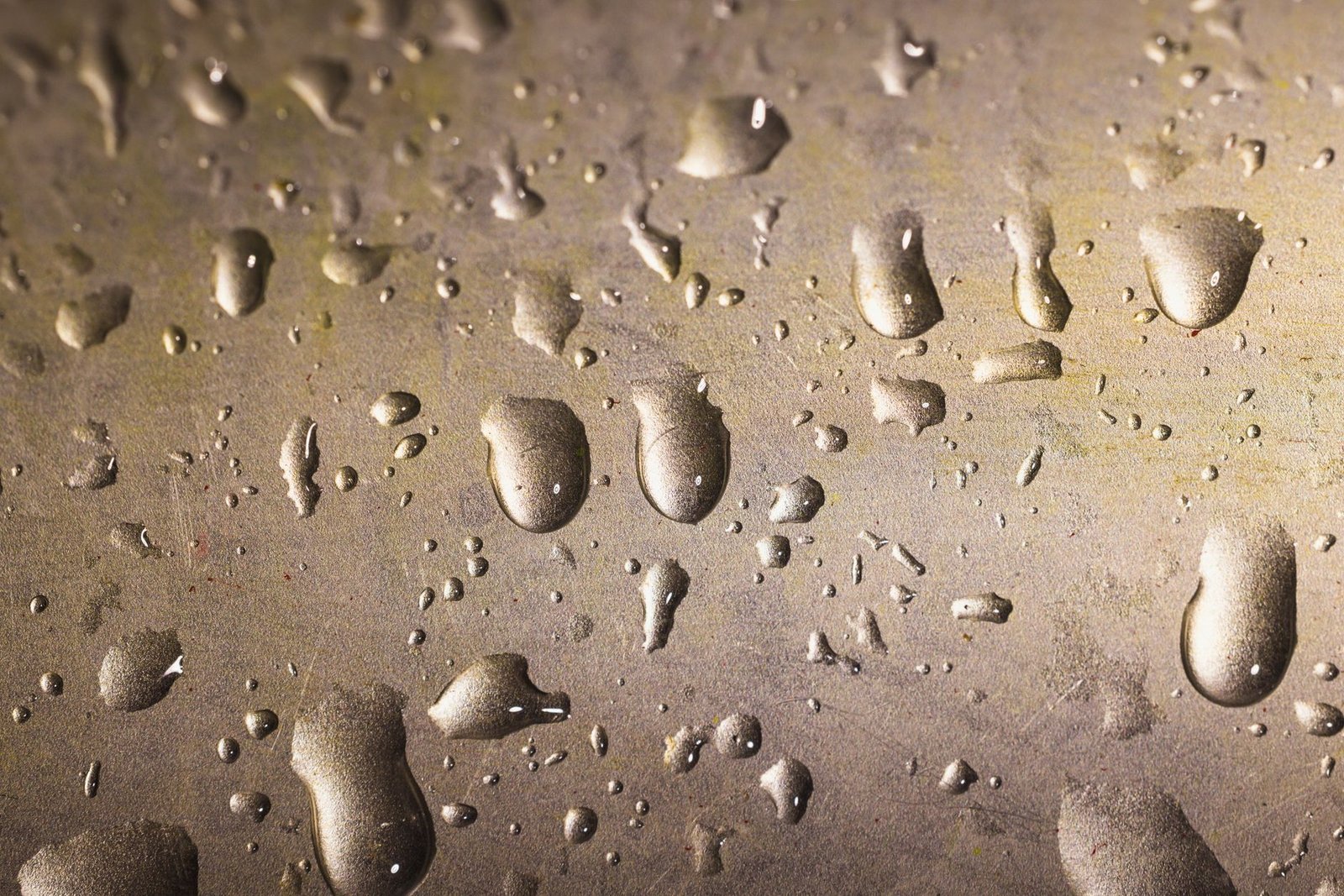
Why cold pipes sweat in the first place
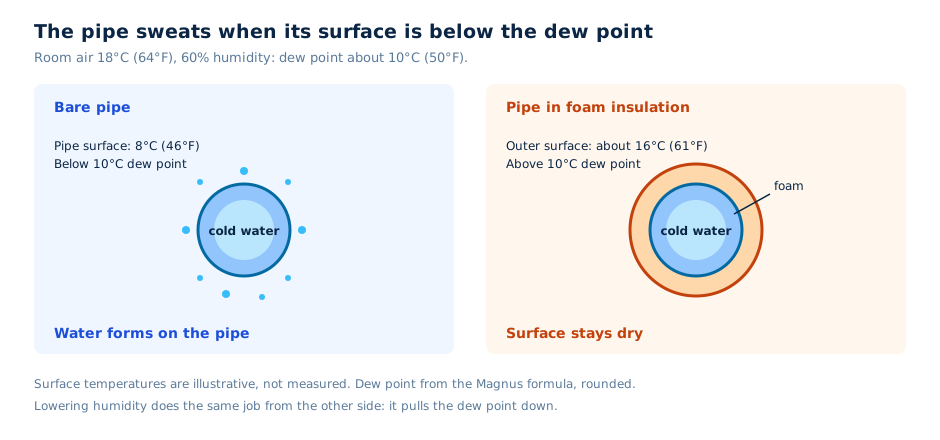
Water in a cold supply pipe keeps the metal well below room temperature. Air that touches that metal gets cooled, and cooled air can hold less vapour, so the surplus turns into droplets. The temperature at which that starts is the dew point, the temperature air has to be cooled to before it is saturated.
Here is a sum of my own, using the standard Magnus formula and rounded, so treat it as a guide. In a basement at 18°C / 64°F, air at 50% relative humidity has a dew point of about 7°C / 45°F. At 60% it is about 10°C / 50°F, and at 70% about 12°C / 54°F. A mains pipe running colder than those figures will sweat; one running warmer will not. I have not measured your pipe, so put a cheap thermometer against it before assuming anything.
That is why the problem is worst in summer and in damp rooms: the water inside is cold and the air outside it is wet.
Where sweating pipes show up most
Anywhere cold metal runs through humid air. In my experience of how these rooms behave, the usual suspects are:
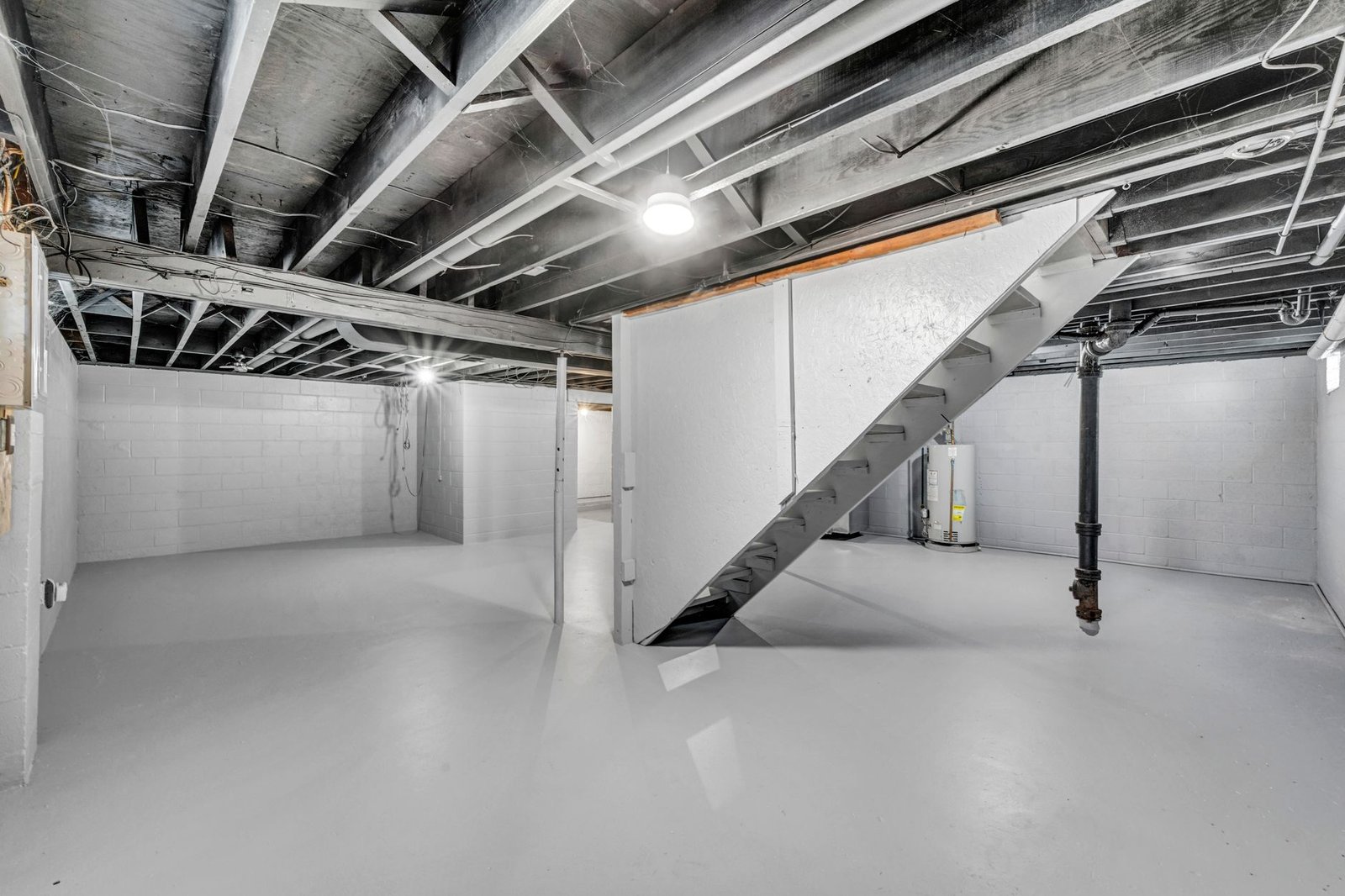
- Basements and cellars, where the air is cool and damp and the incoming mains is often the coldest pipe in the house.
- Behind and under appliances, such as the supply lines to a washing machine or a utility sink.
- Bathrooms and kitchens, where showers and cooking raise humidity several times a day.
- Outside lines and refrigerant lines, which run colder than the surrounding air and sweat for the same reason. Family Handyman notes that HVAC refrigerant lines are prone to it too.
If a basement is the main offender, what humidity a basement should be tells you the number worth aiming for.
Is it condensation or a leak?
Check this first, because the fixes are opposite. Insulating a leaking pipe just hides it.
| Sign | Condensation | Leak |
|---|---|---|
| Where the water is | Spread along the whole pipe | One spot, often a joint or fitting |
| When it happens | Worse on humid, warm days | Constant, whatever the weather |
| Dry the pipe with a cloth | Reappears slowly and evenly | Reappears fast from the same point |
| Water pressure | Normal | May drop at taps or showers |
| Staining | Rarely, apart from rust on old iron | Green or white crust on copper, staining nearby |
The logic of that table matches what Water Safe and Family Handyman both describe: even moisture along the pipe points to condensation, while a localised drip points to a failing joint or pinhole. Wipe the pipe dry, wait ten minutes, and watch where the first bead returns.
If the drip keeps coming from one point, or you can see corrosion at a joint, stop treating it as condensation. Turn off the supply and get the joint repaired by a qualified plumber. Never wrap insulation over a pipe you suspect is leaking.
How to stop condensation on pipes with insulation
Insulation is the standard fix because it needs no power and no ongoing effort. It works by keeping room air off the cold metal, so the outer surface sits near room temperature.
- Dry the pipe completely. Insulation fitted over a wet pipe traps the moisture against the metal, and wet insulation does its job poorly. Fit it to a dry pipe.
- Use a closed-cell foam sleeve that fits the pipe diameter snugly. Slit tubes are the easy kind: open the slit, push it over, and tape or glue the seam.
- Cover everything. Elbows, valves, hangers and the last stretch near a wall are where sweating restarts, because one bare patch is still a cold surface.
- Seal the joins between sleeves so air cannot creep in at the seams.
The EPA’s own guidance is short and clear: cover cold surfaces, such as cold water pipes, with insulation. My opinion, and it is only that, is that lagging should come first for any pipe you can reach, because it fixes the cause at the pipe rather than relying on the air staying dry.
Lower the humidity when wrapping isn’t enough
Some pipes are awkward to lag, and some rooms are simply too wet for even good foam. Then you attack the other side of the equation. Lower humidity lowers the dew point, so the same cold pipe stops being cold enough to sweat.
The EPA suggests keeping indoor humidity below 60%, ideally between 30% and 50%. A basic hygrometer will tell you where you are. Then:
- Run extractor fans during showers and cooking, and let them finish.
- Don’t dry washing in the room with the cold pipes.
- Fix incoming damp at its source before anything else.
- In a basement or cellar, a dehumidifier does this job continuously. Is a dehumidifier worth it in a basement? goes through when it earns its keep, and how to reduce humidity in a cellar covers the non-machine options first.
A dehumidifier does not stop a leaking pipe, and it will not stop a pipe sweating if the room is genuinely open to damp outside air. Fix the water, then the air.
What about replacing the pipe material?
You can, and Family Handyman lists plastic piping (PVC, CPVC or PEX) as a long-term option because it is less prone to condensation than metal. Honestly, it is a renovation decision, not a condensation fix. I would not tear out working copper to cure a few damp beads when a ten-minute foam wrap does the same job.
Wrap the pipe, then check the hygrometer
Condensation on pipes is the same mechanism as condensation on walls and ceilings, just visible on a smaller surface, and the order of fixes is the same: confirm it isn’t a leak, remove the cold-surface problem with insulation, then bring humidity down so it stays fixed. If your pipes are dripping, wrap them and then check the hygrometer. If the number is still high, the pipes were only the first place to tell you.
FAQ
Why are my cold water pipes dripping water?
Almost always condensation: humid air touching a pipe that is colder than its dew point. Wipe the pipe dry and watch. Water returning evenly along the pipe is condensation; water returning from one spot is a leak.
Do hot water pipes sweat?
Rarely, because they are warmer than the air around them. Family Handyman says condensation on hot pipes is less common but can occur in very high humidity. Cold supply and refrigerant lines are the usual problem.
Will pipe insulation stop condensation?
Yes, if it is continuous, tightly sealed and fitted to a dry pipe. Gaps at joints and fittings let moist air reach the cold metal, so the pipe can keep sweating under or beside a partial wrap.
Can condensation on pipes cause mould?
Constant dampness gives mould the moisture it needs on nearby wood, boxes and plasterboard. Fix the water source and dry wet materials quickly; for the timings, see the EPA’s brief guide linked above.
What humidity stops pipes from sweating?
There is no single number, because it depends on how cold the pipe is. The EPA’s general advice is below 60% and ideally 30 to 50%. A colder pipe needs a lower figure.
Is condensation on pipes dangerous?
The water itself is harmless, but it is a sign of high humidity and can drip onto stored items or wood. If a drip never dries and comes from one point, treat it as a leak and have it checked.

