
Last Updated on October 25, 2026 by Umar Farooq
Humidity goes back up after dehumidifier switch-off because the unit only dried the air: the walls, fabrics, carpets and wood still hold moisture, and they release it as the air gets drier, while any leak, damp source or outside air keeps adding more. A small climb is normal. A fast, repeated one points to a source you have not dealt with.
I find this the most misunderstood moment in dehumidifier ownership. The display says 50%, you walk away pleased, and by evening it says 58% and you are convinced the machine is a fraud. It is usually just physics, behaving as it always has.

Why the humidity goes back up after dehumidifier cycles off
Three things are going on at once, and they stack.
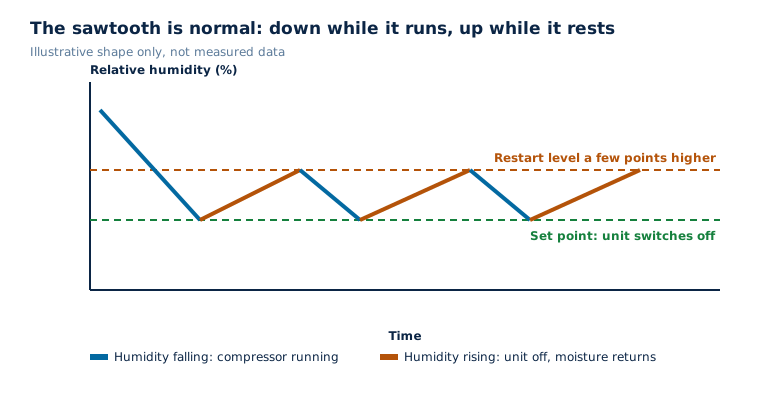
1. The machine is built to stop. A dehumidifier with a humidistat dries the air to your set level and then switches off. GE’s support page puts it plainly: the appliance cycles off when the set humidity level is reached and cycles back on when it detects humidity has increased to 5% greater than the set level. So with a 50% set point, a reading that drifts back to the mid-50s before the compressor restarts is the design working, not failing.
2. The materials are a bigger store than the air. Wood is hygroscopic, which means it gains or loses moisture until it is in equilibrium with the moisture in the air, and Penn State Extension notes that this is a value the wood reaches over a period of time, not instantly. Plasterboard, fabrics and carpet behave in the same general way. My reasoning from that, not a figure I have measured: the air in a room holds very little water compared with everything in it, so when you dry the air quickly, damp materials hand moisture back to it until the two settle at a new balance.
3. Something may still be adding water. Cooking, showers, drying washing indoors, a damp wall or a leak keep supplying the room. GE also notes that humid outside air leaking in through walls, doors and windows can keep a unit running almost constantly.
Normal rebound or a real problem? Read the rate of rise
Do not judge from one glance at the display. Judge from a log. If you do not have one, the humidity logging guide covers how to set it up with a cheap hygrometer. The sensor on the machine itself is a poor witness (my judgement), because it sits in the air the machine has just treated.
Then compare what you see with this table. The readings are my own rules of thumb for interpretation, not published thresholds.
| What the log shows | What it usually means | What to do |
|---|---|---|
| Reading creeps up a few points, then the unit restarts and pulls it back | Normal cycling at the set point | Nothing, or lower the set point |
| Reading rises fastest in the first hour or two after switch-off, then flattens | Materials releasing stored moisture | Run longer at a lower set point |
| Reading climbs steadily for hours with no flattening | A continuing source, or outside air coming in | Find the source, close the room |
| Reading jumps after showers, cooking or washing, then slowly recovers | Daily household moisture | Extract at source, see fix 3 |
| Reading is high even while the unit runs flat out | Unit overwhelmed or hygrometer wrong | Check placement and sizing |
The first question is always the rate, in percentage points per hour. A rebound that flattens is a room settling. A rebound that never flattens is a room being fed.
The EPA’s guide to mould and moisture advises keeping indoor humidity below 60 percent, ideally between 30 and 50 percent, so your log has a target to be judged against. Rising from 48 to 53 is a nuisance. Rising from 55 to 70 is a problem.
Five easy fixes for humidity that keeps coming back
Work down this list. They are ordered by how often I would expect each to be the answer, which is judgement, not a survey.
- Run it to a lower set point for longer. If it stops at 55%, the rebound starts from a number that is already marginal. Drop the set point and let it run until the room has genuinely dried, not just the air. How low is sensible is covered in the dehumidifier settings guide, and the humidistat explainer shows what the control actually does.
- Dry the materials, not just the air. After a leak, spill or flood, the EPA says to dry water-damaged areas and items within 24 to 48 hours. Wet carpet, fabric and plaster will feed a room for far longer than a quick session can remove. Give the machine days of steady running, not an afternoon.
- Find and stop the source. Extract steam from showers and cooking at source, vent the tumble dryer, stop drying washing in the room, and look for a leak or a cold wall that is soaking up condensation. A dehumidifier beside a live water source is bailing a boat that is still taking on water.
- Shut out the outside air. Close the windows and external doors while it runs, and shut the room off if it is the only one you are drying. Open a window for a few minutes first if you need fresh air, then close up. Drying a room with a leak around the frame is dehumidifying the street.
- Keep it on a cycle and let it drain itself. Switching it off at night, or letting the tank fill and trip the float switch, hands the room back to the materials. A continuous drain hose stops the unit shutting down on a full tank, and leaving it on automatic means it restarts the moment the reading climbs.
I would rather see a dehumidifier cycling quietly for a week at a lower set point than blasting for a day and being switched off in triumph. The first dries the house; the second dries the sensor.
A rebound after switch-off is normal, but one that never flattens means a source
If your log shows humidity creeping up a few points and then coming back down when the unit restarts, nothing is wrong. That is the machine doing the job it was built for, and the room’s walls and wood slowly settling to the new level.
If it climbs steadily without flattening, or keeps returning to the same high number within hours of every cycle, stop adjusting the dehumidifier. Look for the water: a leak, a wet wall, unvented moisture or outside air. Fix that and the machine will finally have something it can beat. And if you are still wondering how long it should run each day, the run-time guide has the numbers.
FAQ
Why does humidity go up when my dehumidifier turns off?
Because the unit only dried the air. Walls, fabrics and wood release stored moisture as the air gets drier, and any source in the room keeps adding more, so relative humidity drifts up while the compressor rests. It is the same effect as a radiator cooling when the thermostat switches off the heating.
Is it normal for humidity to rise again after a dehumidifier stops?
Yes, within a few points. GE describes the unit restarting when humidity has risen about 5% above the set level. A reading that climbs well beyond that, or never flattens, is worth investigating.
How much should humidity rise after a dehumidifier turns off?
There is no published figure, so I will not invent one. Use your own log: a rise that flattens and is pulled back by the next cycle is normal, while a steady rise that never levels off is not, in my judgement.
Should I leave a dehumidifier on all the time?
On automatic, yes, in a damp room, because it only runs when the reading is above the set point. Switching it off and on by hand is what lets the room rebound unchecked.
Why is my dehumidifier running but the humidity will not go down?
Usually moisture is arriving as fast as it is removed: an open window, a continuing source, damp materials, or a unit that is too small or too cold to perform. The log tells you which.

