
Last Updated on October 25, 2026 by Umar Farooq
How to size an extractor fan: pick the minimum extract rate for the room in litres a second (15 for a bathroom, 30 or 60 for a kitchen), check it against the room volume, then choose a fan rated comfortably above that, because ducts and bends take some of the airflow back. Duct diameter is a detail; airflow is the number that matters.
Most shopping advice starts with the diameter of the hole, which is a bit like choosing a kettle by the size of its plug. The hole matters, but only after you know how much air the room needs moving.
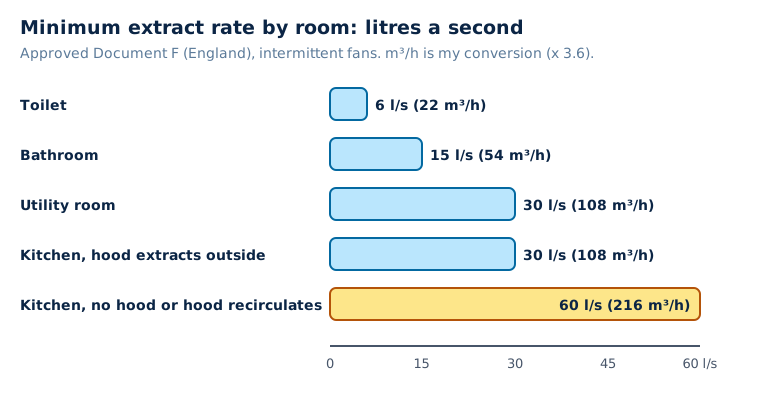
How to size an extractor fan, step 1: find the minimum rate for your room
England’s ventilation guidance, Approved Document F, gives minimum intermittent extract rates in litres a second:
| Room | Minimum intermittent extract (l/s) | The same in m³/h (my conversion) |
|---|---|---|
| Bathroom | 15 | 54 |
| Kitchen, cooker hood extracting outside | 30 | 108 |
| Kitchen, no hood or hood not extracting outside | 60 | 216 |
| Utility room | 30 | 108 |
| Toilet (sanitary accommodation) | 6 | 22 |
To convert litres a second to cubic metres an hour, multiply by 3.6. These are minimums for building work, not a promise that the minimum is enough for a family that showers twice in a row.
Step 2: check it against the room’s volume
Volume is length × width × height in metres. A bathroom 2.4 m long, 2 m wide and 2.4 m high is about 11.5 m³. At 54 m³/h, the 15 l/s minimum changes that air about 4.7 times an hour. That is my arithmetic, and it shows the minimum is fairly generous in a small room.
It matters more in a bigger one. A 3 m × 2.5 m × 2.4 m bathroom is 18 m³, and 54 m³/h is 3 air changes an hour. For a room with no outside wall, Approved Document F says the intermittent fan should extract at four air changes per hour. For that 18 m³ room, four changes an hour is 72 m³/h, which is 20 l/s, more than the 15 l/s minimum. For an internal room, the larger of the two numbers is the one to use.
Air changes per hour in a house explains where that unit comes from and what typical homes have.
Step 3: allow for the duct
A fan’s printed airflow is what it moves in free air. Put it on a duct with bends and a cap and it moves less. The Building America bathroom fan guide says installed airflow can fall below the factory rating because of duct length, bends and terminations, so choose a fan rated above the required amount. Its example: for an intermittent rate of at least 50 cfm, ENERGY STAR recommends a fan rated at least 70 cfm, which is a margin of 40 per cent. That is a US recommendation in US units, so use it as the idea (rate it above the target), not as a rule for UK fans.
Practical consequences:
- Keep the duct short and straight. The Building America guide advises smooth rigid duct and a straight first run; its kitchen guide says to use the diameter the fan manufacturer specifies.
- Do not squeeze a 100 mm fan on to a smaller duct to save a hole in the wall. You lose airflow where you cannot afford to.
- Leave a way in for replacement air, usually the undercut of the door. Approved Document F expects internal doors to allow a minimum free area equivalent to a 10 mm undercut.
Step 4: check position, noise and venting
Size is wasted if the fan is in the wrong place or ends in the wrong place. Approved Document F says fans should be installed as high as practicable and no more than 400 mm below the ceiling. And the duct must go outside: do extractor fans need to vent outside covers that.
Noise counts too. The Building America guide gives ENERGY STAR’s limits of 3 sones or less for intermittent fans and 1 sone or less for continuous ones. A fan so noisy that you stop using it removes nothing.
Sizing a kitchen extractor is a bigger job
Kitchens move more steam and heat, so the numbers are higher. Approved Document F gives 30 l/s for a hood that extracts outside and 60 l/s where it does not. The Building America kitchen exhaust guide gives ENERGY STAR’s figure of 150 to 200 cfm for intermittent operation, and says fans over 400 cfm need makeup air. Those are US figures, shown for scale only. If you are fitting a UK hood, the Part F figure and the maker’s instructions are what to work from. Do I need an extractor fan in my kitchen covers the other options.
Bigger is not always better, and “the right size” is not the same as “enough”
A bigger fan removes steam faster and can run for less time, but costs more to buy, can be louder, and pulls more air through the house. A fan that is correctly sized and clean, with an outside duct, will do the job in a normal bathroom. If it is still not clearing the steam, check the duct and the run time first: how long to run a bathroom extractor fan.
What size extractor fan do I need? The short route
Take the room’s minimum from the table, use the larger of that and four air changes an hour if it has no external wall, then choose a fan rated well above it. Fit it with a short, outside-venting duct. And if you are not sure, ask the electrician or installer for the airflow rating in litres a second, not just the duct diameter.
FAQ
What size extractor fan do I need for a bathroom?
The minimum intermittent rate in England’s Approved Document F is 15 litres a second, about 54 m³ an hour. Choose a fan rated above that, and more if the room is large, has no outside wall, or the duct is long.
How do you calculate extractor fan size?
Work out the room volume in cubic metres, multiply by the air changes per hour you want to get cubic metres an hour, and divide by 3.6 for litres a second. Then compare it with the minimum for the room.
How many air changes per hour does a bathroom need?
Approved Document F sets a flat 15 l/s for a bathroom, and four air changes per hour for a wet room with no external walls. In a small bathroom the 15 l/s works out at about four or five changes an hour.
Does duct length affect extractor fan size?
Yes. Installed airflow can fall below the rated figure because of duct length, bends and terminations, so choose a fan rated above what the room needs.
What size extractor fan do I need for a kitchen?
At least 30 litres a second for a cooker hood that extracts outside, and 60 l/s where there is no hood or it does not extract outside, under Approved Document F. Check the hood’s own rating and instructions.

