
Last Updated on October 26, 2026 by Umar Farooq
How to dry a damp mattress: strip it, blot out what you can, stand it on its edge with at least 60 cm (2 ft) clear on both faces, and keep air moving across it until it is dry right through. Surface dry is not the target. A mattress that feels fine on top and is still damp in the middle is how a one-night problem becomes a permanent smell.
The temptation is to get the hairdryer out and rush it. I would resist that, for reasons below. Patience and airflow beat heat for a thick pad of foam and fibre.

Decide first whether the mattress is worth drying
Not every wet mattress should be saved, and it is better to know before you spend two days on it. Hunker’s guide says a mattress that was rained on, or soaked by a spill or a burst pipe, is probably safe to dry, but one covered in sewage or flood water has to go. It also says to discard one that has stayed saturated for longer than 48 hours, or that already shows mould.
That 48-hour figure fits with the EPA’s mould cleanup guidance, which says wet items should be dried within 24 to 48 hours and that absorbent or porous materials may have to be thrown away if they become mouldy, because the mould can fill the spaces in them and be difficult or impossible to remove. A mattress is about as porous as household items get.
| What made it damp | Worth drying? |
|---|---|
| Spill, sweat, a damp patch from a cold wall | Yes, start now |
| Rain through a window or a leak you have fixed | Yes, if it has not sat wet for more than about 48 hours |
| Sewage or flood water | No: replace it |
| Visible mould or a smell that is not shifting | Probably not: see the last sections |
How to dry a damp mattress in five steps
- Strip it. Remove the sheets, protector and topper, and wash or dry those separately.
- Blot, do not rub. Press clean dry towels firmly onto the damp area and swap them as they soak. Rubbing pushes moisture deeper.
- Extract if you can. A wet-dry vacuum pulls water out of the filling, but check the care label first, as some mattresses do not tolerate suction.
- Sprinkle on baking soda for a few hours over any patches that are still damp, then vacuum it off. It takes up a little moisture and odour; it does not dry the mattress, so do not mistake it for the fix.
- Stand it up and give it air (next section) until it is dry all the way through.
Dry it with a fan and a dehumidifier, not a hairdryer
Stand the mattress on its long edge, on a clean sheet if the floor is dirty, with space all round it. Hunker’s guide suggests at least 2 feet from other objects so more surface is exposed to air. Prop it against a wall only if there is a gap behind, or you have dried one face and left the other wet.
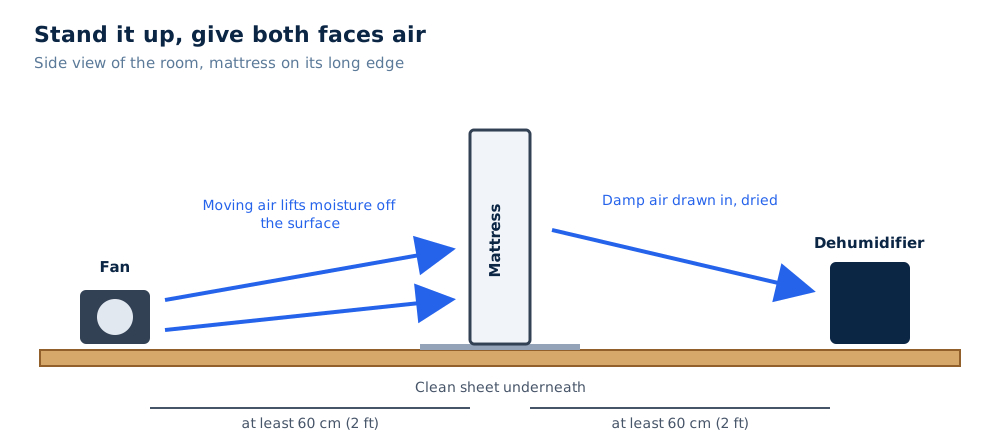
Point a fan at it and run a dehumidifier in the room with the door shut. The fan moves moisture off the surface; the dehumidifier removes it from the air, so the surface can keep releasing more. Without the dehumidifier you are just moving damp air around a closed room. If you do not own one, how to dry bedding indoors covers the same principle with a window open instead.
Hunker also suggests using a hairdryer on the damp patches for 10 to 20 minutes at a time. Other mattress guides say to avoid direct heat. My view: heat can make the top layer feel dry while the core stays damp, and it can damage foam. Slow airflow costs you nothing but time. If you do use heat, keep it low and check the middle, not the surface.
A dry, breezy day outside is the best drying room of all, if you can get the mattress out and it will not be rained on. Bring it in before evening, when the air gets damper.
How to tell the mattress is dry all the way through
There is no gadget I would trust for this, and I have not measured drying times: they depend on mattress thickness, how wet it was, and the room. In practice:
- Press a clean dry towel hard onto the area for a minute. Any cool or damp patch on the towel means it is not finished.
- Check the edges and the underside, which dry last.
- Smell it. A faint damp smell that fades as it dries is normal. One that gets stronger is a warning.
- Wait a day more than feels necessary before the sheets go back on. Dressing a still-damp mattress traps the moisture again.
Keep the room’s humidity in check while you do it. The EPA advises keeping indoor relative humidity below 60 per cent, ideally between 30 and 50 per cent, and how to reduce humidity in a bedroom explains how.
When drying has not worked
If you see black, green or white spots, or the smell is returning after a thorough dry, stop trying to rescue it. Mould inside a porous mattress is not something a surface spray will fix, and the EPA says porous materials may have to be thrown away. How to stop mould on a mattress covers what is worth trying on light surface spots, and when to bin it.
If you or anyone sleeping on it has breathing problems or allergies, ask a doctor, not a cleaning guide, whether to keep using it.
Stop it getting damp again
Most damp mattresses are not spills. They are mattresses with nowhere to dry: a solid base, a bed pushed against a cold outside wall, or a non-breathable protector. Lift it and air it on its side occasionally, and keep the bed a few centimetres off the wall. Mould in the bedroom explains what keeps a bedroom damp.
A damp mattress dries with airflow and time, and is replaced if it stays wet or mouldy
To sum up how to dry a damp mattress: strip it, blot it, stand it up, run a fan and a dehumidifier, and be patient. If it has been wet for more than two days, was soaked by flood water, or has mould, replace it instead.
FAQ
How long does it take a damp mattress to dry?
It depends on how wet it is, its thickness and the room, and I have not measured it, so I will not give a number. A lightly damp one may dry in a day or so with good airflow; a badly soaked one takes longer and may not be worth saving.
Can you dry a mattress with a hairdryer?
Some guides recommend it on a low setting for short periods and others warn against it. It can dry the surface while the core stays wet and can damage foam, so I prefer a fan and a dehumidifier.
Can I sleep on a damp mattress?
I would not. A damp mattress stays damp under bedding and is the setting for mould, so dry it fully first. If someone in the house has health concerns, speak to a doctor.
Does baking soda dry a mattress?
It absorbs some moisture and odour from the surface, but it will not dry a mattress on its own. Use it after blotting, then vacuum it off.
Can a dehumidifier dry a mattress?
It helps, because it removes the moisture the mattress releases into the room. It works best together with a fan moving air across the mattress, in a room with the door closed.

