
Last Updated on October 25, 2026 by Umar Farooq
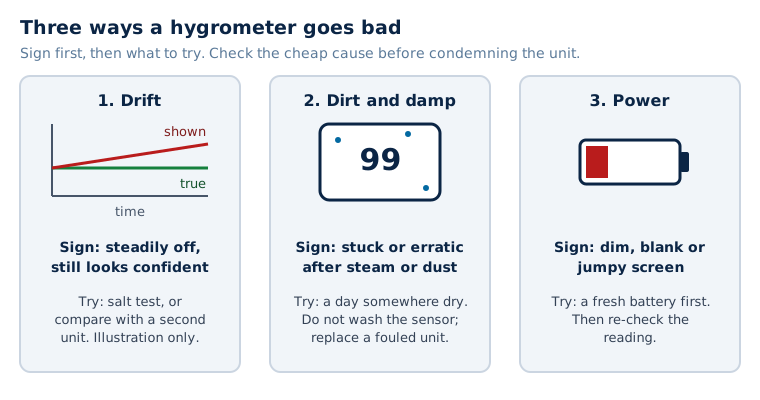
Do hygrometers go bad? Yes, though usually quietly: they drift out of true, the sensor gets fouled, or the power fades, and the display carries on looking confident. A sudden, obvious failure is the rare case.
That is the awkward part. A dead thermometer is obviously dead. A hygrometer that has drifted eight points still shows a tidy number with a decimal place, which is a bit like a clock that is always eight minutes fast and thoroughly pleased with itself.
Do hygrometers go bad, or just drift?
Mostly drift. The National Physical Laboratory’s Beginner’s Guide to Humidity Measurement says hygrometers can suffer from bias and long-term drift, due to conditions of use or just sensor ageing, and that relative humidity instruments might be calibrated every 6 to 12 months, or more often if harshly treated. It adds that modern electronic sensors have increasingly long lifespans if treated well, and that older ones may suffer from drift and slowed response.
Notice what that is not: a lifespan in years. NPL gives none for a household unit, and neither will I, because I have not found a source for one and I have not tested a batch. How fast yours drifts depends on the sensor and on what you put it through. The size of the error and what it means for a damp house is covered in how accurate hygrometers are.
Dirt, droplets and steam shorten the life
The same NPL guide lists what to watch out for: droplets or stray water, and dust for most instrument types. Condensation is on its list of things not to expose sensors to unless they are known to tolerate it. A cheap unit on a bathroom windowsill, or one sitting in a cellar that regularly runs wet, is doing exactly what the guide advises against.
Delmhorst, a maker of moisture instruments, makes a similar point in its guide to the worst things to do with a thermo-hygrometer: leaving the device exposed to airborne pollutants for long periods can cause drift, and a contaminated sensor element should be replaced. It advises against cleaning one, because water, soap and bleach can damage the element. I have no reason to doubt that, and it matches common sense: do not squirt anything at the sensor.
The battery problem that looks like a broken sensor
Digital units run on a battery, and Delmhorst notes accuracy can depend on whether the battery is sufficiently charged. A tired cell can produce a blank screen, a flicker or odd numbers, none of which means the sensor has failed. Change the battery before you condemn the unit; do hygrometers need batteries covers which types do, and which do not.
Four signs yours has gone bad
None of these is a lab test. They are what I would check first.
- The reading never moves. A room’s humidity changes across a day. A figure frozen at the same number through a shower, a boil and a night is suspect.
- It disagrees with a second unit by a lot. A few points is normal; ten is not. That ten is my judgement, not a published limit. Why two hygrometers show different readings helps you tell tolerance from a fault.
- It fails the salt check. The classic home check is a sealed container with damp salt, which should settle the unit at a known value; see how to calibrate a hygrometer.
- A dial needle is stuck or lazy. A mechanical needle that does not move at all across days is broken, not calibrated.
Do not read a reading of 99, or a sudden jump after the unit has been in steamy air, as proof of failure. NPL says droplets or stray water can make a reading misleading, and that a hygrometer exposed to extreme conditions should be checked, so I would give it a day somewhere ordinary before deciding.
Repair, recalibrate or replace?
Match the response to the symptom:
- Flat battery: replace the battery. Cost: pennies.
- Slightly off, adjustable: adjust against a reference. Dials often have a screw; many digital units do not.
- Off and not adjustable, or fouled by damp and dust: replace it. Delmhorst’s advice for a contaminated element is replacement, and a basic home hygrometer costs less than the time spent nursing it.
The one exception is a unit you rely on for something that matters, such as a collection of books or instruments. Then NPL’s check-every-6-to-12-months guidance is worth borrowing.
Treat it as a cheap instrument that needs a yearly argument
So, do hygrometers go bad? They do, gradually. Buy a second one, keep both away from steam and condensation, and compare them once a year. When they disagree by more than you can explain, test one with salt or replace the older one. A hygrometer you cannot trust is worse than none, because it gives you a number to believe.
FAQ
How long do hygrometers last?
No source I found gives a lifespan for household units. NPL says modern electronic sensors have increasingly long lifespans if treated well, and that age can bring drift and slower response. Plan on checking yearly and replacing when it disagrees with a reference.
How do I know if my hygrometer is broken?
Look for a reading that never changes, a large disagreement with a second unit, a failed salt check or a stuck needle. Replace the battery first, since a weak battery can mimic a fault.
Can a hygrometer be fixed?
Sometimes. A flat battery is an easy fix and a dial may be adjustable, but a fouled or heavily drifted sensor is usually cheaper to replace than to repair.
Do hygrometers wear out faster in damp rooms?
Possibly. NPL lists droplets, dust and condensation among things that cause trouble for hygrometers, so a unit in constant steam or condensation is at more risk than one on a dry shelf.
Should I clean a hygrometer sensor?
Delmhorst advises against it, saying water, soap and bleach can damage the sensor element. Keep the unit clean and dry instead of treating it once it is fouled.

