
Last Updated on October 24, 2026 by Umar Farooq
The dehumidifier plug reset button belongs to a built-in safety device in the plug: if it has popped out, unplug the unit, plug it back in, press RESET, and use TEST to confirm the plug still cuts the power. If it will not stay in, or trips again straight away, that is the plug doing its job, and the unit should stop being used.
Most people meet this plug at the worst moment, when a dehumidifier that worked yesterday is dead and the only clue is a small grey box on the cord with two buttons on it. It looks like a fault. Usually it is the opposite: a protective device that has noticed something and switched off.
What the box on the cord actually is
On many dehumidifiers sold in North America the plug is a chunky moulded block with a TEST button and a RESET button, and often a small light. LG’s dehumidifier manual calls it an LCDI plug and says a lit green light means the unit is working properly, as LG’s owner’s manual puts it.
LCDI stands for Leakage Current Detection Interrupter. In plain terms it watches the cord for current escaping where it should not, and cuts the supply if it sees any. An AFCI-type plug does a similar job for arcing faults. They are not the same thing as the shock-protection socket (GFCI) in a bathroom, though the buttons look alike.
Do dehumidifiers have to have one? I can only say what I opened. Intertek’s public notice on the appliance standard says the clause requiring a current protector in the attachment plug names room air conditioners, room heat pumps and similar units, and allows either an LCDI or an AFCI (Intertek notice, 2024). The same standard covers dehumidifiers, and plenty of them ship with the plug, but whether yours must have one is a question for your manual, not for me.
The UK and Europe are different. I did not find an equivalent LCDI plug in the manuals I opened, so I will not describe one. What you do see are plug-in RCD adaptors, which are separate accessories rather than part of the cord. They have their own TEST and RESET buttons and work in much the same way, and one maker’s instructions are quoted below.
Why the plug trips
A trip means the plug detected something and opened the circuit. I can’t tell you which from the outside, but the realistic causes are short:
- A damaged cord. Crushed under a door, chewed, nicked on a sharp edge, or kinked at the plug.
- Moisture on the cord or plug. A dehumidifier lives in damp places, and water on a cord is exactly what leakage protection exists to catch.
- A genuine fault inside the appliance. This is the one you cannot fix by pressing anything.
- A power cut or a brownout. Many plugs drop out when the supply is interrupted and need resetting afterwards. That is normal, not a fault.
- A loose plug. A plug that is not seated firmly can lose contact and look like a trip.
A one-off after a power cut is nothing. A trip that arrives for no reason is worth taking seriously.
How to reset the plug correctly (4 steps)
Check the cord and plug before you press anything. If the cord is cracked, cut, scorched, or the plug is warm, wet or smells of burning, do not reset it and do not use the unit. Never open the plug, and never tape or hold the button down to force it to stay in.
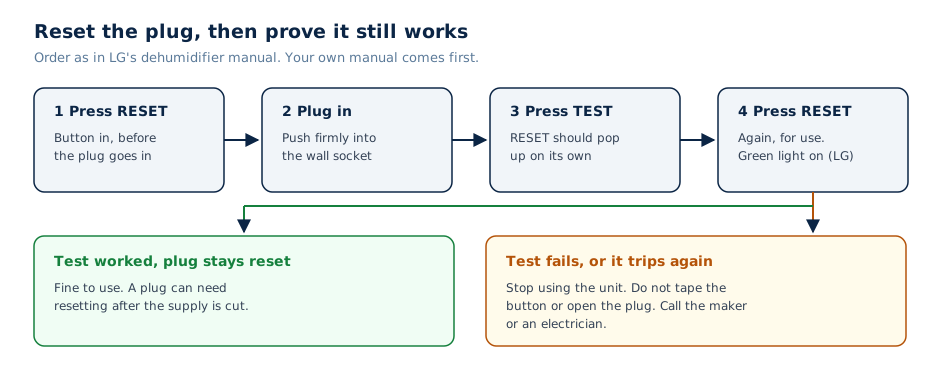
Follow your own manual first, because the order differs between brands. LG’s manual gives this test sequence, with the instruction to test before each use, quoted from the LG owner’s manual:
- Press the RESET button.
- Plug the plug into the wall socket.
- Press TEST. The RESET button should pop up.
- Press RESET again for use.
The same manual states “do not use if above test fails”. Other manufacturers describe a shorter version: unplug, plug back in, press RESET until it clicks or the light comes on. If your manual says that, follow your manual.
Why you should press TEST and not skip it
TEST is not a decoration. It deliberately creates the kind of fault the plug is meant to catch, so you learn whether the protection still works before you trust it overnight in an empty room.
Two results matter. If you press TEST and RESET pops out, the plug is working. If you press TEST and nothing happens, the unit keeps running or the button stays in, and the protection has failed. In that case do not use the unit. LG’s manual is just as direct: “do not use if above test fails”.
UK plug-in RCD adaptors follow the same logic. One maker’s instructions (an RCD plug sold through the trade) say you press RESET so the indicator turns red, press TEST so it turns clear, and “if RED does not appear, DO NOT USE” (RCD plug instructions).
When it keeps tripping, stop
Here is my one firm opinion, and I do not think it is controversial: a plug that trips repeatedly is telling you the truth, and the answer is never to defeat it. Do not tape the button. Do not wedge it. Do not swap in a plain plug. Do not open the plug to look.
The same RCD instructions are blunt about this. They say that if the adaptor trips straight away, unplug it and have the appliance checked by a qualified electrician for an earth leakage fault, and that an adaptor which repeatedly trips with an appliance connected, or fails to trip when tested, needs a qualified electrician’s advice (RCD plug instructions).
For a dehumidifier, that sensibly means:
- Unplug it and keep it out of use.
- Dry the cord and the area if anything is wet, and look for damage you can see without opening anything.
- Check the manual or the maker’s support line, especially if the unit is under warranty.
- If it trips again with a dry, undamaged cord, call an electrician or replace the unit. A dehumidifier is not worth running with its protection switched off.
The cheap, boring checks (a different outlet, a tripped breaker, a full bucket) are in what to check when a dehumidifier will not turn on. I have not repeated them here because a tripped plug is a different problem. If you suspect the cord is the issue, why you should not use an extension cord with a dehumidifier covers the one thing that makes it worse. If the unit keeps stopping with the plug intact, the cause is probably elsewhere: see why a dehumidifier keeps shutting off. If it is the house breaker that goes rather than the plug, that is a dehumidifier tripping the breaker. A hot or burning smell at the plug is its own problem, covered in dehumidifier burning smell.
The dehumidifier plug reset button is a safety device, not a nuisance
The reset button is the visible end of a safety system: it cuts the power when it detects a problem, and it needs a person to decide whether to restore it. Reset it once, test it, and use it if it passes. If it trips again, if TEST does nothing, or if the cord is damaged, stop and get it looked at.
FAQ
Where is the reset button on a dehumidifier?
On many US-style dehumidifiers it is on the plug itself, a small RESET button next to a TEST button on the moulded block on the power cord. Others have no reset button at all, only the plug, so look at the plug end of the cord before you look at the unit.
Why does my dehumidifier plug keep tripping?
Common causes are a damaged or damp cord, a loose plug, a power cut, or a real fault in the appliance. If it trips again after you have dried the cord and checked it for damage, stop using the unit and have it looked at.
Is it safe to keep pressing reset?
Once is fine after you have checked the cord. Pressing it again and again is not: a repeat trip means something real is being detected. Never tape, hold or bypass the button.
What does the TEST button do on a dehumidifier plug?
It simulates a fault so you can confirm the protection still works. After you press it, the RESET button should pop out or the light should go off, depending on the model. If nothing happens, do not use the unit.
Can I replace a dehumidifier plug with a normal one?
I would not. The protection is part of the cord’s design, and swapping it out removes the very thing that caught the problem. If the cord or plug is damaged, contact the manufacturer or a qualified electrician.

