
Last Updated on October 25, 2026 by Umar Farooq
Can extractor fans get blocked? Yes, and in five different places: the grille and filter, the blades, a kinked duct, dust or grease inside the duct, and the flap on the outside wall. A fan can spin happily and move almost nothing if any one of them is choked.
Most people check the first one, if they check at all. The one that actually stops the air is often the last, on the outside wall, where nobody has looked for years.

Can extractor fans get blocked? Five places, in the order the air meets them
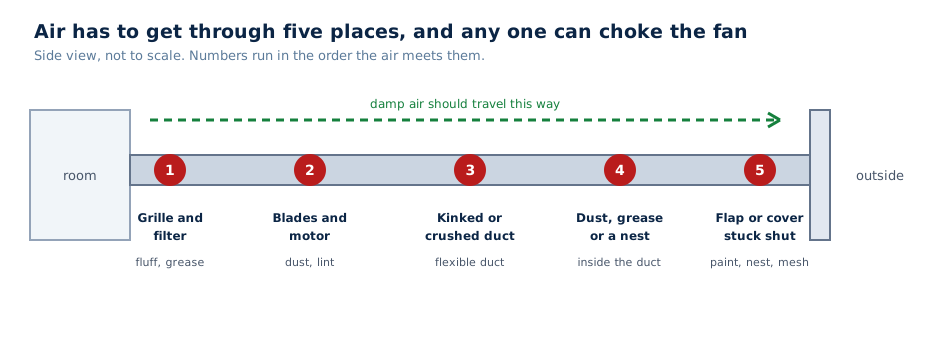
- Grille and filter. In bathrooms it is fluff and dust. In kitchens it is grease on the filter, which cuts the airflow and makes the motor work harder.
- Blades and motor housing. Dust, grease and lint build up on the blades until they are unbalanced or too heavy to spin freely. Electrical Safety First says dust and grime can clog the air intake or stop the blades turning.
- A kinked or crushed duct. Flexible duct gets squashed in a loft, trodden on, or folded round a joist. Smooth rigid duct with few bends is better, as the Pacific Northwest National Laboratory’s Building America guide says, and it asks for the first stretch of duct from the fan to be straight.
- Dust, grease or a nest inside the duct. A long run collects dust over the years, and the outlet end is a tempting spot for a bird or wasp to build in. Water can pool and make it worse; see why a fan drips water.
- The flap or cover on the outside wall. Paint, cobwebs, a nest or a bent hinge can hold it shut. If you are unsure how it should behave, what the flap vent is for explains how it should behave.
Signs your extractor fan is blocked
Electrical Safety First says a blocked fan overheats, which triggers its back-up thermal cut-out, and that it also uses more power and gets noisier. In everyday terms:
- Steam hangs around after the fan has run for a normal time. The airflow side of this is covered in why a fan can run and still leave the steam.
- The fan sounds different: a roar, a rattle, or a hum with slow blades.
- The fan cuts out and restarts after a pause, which can be the thermal cut-out.
- A tissue test. Hold a single sheet of toilet tissue against the grille with the fan running. It should stay put. If it flutters or drops, air is not being pulled through. This is a crude test of mine, not a measurement, but it is useful for comparing before and after a clean.
Safety first, then clearing it
Switch the fan off at the isolator or the consumer unit before you remove any cover. A fan can start without warning, and bathroom fans sit close to water. Do not spray water onto the motor. If there is a burning smell, buzzing or crackling, stop and call a registered electrician instead, as East Sussex Fire and Rescue advises.
With the power off:
- Take off the cover and clean the filter or grille. A vacuum with a brush head, or a damp cloth, is enough for dust. For grease, follow the maker’s cleaning instructions.
- Wipe the blades and housing, supporting the blades so you do not bend them.
- Look into the duct with a torch. Pull out what you can reach, and straighten any kinks.
- Go outside and check the cover. Free the flap, clear the nest, remove any paint bridging the hinge.
- Test it with the power back on, using the tissue test again.
If the duct is long, hidden or full of debris, or if the motor still hums without turning, leave it to a ventilation installer or electrician.
Stop it blocking again
Clean the visible parts of the fan on a regular schedule following the maker’s instructions, and listen for changes. Replace long runs of flexible duct with rigid duct where you can. Fit mesh or a better flap on the outside if birds or insects are a problem, but not so fine that it clogs. None of this takes long, and it is a lot cheaper than a new fan.
A blocked extractor fan still looks like it works, so judge it by air, not by spin
An extractor fan that is blocked has not failed. It just stops doing its job while looking busy. Check all five places, start with the outside flap, and treat noise, slow blades or a burning smell as a reason to stop and call someone.
FAQ
What happens if an extractor fan is blocked?
It moves less air, gets noisier and runs hotter. Electrical Safety First says a blocked fan overheats, which triggers the back-up thermal cut-out, and the fire services say neglected or blocked fans can become a fire risk.
How do I know if my extractor fan is blocked?
Steam hangs around, the fan sounds different, or the blades turn slowly. A simple check is to hold a sheet of tissue to the grille with the fan running. If it does not hold, check the filter, blades, duct and outside cover.
Can birds or insects block an extractor fan?
Yes. The outside end of the duct is attractive to nesting birds and insects, especially if the flap is broken or missing. A cover that closes properly and a duct that is checked now and then are the cure.
Can I clean a blocked extractor fan myself?
You can clean the visible parts (cover, filter, blades) with the power off. Anything involving wiring, or a duct you cannot reach, should go to a registered electrician or ventilation installer.
How often should an extractor fan be cleaned?
There is no universal figure. Electrical Safety First says to clean it regularly following the maker’s instructions, so check the manual for your model and clean sooner in a kitchen or a dusty room.

