
Last Updated on October 24, 2026 by Umar Farooq
A bathroom extractor fan not removing steam is almost always moving too little air, not broken: the usual causes are no replacement air under the door, a dusty grille or impeller, a blocked or badly routed duct, a fan that is too small, or a timer that stops too soon. A fan that is audibly running can still be doing very little, which is the annoying part.
The motor is rarely the problem. The fault is usually somewhere along the path the air has to take.
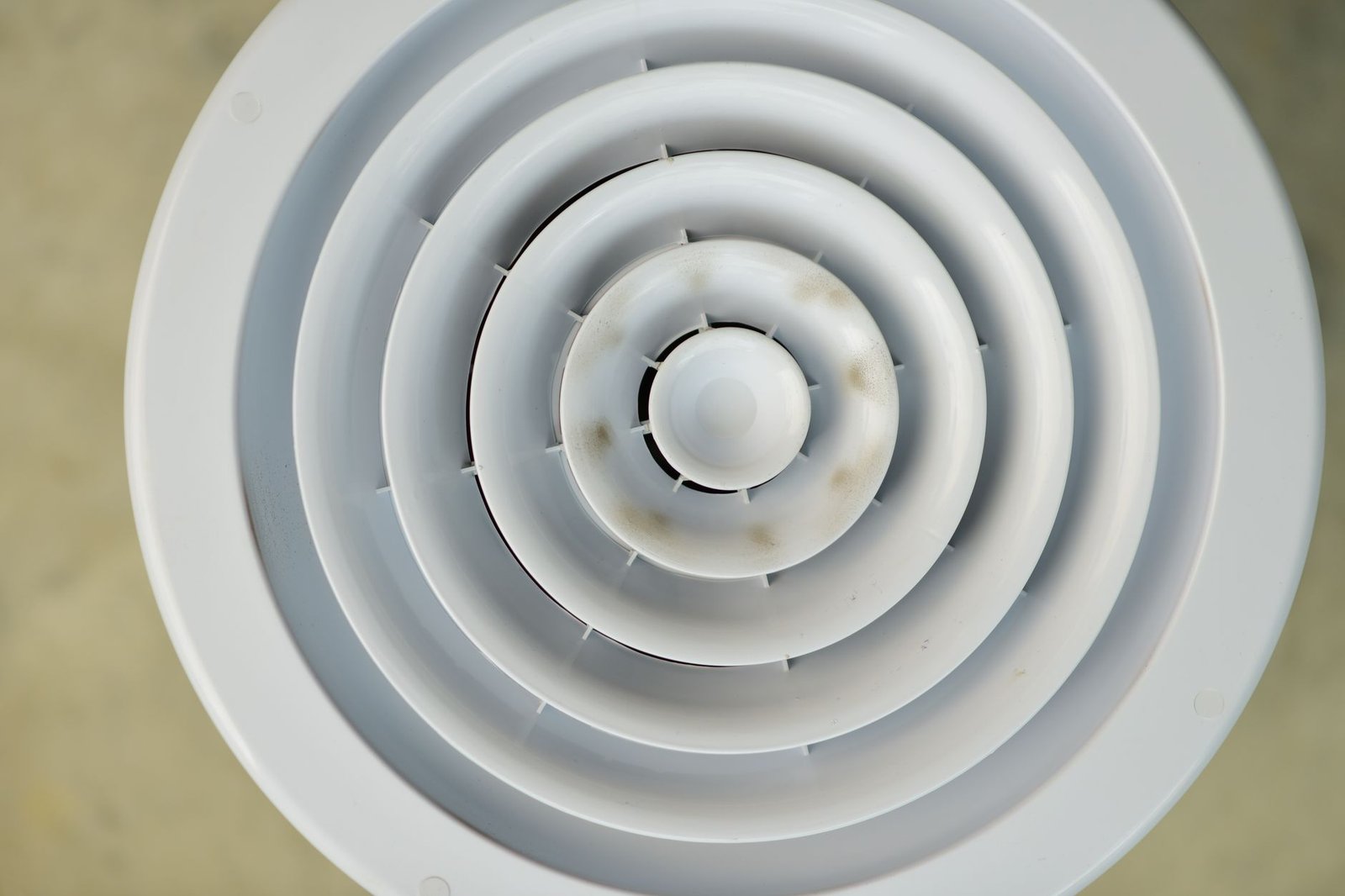
Bathroom extractor fan not removing steam? Check the air coming in first
A fan can only push air out if air can get in. Seal the room and the fan is trying to pull a vacuum, so it moves a trickle however good it is. This is the most overlooked cause, and the cheapest to fix.
England’s Approved Document F, the statutory ventilation guidance, expects internal doors to provide a free area equal to a 10 mm undercut on a 760 mm door (paragraph 1.25), so that air can flow through the house. That is new-work guidance for England, and I have not found a figure in it written specifically for bathroom doors. The installer blogs that came up when I searched quote a 12 mm gap, with no source given. Treat 10 to 12 mm as the ballpark and not as a measured limit.
Thick new carpet, a new door lining or a draught strip can all close that gap unnoticed. The test is free:
- Run the fan with the door shut.
- Put your hand at the bottom of the door. You should feel air moving in.
- If you feel nothing, and the door drags on the floor or has a strip fitted, that is your problem.
One caution that I will be blunt about: do not fix this by leaving the door open during a shower. The steam then leaves with the fan’s help and travels to the landing and bedroom instead, which is how a bathroom problem becomes a house problem. I covered the trade-off in how long to run a bathroom extractor fan.
A fan can spin and still move almost no air
Switch the fan off at the wall isolator or consumer unit before you take a grille off or put a hand near the fan. It is mains-wired in a wet room. If you are not sure the power is off, stop.
Dust, hair and lint build up on the grille and on the impeller (the little fan wheel), and a furry impeller moves far less air than a clean one. Bathrooms are worse than most rooms because the dust gets damp and sticks.
The quickest check that needs no equipment comes from the US Department of Energy’s Building America Solution Center page on bathroom fans, where a training image caption says a bathroom fan should have enough suction to hold a tissue. So:
- Turn the fan on and hold a square of toilet paper flat against the grille.
- If it clings, the fan has suction. If it flutters off or only sticks at one edge, airflow is weak.
- If it holds at the grille but the room is still wet, the problem is further down the line: look at the duct, the outside flap or the size.
The tissue test is a rough pass or fail. It does not tell you how many litres per second the fan moves, but it beats guessing.
If the tissue fails, clean the grille with the power off: most pull off or unclip, and a damp cloth and a soft brush are enough. Do not go further into the fan housing unless you are confident with electrics. A clean grille that still fails the tissue test points at the impeller, the duct or the outside end, and that is where I would call someone out.
One more type to rule out. Some fans only filter and recirculate the air in the room. They can freshen it but they cannot remove moisture, because nothing leaves the building. If your fan has no duct or outlet at all, that is the answer. Look for a duct or a wall or roof outlet.
Follow the duct to the end, because the steam has to go somewhere
This is where a good fan quietly loses most of its power. The Building America page says duct work, termination choices and installation may decrease the measured airflow, and gives the example of a 90-degree elbow right next to the fan outlet, which can reduce it significantly. It also says to vent the fan directly to the outside, not into an attic or crawlspace.
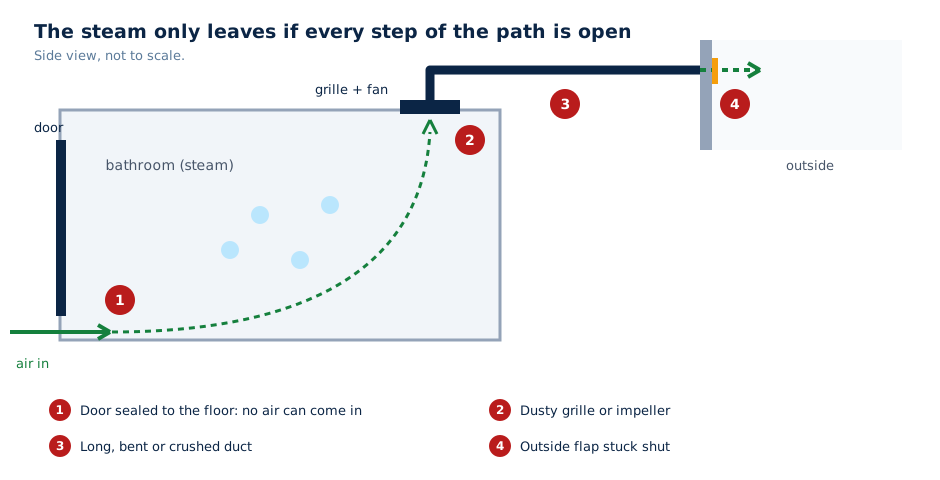
Walk the whole route, with these questions:
- Does the duct finish outside? A duct that ends in the loft or in a wall or ceiling cavity does not remove the steam. It moves it to a colder place where it condenses. Condensation in loft explains what that looks like. Approved Document F also says to extract to the outside.
- Is the duct crushed or kinked? Flexible duct squashed by loft insulation, a joist or a stored box can lose most of its cross-section. In a loft you can often see this from the hatch.
- Is it long, with lots of bends? Every bend and every metre adds resistance. Approved Document F tells installers to check that ductwork is installed to a standard that will not reduce its performance (paragraph 4.7), and rigid duct with few bends does that better than long runs of flexible.
- Is the outside flap free to open? A stuck, painted-over or blocked grille or flap at the outside end stops the air at the last step. Check it from outside if you can reach it safely from the ground. Do not go up a ladder for this on your own.
The duct itself you can often inspect from the loft hatch without touching anything electrical, but fitting, rerouting or replacing it is installer work. If you are wondering whether a bathroom fan can legitimately end in the loft, the sources I opened say to extract to the outside.
Is the fan too small, or is the timer too short?
If the air comes in freely, the grille is clean and the duct is clear, then the fan itself may not be up to it.
Size. Approved Document F lists an extract rate of 15 litres per second for a bathroom using an intermittent fan (Table 1.1, bathroom row). It also says a room with no external walls needs four air changes per hour. A large shower room or a bathroom with a long bath, on a long duct, can easily need more than the minimum. The US Building America page, written for American rules, recommends a fan rated for at least 70 cfm to meet a 50 cfm requirement, and says the EPA recommends going higher than the required amount. I would treat a fan chosen purely to hit the minimum as a likely cause of lingering steam in a big or steamy room, and that is my judgement, not a measurement.
Run time. A fan cannot clear steam as fast as a shower makes it, so it needs to keep running after you step out. Approved Document F says a room with no openable window should have controls that keep the fan on for at least 15 minutes after you leave (paragraph 1.51), and tells installers to check run-on timers are set to at least that (paragraph 4.6).
This is where a stopwatch is useful. Turn the light off, start the timer and see when the fan stops. If it stops after two or three minutes, the run-on is set too short or has failed. Many run-on timers have a small dial or switch for the delay, but the controls are usually wired in, so adjusting one is a job for an electrician or the installer. How long to run a bathroom extractor fan has the timings and the mirror check, so I will not repeat the table here.
If your fan has a humidity sensor, remember it only senses the air near the fan. Approved Document F says automatic controls should have a manual override (paragraph 1.50), so check you can switch it on yourself.
What to hand to an electrician or installer
Everything above is a look, a test or a clean. These are not DIY jobs, and I am not going to give wiring steps for any of them:
- Replacing the fan, the motor or the switch. It is mains wiring in a wet room, and what you can fit near a shower depends on its zone.
- Changing the run-on timer or the sensor settings when they are wired inside the fan or at the switch.
- Rerouting or replacing the duct, or fitting a new outlet through the wall or roof.
- Sizing a replacement properly. A good installer measures the airflow once the duct is in. Approved Document F expects airflow to be measured on new dwellings (paragraph 4.2), and the same sort of check is a sensible request for a replacement.
When you ring, give them what you found: whether the tissue test passed, whether air comes under the door, where the duct ends and how long the fan runs after the light goes off.
When the fan is fixed but the walls still run wet
Even a perfect fan struggles if the bathroom is cold and the shower is long, because steam condenses on cold surfaces faster than the fan can clear the air. If your ceiling is dripping, bathroom ceiling condensation helps you tell condensation from a leak. If you are still deciding whether the room needs a fan at all, do I need a bathroom extractor fan covers the rules.
As a last resort, a dehumidifier can mop up what a good fan leaves behind. See dehumidifier in bathroom for how to use one in a wet room without making things worse.
A fan that runs but leaves the steam is nearly always an airflow fault
So, if your bathroom extractor fan is not removing steam, work through the path in order: air in under the door, a clean grille and impeller, a duct that is straight and finishes outside, a fan with enough capacity, and a timer that runs on after you leave. Do the checks that need no tools first, which are the door gap, the tissue test and the stopwatch. Those three find most faults without any electrical work. Leave anything wired, anything in the loft and anything on the roof to someone qualified.
FAQ
Why is my bathroom extractor fan running but not working?
It is probably moving too little air. The common reasons are a sealed door with no gap, a clogged grille or impeller, a crushed or long duct, or a duct that does not reach the outside. Try the tissue test at the grille, then check the duct route.
Why does my extractor fan not clear the steam straight away?
Fans cannot remove steam as fast as a shower produces it, so the room will always be steamy during the shower. What matters is that it clears after you step out. If the mirror is still fogged well after the run-on has finished, the airflow is too low or the timer is too short.
Does the bathroom door need to be shut for an extractor fan to work?
Shut, with a gap underneath. Keeping the door closed contains the steam so the fan extracts it, and the gap lets air in to replace what the fan pulls out. A door sealed to the floor starves the fan.
How do I know if my extractor fan is strong enough?
The tissue test shows suction at the grille, and the 15 litres per second figure in Approved Document F is the minimum rate for an intermittent bathroom fan. To know what yours moves, you need an airflow measurement from an installer. A fan that struggles in a big or steamy bathroom is probably too small.
Can a bathroom extractor fan vent into the loft?
The Building America guidance says to vent to the outside, not into an attic, and Approved Document F says to extract to the outside. A duct that ends in the loft puts warm, wet air into a cold space where it condenses. Move the outlet outside rather than living with it.
Should I replace the fan or just clean it?
Clean the grille first, with the power off, and run the tissue test again. If a clean grille still fails, the problem is the impeller, the duct or the size, and that is a job for an installer. Replacing a fan without fixing the duct often changes nothing.

