
Last Updated on October 24, 2026 by Umar Farooq
Why is my concrete floor sweating? Because the slab is colder than the dew point of the air above it, so water condenses on the surface; less often, moisture is rising through the slab from the ground. Which one you have decides the fix, and you can usually tell in a day with a square of plastic and some tape.
I have stood in a garage in late spring with shoes squeaking on a floor that was bone dry the week before, and the instinct is always to blame a leak. Most often the floor is simply the coldest object in the building, and the air has just got more humid than it can cope with.

Why is my concrete floor sweating? Usually the slab is colder than the air’s dew point
A thick slab warms up slowly. After a cold winter it can sit well below the air temperature for weeks, because it has the ground underneath it and a lot of thermal mass. That lag is my reasoning rather than a measured figure, but it matches when people notice the problem: spring and early summer, in garages, basements and workshops.
Meanwhile the air gets warmer and wetter. Dew point is the temperature at which air can no longer hold its water, and as a rough standard calculation, air at 21°C (70°F) and 50% relative humidity has a dew point of about 10°C (50°F). Any surface colder than that collects droplets. A slab at 10°C in a 21°C room will sweat, and nothing is leaking.
A forum thread on Green Building Advisor states it plainly: you want the surface of the floor to stay above the dew point. His two routes were to lower the room’s dew point (a dehumidifier or air conditioning) or to raise the floor’s temperature (insulation). Everything else in this article is a variation on those two.
The less common cause is genuine moisture movement: water in the ground working its way up through a slab with poor or no barrier beneath it. That is a different problem, and the test below separates the two. It is the same sweat-or-seep question I answer for a basement that turns humid in summer, where the dew point diagram lives.
Sweat or seep: the plastic sheet test
A wet slab is slippery. Keep walkways dry while you test, and do not use a damp garage floor for ladders or heavy lifting until it is dry.
The test, as Hunker describes it, is simple:
- Dry a patch of the floor and tape a piece of plastic sheeting over it. Seal all four edges.
- Leave it for about a day.
- Lift or look at the sheet and compare.
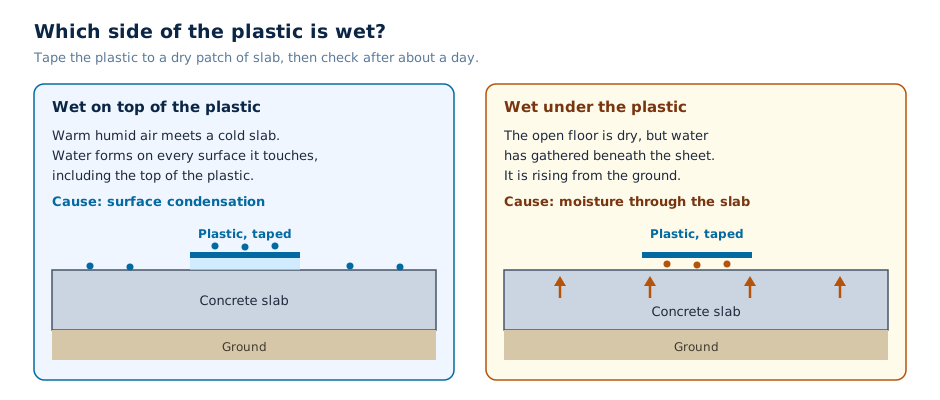
Moisture on top of the plastic, with a dry patch beneath, means warm humid air is condensing on a cold slab. Moisture underneath, with the open floor dry, points to water coming up through the concrete. Hunker’s advice for the second result is to call a professional, and I agree: that is a drainage or barrier question that a dehumidifier will not settle.
One honest limitation. A single patch tells you about that patch. Run the test in a couple of places, near the walls as well as the middle, and repeat it in a different week if the result is ambiguous. If the floor is only wet during humid spells and dry in between, that is condensation behaving exactly as expected.
Keep outside air out until it is drier than the air inside
Opening the garage door on a muggy afternoon is the classic way to make a floor sweat. Warm, damp air blows in, meets the cold slab, and leaves water behind.
Ventilation only helps when the outside air holds less moisture than the inside air. Compare dew points (any weather app shows them), not how pleasant the day feels. If the outside dew point is higher than the dew point inside, keep the doors and vents shut. If it is lower, open up. The cellar guide walks through that comparison, and the ventilation guide covers the general rule.
Fans are a different matter. Moving air does not change the dew point or warm the slab, so my view is that a fan helps a wet floor evaporate but does not stop it condensing again. Treat it as a helper, not a cure.
Dry the air so the dew point drops below the floor
A dehumidifier attacks the cause. Lower the room’s humidity and the dew point falls below the slab temperature, and the sweating stops.
Aim for a relative humidity in the range the EPA recommends for indoor spaces: below 60%, ideally 30 to 50%. Run it with the door and vents shut, and put a cheap hygrometer in the space so you can see it working. Do not expect a drained tank to be a quick fix in a large, leaky garage; there is always more air arriving than the machine can treat. Temperature matters too, and the garage guide explains why a compressor unit struggles in a cold space.
Warm the floor, because that is the other half of the equation
If the floor stays above the dew point, there is nothing to condense. In a basement or garage that you actually use, a little background heat in the shoulder seasons narrows the gap. The Green Building Advisor thread suggests insulation between the slab and the room, since a covering with some insulating value keeps the surface warmer. Not every covering does: the same discussion points out that a dimple mat has no insulation value.
I will leave coatings and sealers out of this. They change how the surface looks and wears, and I have found nothing in the sources I opened to show they stop condensation forming on it.
Cut what you are adding to the air
Slabs sweat sooner when the room is producing moisture. A few habits make a real difference:
- Dry washing outdoors or in a room that is ventilated and dehumidified, not on racks in the garage.
- Do not store wet gear, firewood or damp boxes on the floor. Raise things on shelves.
- Vent a tumble dryer outside.
- Keep rainwater and gutters directing away from the slab edge.
The same logic applies to walls: why walls sweat uses the identical cold-surface mechanism.
A floor that sweats only in warm, muggy spells is condensing; one that is wet all year is leaking
That is the working rule I use, and it is a judgement from how the two mechanisms behave, not a number. Condensation follows the weather, so it eases when humidity drops. Water from below is steady. Run the plastic test, fix the air if it points that way (ventilate only when the outside is drier, dehumidify, keep the floor warm, and stop adding moisture), and call a professional if it points the other way.
FAQ
Is a sweating concrete floor dangerous?
The main immediate hazard is slipping on the wet surface. Persistent damp can also feed mould on stored items and nearby materials, so deal with the moisture rather than just wiping it up.
Does a sweating slab mean there is a leak?
Not usually. Most sweating is condensation from humid air meeting a cool slab. A leak or moisture from the ground is more likely if the plastic sheet test shows water underneath, or the floor stays wet through dry weather.
Why does my garage floor sweat in spring and summer?
The slab is still cool from winter while the air gets warmer and more humid, so the surface drops below the air’s dew point. It usually stops when the weather dries out or the slab warms up.
Will a dehumidifier stop my concrete floor sweating?
It can, if the cause is humid air. Lowering the humidity lowers the dew point below the floor temperature. It will not fix water coming up through the slab, and it needs closed doors and vents to work.
How long should I leave the plastic sheet on the floor?
About a day, according to Hunker’s description. Seal the edges, and if you are unsure of the result, repeat it in another spot or another week.

