
Last Updated on October 24, 2026 by Umar Farooq
Ideal bedroom humidity is 30-50% relative humidity, and never above 60%. That is the same band the US EPA gives for any indoor room, and nothing about a bed makes it special, apart from the fact that you spend eight hours a night breathing into it.
The number is the easy part. Measuring it in the right place, and knowing which way to nudge it when the season changes, is where most people go wrong.
What counts as ideal bedroom humidity, and who says so
The EPA’s brief guide to mould and moisture says to keep indoor humidity below 60%, ideally between 30 and 50%. ENERGY STAR’s dehumidifier page says the optimum level for a building is generally considered to be between 30% and 50%. Those are the two primary sources, and they are about buildings, not about sleep.
The sleep sites mostly repeat that range. The Sleep Foundation attributes 30-50% to the EPA, and adds that the best range for sleep has been debated, with some studies suggesting 40-60%. I would not chase the top of that. Anything creeping over 55% in a cold bedroom is where condensation starts to show on glass and outside walls, which is a building problem before it is a comfort one.
So my working target is 40-50%, which sits inside the official band with a margin either side. That is my judgement, not a measured result.
Measure it at bed height, not on the windowsill
A hygrometer is a small, cheap gadget, and the EPA puts a humidity meter at roughly $10-$50. Where you put it matters more than what it cost.
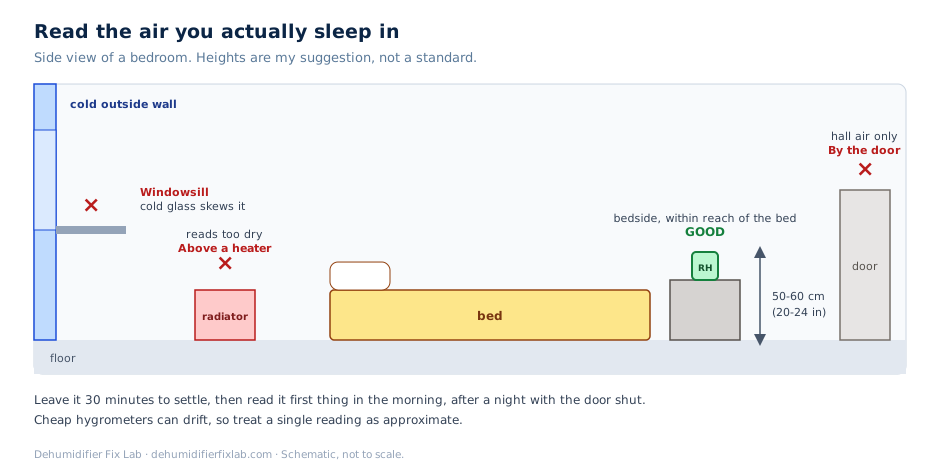
Put it on the bedside table, within reach of the bed, and keep it off the windowsill (cold glass skews the reading), away from radiators (it reads too dry) and clear of the door (it reads the hallway). Give it half an hour to settle after you move it.
Then read it first thing in the morning, after a night with the door shut. A bedroom is often at its dampest then, because people breathe out water vapour all night. Check again mid-afternoon and you will see the gap. Cheap units drift, so if two of them disagree by a few points, how humidity is measured explains how to check one properly.
Winter wants a lower target than summer
ENERGY STAR says that in colder climates, winter humidity should be 30-40% RH to prevent window condensation. The reason is physics, not fussiness: a cold pane cools the air touching it until it can no longer hold its water. In summer there is no cold surface, so 40-50% is comfortable.
The window is a free second instrument. Dry glass on a cold morning means your number is fine for the weather. A film of water along the bottom edge means you are over the limit for today’s outside temperature, whatever the hygrometer says. The EPA makes the same point: condensation on windows, walls or pipes can be a sign of high humidity, so act quickly to dry the surface.
| Season | Sensible target | What to watch |
|---|---|---|
| Winter (heating on) | 30-40% | Condensation on glass and outside walls |
| Spring and autumn | 30-50% | Mornings after cold, still nights |
| Summer | 40-50% | Muggy nights; do not let it pass 60% |
If it reads too high: find the water first
Above 50% for days at a time, work down this list before buying anything.
- Stop drying washing in the bedroom. It is the biggest avoidable source.
- Open a window for ten minutes when the outside air is drier than the inside, then close it.
- Pull wardrobes and the bed a few centimetres off cold outside walls, so air can move behind them.
- If it still sits above 55-60%, a dehumidifier is justified.
The full routine is in how to reduce humidity in a bedroom. If you are unsure whether a machine is worth the money, do I need a dehumidifier in my bedroom walks through the decision, and a quiet dehumidifier for the bedroom covers the noise question if you do go ahead.
If it reads too low
Below 30% for weeks, the air is dry. Heating in winter is the usual cause. Do not reach for a humidifier on the first dry morning: the EPA still wants you under 60%, and an over-keen humidifier can push a cold room straight back into condensation. If you add moisture at all, do it gradually and recheck the glass.
Ideal bedroom humidity is a band, so read it and adjust
Treat 30-50% as the fence and 40-50% as where I would aim. Lower the target a few points in winter, measure at bed height in the morning, and let the window tell you when you have gone too far. The rest of the house follows the same rules, which the indoor humidity guide lays out in full.
FAQ
What is the ideal humidity for a bedroom at night?
30-50% relative humidity, kept under 60%, is the range the EPA and ENERGY STAR give for indoor spaces. I would aim for 40-50% in summer and nearer 30-40% in winter, to avoid condensation on cold surfaces.
Is 60% humidity too high for a bedroom?
It is the ceiling, not a target. The EPA says to stay below 60%, so a bedroom sitting at 60% every night has no margin, and cold walls and windows will be wetter than the room average.
Is 40% humidity good for a bedroom?
Yes. 40% sits inside the 30-50% band and is a comfortable winter figure. ENERGY STAR gives 30-40% as the winter range for preventing window condensation.
How do I check humidity in my bedroom?
Use a hygrometer on the bedside table, away from the window, radiator and door, and read it first thing in the morning. The EPA describes these meters as small and inexpensive, and they are sold at many hardware stores.
Should I use a humidifier or a dehumidifier in the bedroom?
Whichever way the reading is off. Over 50-55% for days, ventilate and consider a dehumidifier. Below 30% for weeks, add moisture gently. In between, leave it alone.

