
Last Updated on October 24, 2026 by Umar Farooq
How to stop condensation on a boat: make less moisture below decks, keep a little air moving through the cabin, and stop warm air touching a cold hull, in that order of cost. Heating alone does not do it, because the water is still in the air and it just lands somewhere else.
A boat is a small, cold box with people breathing in it. Nobody should be surprised that it drips. The surprise is how much of the cure is free.

Why a boat runs wet when the house does not
Condensation is water vapour turning back into liquid when air meets a surface colder than the air can tolerate. A boat sets that up almost perfectly.
The hull is thin and sits in cold water or cold air, so the inside face of it is the coldest surface you own. The cabin volume is tiny, so two people sleeping, a kettle and a pan of pasta can move the humidity a long way in an hour. And most of the cold surface is hidden: behind cushions, inside lockers, under bunks, where no air moves to dry it.
That is why it is worst overnight, and why you find it first as damp bedding or a musty locker rather than drops on a window. The house version is the same physics, only slower, and caravans and motorhomes sit in between.
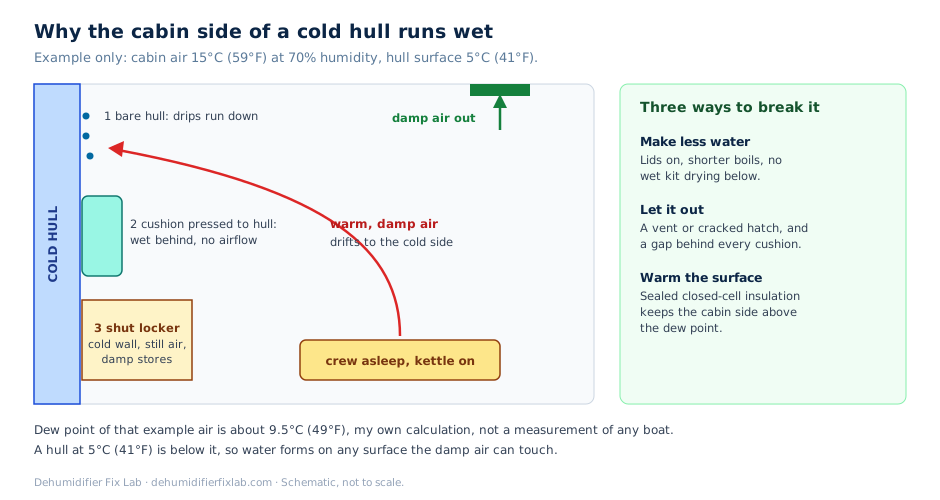
Make less water below decks
- Cook with lids on and turn the heat down once it boils. A rolling boil with the lid off is a steam machine.
- Do not dry wet clothes or oilskins in the cabin. If they must come in, hang them under a vent or open hatch, not over a closed saloon. Wet washing puts a lot of water into the air of any home, and a boat has less room for it.
- Wipe down glass and hull-side surfaces in the morning. It takes a minute, and standing water on timber and seals is where the black spots start.
- Do not run an unflued gas heater. Burning gas produces water vapour as a by-product, so it makes the cabin wetter while it warms it.
Never use an unflued gas or paraffin heater in a closed cabin, and never run any combustion heater without a working carbon monoxide alarm. Condensation is an annoyance. Carbon monoxide is not.
A sleeping crew is the one source you cannot remove, which is why the next step matters.
How to stop condensation on a boat with ventilation you can leave on
Ventilation is the cheapest cure and the one people resist hardest, because it feels like letting the heat out. It is, a bit. That is the price of getting the water out too. Aim for slow, steady, low-level exchange, not ten minutes of airing and then sealing up again:
- Keep the Dorade or solar vents open when you are aboard and when you are away.
- Crack one hatch or port light a finger’s width, ideally with a rain cover so it can stay open in weather.
- Open the hatch for a few minutes first thing, before boiling the kettle. The air outside is cold, but cold air also holds less water, so swapping a cabin full of breath for outside air nearly always dries it.
Heat helps only if air is moving. Warming a still cabin lowers the humidity reading but leaves the same water in the air, ready to drop out on the first cold hull panel. A small fan sweeping air along the hull and glass does more than extra heat.
Practical Boat Owner’s account of insulating a liveaboard lands in the same place: ventilation and insulation are equally important, and doing only one disappoints.
Warm the cold spots, not just the air
Insulate the hull sides and deckhead with closed-cell material. Closed-cell matters: foam that soaks up water simply becomes a wet sponge on the hull. PBO’s liveaboards warned against anything that absorbs moisture. A Beneteau owner who lined his hull and ceiling with closed-cell foam, writing up the job in detail, reported that after two winters the cabin sat at 22°C with 45% relative humidity while it was below freezing outside. That is one boat and his own readings, but it shows what is possible.
Two things go wrong with insulation. Gaps: air gets behind loose panels, meets the cold hull and condenses where you cannot see it, so bond it fully and seal the joints. Cold patches: one uninsulated stringer or fixing collects water from the whole panel. If a full job is too much, insulate the worst two or three spots (usually the bunk side and the forepeak) and add thin closed-cell mats behind lockers.
Cushions, mattresses and lockers: where it hides

- Pull cushions away from the hull by a few centimetres so air passes behind them. Nothing should lie hard against the hull side, because that traps moist air against the coldest surface.
- Raise mattresses on slats or a breathable mesh layer rather than laying them on a solid bunk board.
- Take lockers apart for the winter. Open doors and prop them, or fit vented panels, and keep stores off the hull side. A shut locker is a still, cold, wet pocket.
- Check behind panels and under bunks monthly with a torch. Dark spots on timber mean water has been standing there.
If you find mould, fix the water first. For small areas (under about 10 square feet, roughly 1 square metre) the EPA says most people can clean it themselves.
Can a dehumidifier help when power is short?
A dehumidifier treats the symptom, not the cause, but on a wet week at a marina it is a reasonable add-on. I have not tested one on a boat, so this is principle, not a product recommendation.
Mains equipment on a boat needs correct marine-grade shore power wiring, a working RCD (residual current device) and a dry, secure spot for the machine. Do not run a mains dehumidifier unattended unless you are sure of the installation, and never on a boat’s battery supply through an improvised inverter setup.
Three principles decide whether it is worth it:
- It needs shore power. A compressor or desiccant unit draws real power, so at anchor or on a flat battery it is off the table.
- It works best in a closed cabin, the opposite of the ventilation advice. Run it for a few hours with the boat shut, then ventilate. Never with every hatch open.
- It needs somewhere for the water to go. A machine that stops when its tank is full is a poor fit for an unattended boat.
For small closed spaces without power, such as a locker or wardrobe, a passive disposable dehumidifier is the low-power compromise: it needs no electricity and only holds so much, so treat it as a top-up for lockers, never as the main defence. The EPA recommends indoor humidity below 60%, ideally 30% to 50%, and says condensation can be a sign of high humidity. A cheap hygrometer in the cabin tells you where you stand, and how to lower humidity in a house covers the principles that carry across.
Winter lay-up: leave it dry, not sealed
The goal is a dry start and a cabin that can breathe.
- Dry it first. Wipe the hull, bilge edges and lockers dry on a drier day. Sealing a damp boat in for the winter is the classic mistake.
- Empty it. Take cushions, bedding, clothes, food and paper ashore if you can. If they stay, stand cushions on edge.
- Open everything that opens. Prop locker doors and floorboards and leave vents open. A cover needs a gap at the ends, not a plastic bag that holds the damp in.
- Add a passive moisture absorber in closed spaces, and plan to check and replace it.
- Visit monthly for a look at drips and damp. The same cold-weather logic applies ashore, as I cover in running a dehumidifier in winter.
Condensation never quite goes, so aim for manageable
Nobody gets rid of it entirely. What works is a stack: less steam, a trickle of ventilation, warmer hull-side surfaces, cushions lifted off the hull, and a dry boat going into the winter. Do those five and how to stop condensation on a boat becomes a morning wipe-down rather than a rebuild.
FAQ
Why is there so much condensation on my boat?
Because warm, damp air from breathing and cooking meets the coldest surface on the boat, the inside of the hull, in a very small volume of air. Cold, still, closed spaces make it worse.
Does opening a hatch stop condensation?
Usually yes, if the outside air is drier or colder than the cabin air. Cold outside air holds less water, so swapping it for damp cabin air lowers the moisture. A hatch cracked open all the time works better than a big airing once a day.
Will a heater stop condensation on a boat?
Not by itself. Warm air holds more water, so the reading drops, but the water is still there and returns when the heat is off or the air reaches a cold hull panel. Pair heat with airflow, and avoid unflued gas heaters, which add water vapour.
What is the best insulation for stopping condensation on a boat?
Closed-cell foam, bonded fully to the hull with the joints sealed, so there are no air gaps for moisture to collect in. Avoid anything that soaks up water.
Should I run a dehumidifier on my boat?
On shore power, for a few hours with the boat shut, it can help on wet weeks. Make sure the wiring and RCD are sound, and treat it as an add-on to ventilation and insulation, not a replacement.

