
Last Updated on September 1, 2026 by Umar Farooq
Where to put a dehumidifier: central to the space you want dried, at least 30 cm / 12 inches clear of walls and furniture, with the internal doors open and the external ones shut. Get those four things right and a modest machine will out-perform a much larger one shoved in a corner with the door closed.
Where to put a dehumidifier is the part most buying guides skip entirely. People agonise over capacity and then put the unit in the worst place in the house, which is a bit like buying a better kettle and not filling it.
The principle everything else follows from
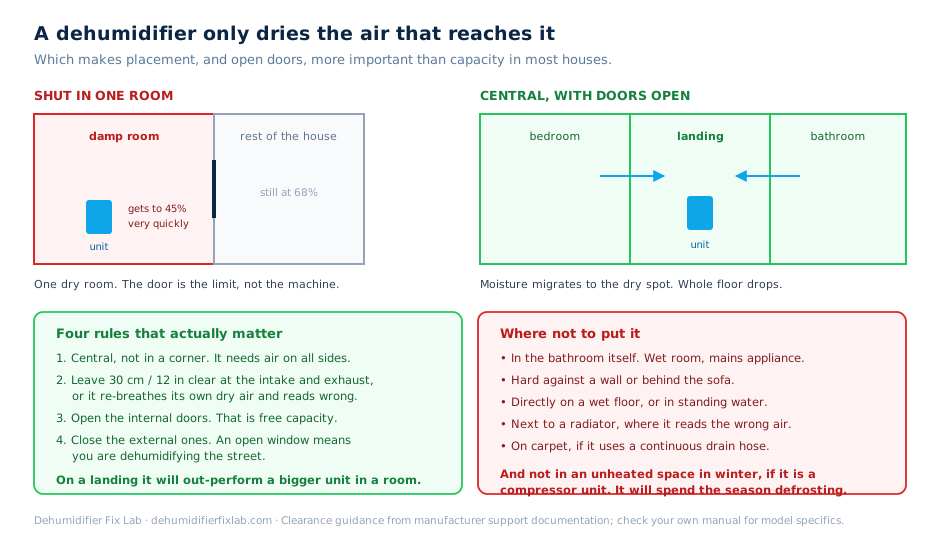
A dehumidifier only dries the air that physically reaches it.
It has no reach. It is a box with a fan, pulling in whatever air is nearby and pushing out drier air. Moisture then migrates towards that drier air by diffusion, which happens steadily but only if there is a path.
Close a door and you have drawn a line the machine cannot cross. Open it, and the same machine is now treating two rooms. This is why a small unit on an open landing frequently beats a large one shut in the damp bedroom — and why capacity is the second question, not the first.
Rule 1: central, not in a corner
Corners are the worst position in any room and they are where everyone puts it, because that is where the plug socket is.
A dehumidifier needs air to reach its intake from all directions and needs somewhere for its outlet air to go. In a corner it is drawing from a dead zone and blowing into a wall, so it re-breathes its own dry outlet air, reads a humidity that no other part of the room is experiencing, and stops early.
Central is better. Awkward, but better. If a genuinely central position is impossible, get it away from the walls and clear of the furniture, and use a longer lead rather than a different corner. (Not a long thin extension lead, though — see the safety note below.)
Rule 2: leave 30 cm clear all round
Manufacturers generally specify clearance at the intake and exhaust, and it is one of the more commonly ignored instructions in the manual.
30 cm / 12 inches on all sides is a good working figure. That means not against a wall, not behind the sofa, not in a cupboard, and not boxed in by storage.
Two things go wrong when it is tight. Airflow drops, so the machine treats less air per hour and works harder for the same result. And the humidity sensor sits in a pocket of air that has just been through the machine, so it reads low and switches off while the room is still damp. That second one is why people conclude the humidistat is faulty when the machine is simply badly placed.
Rule 3: open the internal doors
This is the free capacity nobody uses.
If you want a whole floor dried, put the machine on the landing or in the hallway and leave the bedroom and bathroom doors open. Moisture generated anywhere on that floor migrates towards the dry spot the machine creates. Meaco make the same point about landings, and it matches what the physics predicts.
If you want one specific room dried fast — a spare room where washing is drying, say — then closing that room’s door is right, because you are concentrating the machine’s effort on a small volume. Drying clothes indoors is the clearest case for shutting the door.
So the rule is really: open doors for whole-house maintenance, closed doors for one-room jobs. Decide which you are doing before you decide where the machine goes.
Rule 4: shut the external ones
An open window while the machine runs means you are dehumidifying the street. It will never finish, and the meter keeps turning.
This is not an argument against ventilation — ventilating when the outside air is drier than the inside air is the cheapest dehumidification there is. It is an argument against doing both at once. Ventilate, close up, then run the machine.
Where to put a dehumidifier, room by room
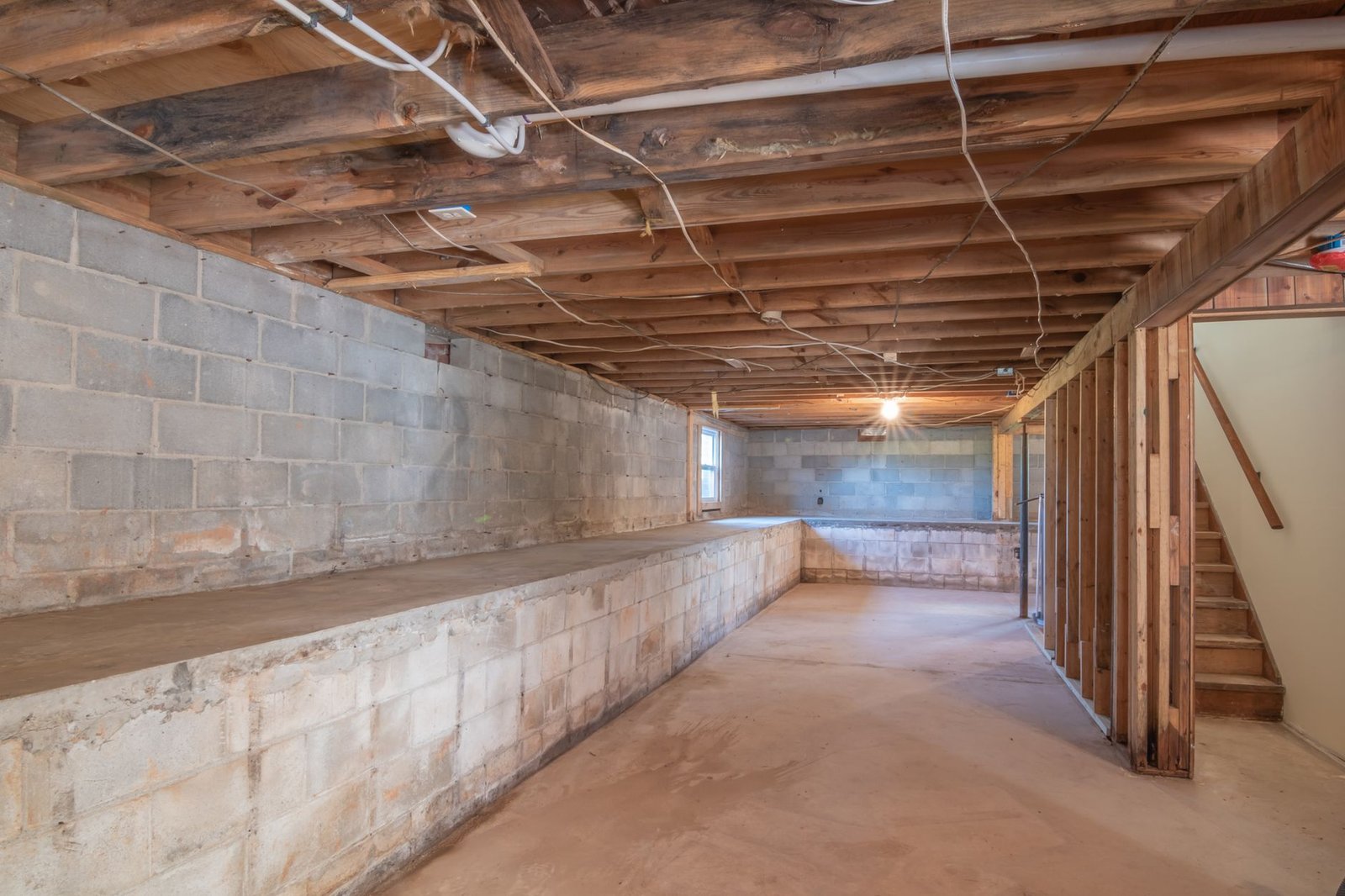
Basement or cellar. Central, up off a wet floor — on a small table or a plinth if the floor is ever damp. Not in the wettest corner: that gives you one dry corner and an unchanged room. This is also the place where a drain hose pays for itself, because a full tank means a stopped machine and basements collect a lot of water.
Bathroom. Not in the bathroom. It is a wet room and this is a mains appliance. Put it on the landing outside with the bathroom door open after showers, which works nearly as well and does not involve a plugged-in machine in a room full of water.
Bedroom. Away from the bed, for noise, and not blowing warm outlet air at anyone. Low fan speed overnight. Bear in mind it will warm the room slightly, which matters more in summer — more on that here.
Laundry or utility room. Right next to where the washing hangs, door closed, on high fan. This is the one case where cornering the machine in a small space is genuinely the right call.
Garage. Central, off the floor, and think hard about temperature first: below about 5°C a compressor unit will spend the winter defrosting rather than collecting. The garage guide covers the whole decision.
Loft or attic. Only in a sealed or encapsulated roof space. In a vented attic the machine is trying to dry outdoor air and will run for ever. Worth reading first.
Five places not to put one
- In the bathroom itself. Mains appliance, wet room.
- Hard against a wall or behind furniture. Restricted airflow, and a sensor reading its own outlet air.
- Directly on a wet floor or in standing water. Obvious once said, and still common in basements.
- Next to a radiator or in direct sun. It will read the wrong air and cycle strangely.
- On carpet, if it uses a drain hose. A slow leak into underlay is a smell you will not get out.
Plug it into a wall socket, not a long thin extension lead. Voltage drop during the compressor’s inrush causes failed starts, and repeated failed starts are what destroy overload protectors. If you need it further from the socket, use a short heavy-gauge lead rather than a light one on a reel.
Where to put a dehumidifier if you only have one
Usually not, and this is where honest advice diverges from the sales pitch.
One well-placed machine can hold a floor of a normal house at a sensible reading — provided the doors are open and there is no single room generating a lot of moisture. What it cannot do is dry a two-storey house from the ground floor, because dry air does not climb stairs against warm damp air rising the other way.
If you have a damp basement and a condensation problem upstairs, that is two machines or two seasons, not one heroic unit. And if you are trying to work out what capacity the space needs once you have the position right, the sizing guide takes it from there.
Frequently asked questions
Where is the best place to put a dehumidifier in a house?
Somewhere central, with internal doors open — a landing or a hallway in most houses. That lets moisture from several rooms migrate to the dry spot the machine creates, instead of drying one room while the rest of the floor stays damp.
How much space does a dehumidifier need around it?
At least 30 cm / 12 inches at the intake and exhaust, and ideally on all sides. Any tighter and airflow drops while the humidity sensor starts reading the machine’s own outlet air, so it switches off too early.
Should I put a dehumidifier upstairs or downstairs?
Wherever the moisture actually is, which a hygrometer will tell you in a week. If the problem is condensation on bedroom windows, upstairs. If it is a damp basement, downstairs. One machine will not reliably do both floors.
Can I put a dehumidifier in a bathroom?
No. It is a mains appliance and a bathroom is a wet room. Put it on the landing outside and leave the bathroom door open after showers — that captures most of the moisture without the risk.
Should the door be open or closed when running a dehumidifier?
Open for whole-floor maintenance, closed for a single-room job like drying washing. Either way, external doors and windows should be shut while it runs.
Does a dehumidifier work better on the floor or raised up?
Floor level is fine and is where most units are designed to sit. Raise it only if the floor is ever wet, or in a basement where you want the intake away from the coldest, dampest layer of air.
Where should I put a dehumidifier in a bedroom?
Away from the bed for noise, not blowing its outlet air at anyone, and clear of curtains and furniture. Low fan speed overnight, and remember it will warm the room by a degree or so.
Related guides: Dehumidifier settings · What size dehumidifier do I need? · How to dehumidify a room · Dehumidifier drain hose setup
Sources
- Meaco — How to use a dehumidifier and where best to put it around the house — the landing placement argument, from a manufacturer who has thought about it properly.
- GE Appliances — Dehumidifier: Ideal Operating Conditions — clearance and operating-temperature guidance.
- EPA — A Brief Guide to Mold, Moisture and Your Home — ventilation and airflow behind furniture as mould control.
Where this guide and your appliance’s own manual disagree, follow the manual. And if yours has lived in the same corner since the day you bought it — move it into the middle of the room for a fortnight and watch the tank. That comparison costs nothing and it surprises people.

