
Last Updated on September 1, 2026 by Umar Farooq
The difference between humidifier and dehumidifier is direction: one puts water into the air, the other takes water out. That is genuinely all of it. Which one you need is not a matter of preference or season — it is decided by a single number, the relative humidity in the room, and you can measure it this week for the price of a takeaway coffee.
Below 30%, you want a humidifier. Above 60%, you want a dehumidifier. Between the two, and this is the part nobody selling either appliance will tell you, you want neither.
The difference between humidifier and dehumidifier, in one table
| Humidifier | Dehumidifier | |
|---|---|---|
| What it does | Adds water vapour to the air | Removes water vapour from the air |
| How | Boils, atomises or evaporates water from a tank | Condenses water onto a cold coil, or absorbs it onto a wheel |
| You fill it, or empty it | Fill it | Empty it |
| Effect on room temperature | Cools very slightly | Warms very slightly |
| Typical season | Mid-winter, in a heated house | Summer, and any damp room year-round |
| Problem it solves | Dry throat, static, cracking timber | Condensation, mould, musty smell, washing that will not dry |
| Left running wrongly | Condensation and mould | Over-dry air, shrinking joinery |
The direction of the water is the headline, but the temperature row is the one people find surprising. A humidifier evaporates water, and evaporation absorbs heat, so it cools the air fractionally. A dehumidifier condenses water, and condensation releases heat, so it warms the air fractionally. They are not opposites that cancel out — running both at once is two machines undoing each other while billing you for the privilege.
Test 1: buy a hygrometer, not an appliance
This is the strong opinion of this article and I will state it plainly: do not buy either machine until you have measured the room for a week. A hygrometer costs a fraction of what either appliance costs, and it is the only thing that can actually answer the question.
Not one reading. A week of them. Humidity swings enormously across a day — showers, cooking, drying washing, the heating coming on, the temperature dropping overnight. A single reading at 8pm on a Tuesday tells you almost nothing about what the room is doing at 6am.
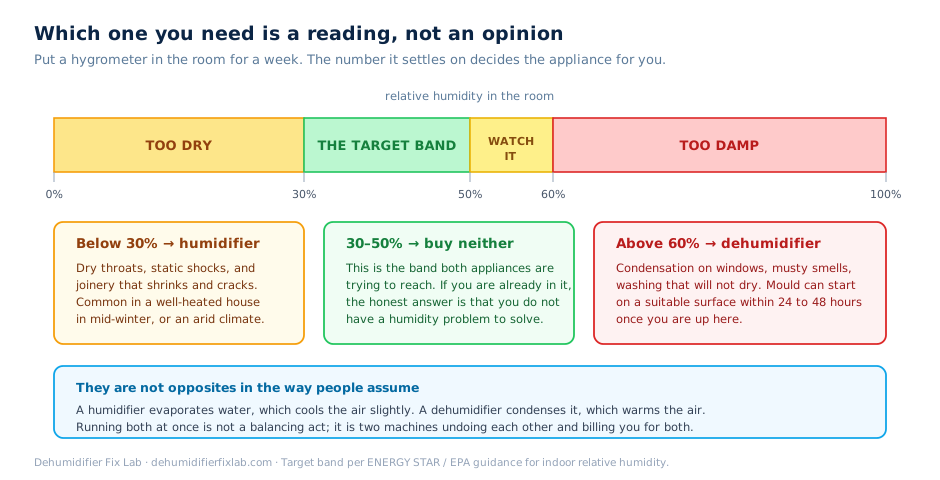
The target band is 30–50% relative humidity, which is what ENERGY STAR and the EPA both recommend for indoor air. If your week of readings sits inside it, you have no humidity problem to solve, and the honest answer is to keep your money.
Test 2: read the symptoms, they point in opposite directions
If you cannot wait for a hygrometer, the room will tell you which way it is going. The two symptom lists barely overlap, which is helpful.
Signs the air is too dry — you want a humidifier:
- Static shocks off door handles and clothing
- Dry throat or blocked nose on waking, particularly in winter
- Timber floors, doors and furniture developing gaps or cracks
- A musical instrument that keeps going out of tune
- Skin that is tight and itchy indoors but fine outside
Signs the air is too damp — you want a dehumidifier:
- Condensation running down the inside of windows in the morning
- A musty smell in a room, a cupboard or a wardrobe
- Black speckling in window reveals, in corners, or behind furniture on outside walls
- Washing that takes two days to dry indoors
- Books, leather and cardboard that feel cool and slightly damp
If you are ticking items from both lists, you almost certainly have two different rooms with two different problems, which is common in a house with an unheated back bedroom.
Test 3: check whether it is a whole-house problem or a one-room problem
Humidity is not uniform. A well-heated Victorian house in January might sit at 35% in the living room and 65% in the coldest bedroom, on the same day, because the cold room’s air is holding the same amount of water at a lower temperature.
That matters enormously for what you buy. A single machine dropped in the wrong room achieves very little, and where you put it frequently matters more than what capacity you buy.
It also explains the one genuinely awkward scenario: a house that needs a humidifier in the sitting room and a dehumidifier upstairs. That is not a contradiction, and it is not unusual — the difference between humidifier and dehumidifier need is a per-room question, not a per-house one. It just means the honest answer is either two appliances in two places, or — better and cheaper — improving the heating and insulation in the cold room so it stops being a different climate.
A note on combination units
Machines marketed as doing both exist. My view, and it is a view rather than a measurement, is that they solve a problem most homes do not have. If a room needs adding to in January and removing from in July, two properly-sized appliances used six months apart will do both jobs better than one compromise doing each of them adequately. Buy the one your hygrometer says you need now.
What each one will not do
A humidifier will not fix a heating problem. If the air is dry because the heating is running hard and the house leaks, you are treating a symptom.
A dehumidifier will not fix damp. This is the important one. If water is actively coming in through a wall, a roof or a failed seal, the machine will run permanently, cost you a fortune, and never win. Find the water first, fix it, and then size a dehumidifier for whatever humidity is left. It manages humidity; it does not manage water ingress, and no capacity figure changes that.
That distinction also decides whether a dehumidifier will help with mould. It will, if the mould is being fed by humid air landing on cold surfaces. It will not, if the mould is being fed by a leak. The full answer on dehumidifiers and mould is worth reading before you buy anything.
Frequently asked questions
What is the difference between a humidifier and a dehumidifier?
A humidifier adds moisture to air that is too dry; a dehumidifier removes moisture from air that is too damp. Everything else follows from that. You fill a humidifier and empty a dehumidifier, and they suit opposite problems.
Do I need a humidifier or a dehumidifier?
Measure the room’s relative humidity for a week. Below 30% means a humidifier, above 60% means a dehumidifier, and 30–50% means you need neither. Symptoms give you a strong hint, but a hygrometer settles it for a few pounds.
Can you use a humidifier and dehumidifier in the same room?
There is no reason to, and it wastes money — they are actively working against each other. In the same house, in different rooms, it can genuinely make sense if one room is much colder than the rest.
Which is better for allergies, a humidifier or a dehumidifier?
They help with different triggers. Dust mites and mould need humidity above roughly 50% to thrive, so a dehumidifier addresses those. Dry air irritates airways directly, which is a humidifier’s territory. Measure the room and treat what it actually reads.
Does a dehumidifier cool a room like an air conditioner?
No. It warms the room slightly, because both its coils sit indoors. What it does is make a warm room feel far more comfortable by allowing sweat to evaporate properly.
Do I need a humidifier in winter and a dehumidifier in summer?
That is the common pattern in a heated home, but it is not a rule. Cold, poorly heated houses often get damper in winter, not drier. Your hygrometer will tell you which kind of house you have.
Is a humidifier or dehumidifier better for a baby’s room?
Neither, by default. Aim for the 30–50% band and use whichever appliance the reading calls for. If you do run a humidifier, clean it religiously — a dirty tank atomises whatever is growing in it straight into the room.
Related guides: How dehumidifiers work · Dehumidifier settings · Does a dehumidifier help with mould? · Where to put a dehumidifier
Sources
- ENERGY STAR — Dehumidifiers — the recommended 30–50% indoor relative humidity band.
- EPA — A Brief Guide to Mold, Moisture and Your Home — why keeping indoor humidity below 60% is the primary mould control, and the difference between humidity and a water leak.
- EPA — Mold Course, Chapter 2 — the surface-moisture conditions mould actually needs.
Where this guide and your appliance’s own manual disagree, follow the manual. And if you take one thing from this: measure first. I have never regretted spending a fiver on a hygrometer, and I have watched plenty of people regret spending two hundred on the wrong machine.

