
Last Updated on October 25, 2026 by Umar Farooq
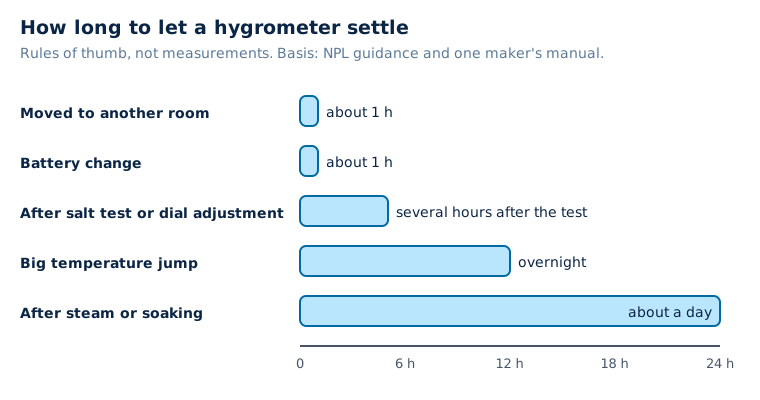
How long does a hygrometer take to adjust? Roughly an hour after you carry it into another room, and several hours to overnight after a calibration test or a long soak in damp air. No source gives one figure for every unit, so the numbers below are rules of thumb, flagged as mine where they are.
The mistake is reading it two minutes after you hang it up, deciding the room is 71%, and ordering a dehumidifier. A hygrometer that has just moved is still catching up with its surroundings.
Why a hygrometer needs time to settle at all
Two things have to catch up: the sensor has to reach the temperature of the new place, and the humidity has to equalise around it. The National Physical Laboratory’s Beginner’s Guide to Humidity Measurement lists both in its do’s: let the instrument reach the temperature of the location, and allow time for the humidity reading to stabilise. In its troubleshooting list it also asks whether the hygrometer and the conditions have had long enough to stabilise.
Temperature matters more than people expect, because relative humidity depends on it. NPL gives an example: at 50 %rh, a rise from 20 °C to 21 °C will cause the relative humidity to fall by about 3 %rh. A unit carried from a cold hall into a warm living room is warming up while it reads, and its figure will drift for as long as it does.
Case 1: how long does a hygrometer take to adjust to a new room?
My rule is an hour. That is judgement, not a standard, and I have not timed a range of units. Go longer if there is a large temperature difference, for example a unit that has been in a cold car or an unheated outbuilding, and give it overnight in that case.
Do not judge a position by its first reading. How to read a hygrometer covers the habit of reading at consistent times, and where to put a hygrometer covers the spot itself.
Case 2: after a salt test or a dial adjustment
This is the long one. The salt test itself takes about 12 hours, as set out in how to calibrate a hygrometer. After that, the unit still needs to return to the room.
A manufacturer’s manual gives a rare real figure for dials. The Barigo hygrometer instructions describe a regeneration method of about 6 hours sealed in a lidded saucepan over water, then turning the adjustment screw to read 95%, then returning the unit to its place. It says that after a few hours the hygrometer will adjust itself to the humidity that prevails. That is one maker’s procedure for one type of dial, so use it as a guide to the order of magnitude: hours, not minutes.
Case 3: after steam, condensation or a long spell in damp air
NPL says droplets or stray water can make humidity measurements misleading, and that a hygrometer exposed to extreme conditions should be checked. If a unit has been in a steamy bathroom or got wet, give it a day somewhere ordinary, away from the damp, before you judge it. If it still reads oddly after that, see whether hygrometers go bad.
Case 4: after a battery change
I found no manufacturer figure for this. A digital unit usually shows a number quickly, but the first reading after power-up is the least trustworthy, so I wait the same hour as for a move. If nothing else has changed and the figures start to disagree with a second unit, a weak battery is worth ruling out.
| Situation | My rule of thumb | What backs it |
|---|---|---|
| Moved to another room | About 1 hour | NPL: reach the temperature, allow time to stabilise |
| Moved from a very different temperature | Overnight | NPL’s 20 to 21 °C, 3 %rh example |
| After salt test or dial adjustment | Several hours | One maker’s manual: “a few hours” after 6 hours’ regeneration |
| After steam or soaking | A day | NPL: droplets mislead, check after extreme exposure |
| After a battery change | About 1 hour | Nothing published; my habit |
How to tell it has finished: three readings, not one
The simple test is to look at it three times. Write down the reading, wait 15 minutes, write it down again, then once more. If the three sit within a point or two and are not all heading the same way, it has settled. If they are climbing or falling steadily, it is still catching up. The 15 minutes and the point or two are my own choices; the logic of waiting for a stable figure is NPL’s.
A log makes this easy, and how to log humidity at home shows one that takes a minute a day.
Give it an hour for a move, overnight for a test, and judge by the trend
So, how long does a hygrometer take to adjust? Longer than the impatient want and shorter than the cautious fear: an hour for a move, an overnight for a big temperature jump or a calibration, a day after a soaking. A reading that is still moving is not a reading yet.
FAQ
How long does it take a hygrometer to give an accurate reading?
After moving it, I would allow about an hour, and longer if the temperature differs a lot. That figure is my own rule, backed by NPL’s advice to let the instrument reach the temperature of the location and the reading stabilise.
Why does my hygrometer keep changing?
Humidity changes with the room, and relative humidity also changes with temperature, so a reading can move even when the moisture is constant. NPL’s example is a drop of about 3 %rh for a 1 °C rise at 50 %rh.
How long should a hygrometer sit in the salt test?
About 12 hours, as in the salt-test guide. Check the unit afterwards, then give it time in the room before trusting its readings again.
Does a hygrometer need to acclimatise before use?
Yes, in the sense that NPL advises letting it reach the temperature of the location and allowing the reading to stabilise. For a new unit I would hang it in position for an hour first.
Is a slow hygrometer faulty?
Not necessarily. Slow response can be normal for some types, and NPL notes that older hygrometers can show slowed response. If a unit never settles, compare it with a second one.

