
Last Updated on October 25, 2026 by Umar Farooq
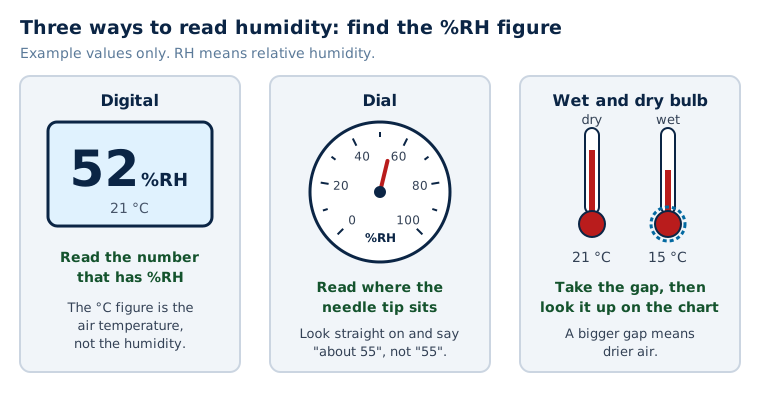
How to read a hygrometer: wait for it to settle, find the relative humidity figure (it is always a percentage, written %RH), and compare it with the 30 to 50 per cent target and the 60 per cent ceiling. On a digital unit that is the big number; on a dial it is the end of the needle.
The only real trap is that most digital units also show a temperature, and the temperature is not the one you are after. People do read 19 as the humidity at least once. Nobody admits it.
Digital hygrometer: which number is the humidity?
The one followed by a percentage sign, usually labelled RH. The other, with a degree sign, is the air temperature at the sensor. RS Components describes digital models as showing relative humidity directly, with some also showing temperature and some storing minimum and maximum readings.
Those minimum and maximum buttons are the most useful feature on a cheap unit, and the least pressed. A reading taken at noon tells you about noon. The overnight maximum tells you what the room did while you were not looking, and that is usually when a damp bedroom shows its hand.
If your screen has a third figure, check the manual before guessing. Some units add a “comfort” smiley or a dew point, and the manual is the only place that says which.
Dial hygrometer: read the needle straight on
A round dial has no battery and no menu. According to the National Physical Laboratory’s Beginner’s Guide to Humidity Measurement, mechanical hygrometers use a change in the length of hair or another organic material, and many remain in use for room monitoring. The material stretches or shrinks as the air gets damper or drier, and a linkage moves the needle.
Reading one is simple, but a few habits help:
- Look at it from straight in front. At an angle the needle appears to sit on a different number (the technical word is parallax; the practical word is “annoying”).
- Read the scale, not your memory of it. Dials are often marked in steps of 5 or 10, so an in-between position is an estimate. Say “about 55”, not “55”.
- Tap the case gently first if the needle looks stuck. That is a habit, not a documented test, and a needle that never moves across a day is a dead unit.
Wet-and-dry bulb: the two-thermometer table
The oldest-looking type is two thermometers side by side, one wrapped in a wet wick. NPL describes this psychrometer as comparing a dry thermometer with one sheathed in a wet wick, in moving air, then finding the humidity from tables or calculation. The bigger the gap between the two temperatures, the drier the air.
You read both temperatures, subtract, and look up the pair on the chart that came with it. It is accurate but fiddly, which is why it lives in labs and meteorological stations while your hallway has a £10 digital box.
Wait before you believe it
A hygrometer that has just been moved is still catching up. NPL’s do’s and don’ts include letting the instrument reach the temperature of the location and allowing time for the reading to settle.
How long? Nobody publishes a number for a consumer unit, and I have not timed one. My rule is at least an hour after moving it between rooms, and overnight after a long spell in a cold car or a bag. See how long a hygrometer takes to adjust for what I can and cannot say about that.
What the number means: three lines worth remembering
The EPA’s guide to mould and moisture says to keep indoor humidity below 60 per cent, ideally between 30 and 50 per cent. That gives you three bands:
| Reading (%RH) | What it tells you |
|---|---|
| 30 to 50 | The target range |
| 50 to 60 | Acceptable, but near the ceiling; watch the trend |
| Above 60 | Over the EPA ceiling; find the moisture source |
Do not read the bands as a cliff edge. Any cheap unit is a few points out, as how accurate hygrometers are explains, so 58 and 62 are neighbours, not opposites. For the line itself, is 60% humidity too high in a house goes through it.
One reading is a snapshot: how to read it over time
Relative humidity depends on temperature. NPL gives the example that at 50 %rh a rise from 20 °C to 21 °C will cause the relative humidity to fall by about 3 %rh. So the same moisture in the air reads lower when the heating comes on and higher when the room cools overnight. A reading with no time of day attached is half a fact.
NPL also warns that measuring at a cold spot can over-estimate the typical humidity in the room, even if the water vapour is evenly spread. That is why where to put a hygrometer matters as much as reading it correctly.
Two practical habits fix most of this: read it at the same times each day, and write the figure down. A week of notes beats any one glance, and how to log humidity at home shows a simple way to do it.
How to read a hygrometer well: same spot, same time, for a week
To read a hygrometer well you do not need to be clever, just consistent. Find the %RH figure, give the unit time to settle, keep it away from cold walls and radiators, and compare it with the 30 to 50 target and the 60 ceiling. Then take the min and max, not the single glance.
If the pattern sits above 60 most days, the hygrometer has done its job. What you do next is about the moisture source, not about the gadget.
FAQ
How do you read a hygrometer for the first time?
Find the figure with a percent sign, which is the relative humidity. Leave the unit for a few hours in the room you want to measure, then note the number and the time. Compare it with the 30 to 50 per cent target.
What is a good reading on a hygrometer?
The EPA advises keeping indoor humidity below 60 per cent, ideally between 30 and 50 per cent. A reading in the 40s is comfortable by that standard, and a steady 65 is a prompt to look for the moisture source.
How do you read an analog hygrometer?
Look straight at the dial and read where the needle points on the percentage scale. Estimate between marks and treat the result as approximate, because dials are usually less precise than digital units.
Why does my hygrometer show different readings in different rooms?
Humidity varies from room to room with temperature and moisture sources, and a reading near a cold wall or a bathroom door will differ from the middle of a room. Different units can also disagree by a few points, which is why two hygrometers in one room rarely agree.
Do you read the temperature or the humidity?
For damp, you want the humidity, the figure marked %RH. The temperature is useful because relative humidity changes with it, but it is not the damp reading.

