
Last Updated on October 25, 2026 by Umar Farooq
A new dehumidifier smell is usually a faint plastic or “new appliance” odour that fades on its own over the first few days of use, and the manufacturers I could read say so in plain words. The ones to worry about are the smells that get stronger, not the ones that are merely present.
Nobody warns you about this. You unbox a machine whose entire job is to make a room feel better, switch it on, and it smells like a shower curtain left on a radiator.

Why you get a new dehumidifier smell, and what the manuals actually say
I went looking for the manufacturers’ own words, because most pages on this topic are other people’s guesses. This is what I could actually open:
- Philips says that the first times you use its dehumidifier it might produce a plastic smell, that this is normal and that it will fade away. It gives no timeframe (Philips support).
- Ionmax, in the safety section of its manual, covers desiccant models: a peculiar burning, sour or chemical-like smell from a new unit is, it says, caused by the zeolite desiccant, is normal and is not harmful to humans or pets. It suggests running the unit on its Laundry setting in an open space such as a garage, for a few hours over several days (Ionmax manual, point 22).
- Andatech, the distributor behind that advice, says the same about zeolite and that the smell “will not last long” (Andatech support).
That is the evidence. Notice what is missing: none of these pages tells you why a compressor unit smells of plastic. Another guide I read blames residue from manufacturing and packaging warming up for the first time, which is plausible, but it cites nothing, so I am treating it as a reasonable guess and not a fact. The same goes for lubricants, oils and the coil heating on first runs: you will see them listed elsewhere, and I could not find a manual that confirms any of them.
Two types of machine, then, and the distinction matters. A compressor dehumidifier (the usual kind in a UK house) smells of warm new plastic. A desiccant one smells of its zeolite, and the manual above treats even a “burning” note as expected. If you do not know which you own, the manual’s first pages will say, and the answer changes how worried you should be.
How long does a new dehumidifier smell last?
Honest answer: the manuals do not agree, and several are silent. Philips gives no figure. Ionmax says “a few hours over several days”. Andatech says it will not last long. Other guides say anything from hours to a week, which is their estimate, not a measurement.
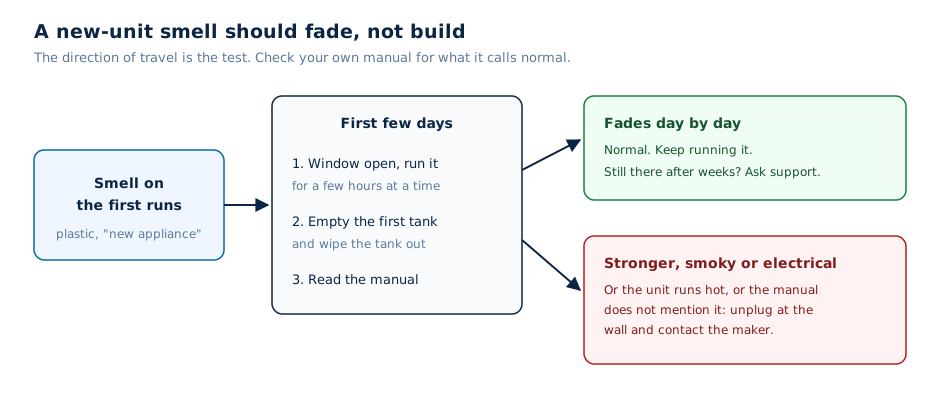
My working rule, and it is judgement and not a standard: expect it to be clearly weaker by day three, and ask the manufacturer if it is still obvious after two weeks of regular running. What matters more than the number is the direction. A smell that fades with each run is a new machine settling in. A smell that is the same on day ten as day one deserves a message to support.
Three simple fixes for the first days
Nothing here needs a tool, and none of it needs a cleaning product.
- Run it with the window open. Put the machine in a well-ventilated room for the first few hours of use, so the smell has somewhere to go that is not your bedroom. Give it room to breathe: where to put a dehumidifier covers clearances. Do this before you shut the doors and rely on it, because a closed-up room is exactly where a plastic smell lingers.
- Empty the first tank and wipe it out. The first few litres of water have passed over parts that have never been used. Pour them away, wipe the tank with a damp cloth and warm water, and refit it dry. Skip the bleach; the full cleaning routine explains what the plastics tolerate.
- Take the filter out and look at it. A new filter should not smell of anything. If it does, wash it as the manual says, dry it completely and refit it. The filter guide has intervals. Philips adds that a dirty filter can produce a bad smell of its own, but that is a separate problem from a factory odour.
One caution on the open-window advice: it is for the first hours, and for the smell. Once the odour has gone, close the window and let the machine do its actual job, because a dehumidifier working against an open window is drying the street. If the smell is musty, not plastic, that is a different diagnosis and I cover it in why a dehumidifier smells like mildew.
Three red flags: when a new dehumidifier smell means unplug it
If a smell is acrid, smoky or electrical, or the machine is hot to the touch, switch it off and unplug it at the wall. Do not run it “to see if it clears”. Do not plug it back in.
Plastic and “new appliance” are one thing. These are another:
- The smell gets stronger with each run. New-unit odours should fall away. One that builds is not a factory smell settling.
- It smells of smoke, hot electrics or something scorched. The plastic-smell reassurance above does not stretch to this on a compressor unit. The only place I found a manual calling a “burning” note normal is for zeolite desiccant models, and only because that manual says so. If yours does not say it, do not assume it.
- The casing is hot, the fan is noisy or the socket trips. A smell with any of those is a fault until proved otherwise.
Unplug it, keep the box and receipt, and contact the manufacturer or the shop. A new machine inside its return window is their problem, not yours.
A smell that fades means the unit is settling; one that builds means call support
The short version of everything above: a faint plastic smell in the first days of a new dehumidifier is what Philips, Ionmax and Andatech each describe as normal. Ventilate, empty the first tank, check the filter, and it should fade. Where it does not, or where it turns smoky, trust your nose and the manual over any blog, this one included. I am not a lab, and I cannot tell you what is in your particular machine’s plastics, which is exactly why the manual’s wording is the only authority I will point you to.
FAQ
Is a new dehumidifier smell normal?
Yes, a faint plastic smell during the first uses is normal according to Philips support, and Ionmax and Andatech say the same about the zeolite smell of desiccant models. A burning, smoky or growing smell is not normal on a compressor unit.
How long should a new dehumidifier smell last?
There is no single figure. Philips gives none, Ionmax says a few hours over several days of running, and Andatech says it will not last long. Treat that as a few days, and contact the maker if it is still strong after a couple of weeks.
Is the smell from a new dehumidifier harmful?
Ionmax and Andatech state that the zeolite smell on their desiccant units is not harmful to humans or pets. I found no manual making a claim either way for compressor units, so I will not make one. If it bothers you, ventilate the room, switch the unit off and ask the manufacturer.
Why does my new dehumidifier smell musty?
A musty smell from day one is not a typical factory odour. It can mean the room itself smells, because the machine pulls the room’s air through itself and hands it back. Wipe the tank, check the filter and read the mildew guide above.
Can I wipe the tank with vinegar or bleach?
Plain warm water and a damp cloth is enough for a new tank. Strong cleaners are unnecessary on unused parts and can attack seals, so only use what your manual names.
Should I leave a new dehumidifier running to get rid of the smell?
Run it, but attended and ventilated: a few hours at a time with the window open, as Ionmax suggests for its units. Do not leave it running unattended if the smell is sharp or growing.

