
Last Updated on October 24, 2026 by Umar Farooq
How to ventilate a bedroom at night: leave a window open a small gap (on the latch), open the bedroom door a few centimetres, and keep any trickle vent or wall vent clear. Trickle vents alone did far less than a window in the one measured study I could open.
I used to think a closed bedroom in winter was a virtue: warm, quiet, no draught on the ear. Then I put a CO2 reading next to the data below and stopped being smug about it.

What a shut bedroom does to the air by 3 am
A sleeping person adds moisture and carbon dioxide to the room all night, and a sealed room has nowhere to put either.
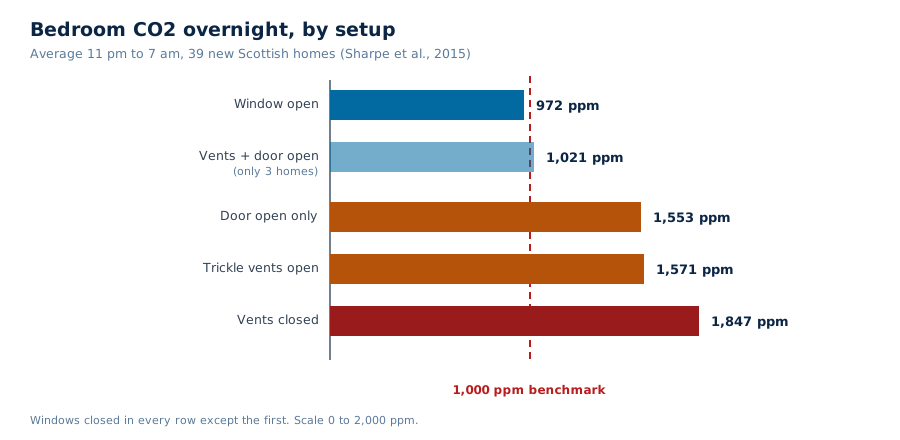
Nobody is measuring your bedroom, so here is the nearest thing I could open. A Strathclyde-led team monitored bedrooms in new Scottish homes and published the results in the International Journal of Environmental Research and Public Health. The average CO2 between 11 pm and 7 am across 39 homes was 1,520 ppm, and 83% of the properties averaged above 1,000 ppm, which the authors treated as a reasonable threshold for adequate ventilation.
That is a small sample from one country, and new, airtight Scottish homes are not every house. But the shape of the result is useful. I have not found a measured moisture figure for a sleeping adult that I would trust enough to quote, so I will say plainly: the water vapour side is real (it is why bedroom windows run wet in winter), but I cannot give you a number for it. For the damp side of the story, see how to reduce humidity in a bedroom.
How to ventilate a bedroom at night without freezing
The cheapest way to move real air is a window opened a small gap rather than a vent left to do all the work.
In the same study the bedrooms with a window open averaged 972 ppm (11 homes). With windows closed and only the trickle vents open, the average was 1,571 ppm. The authors concluded that trickle ventilation as installed and used did not reach the target rates in those homes. That does not make a trickle vent useless: it is better than nothing, since the bedrooms with vents closed averaged 1,847 ppm. It does mean a vent is a floor, not a ceiling. If you want to know what yours is doing, what trickle vents are and how to use them covers that.
Getting the window gap without the draught:
- Use the latch, not the full opening. A restrictor or the first notch on the stay gives a gap of a finger or two. It lets air through and keeps the window reasonably secure, though only you know how comfortable you are with that on the ground floor.
- Keep the bed out of the line of fire. Air from a gap falls towards the floor and mixes. Put the head of the bed away from the window, or hang a curtain between them.
- Use the radiator as a pre-heater. If the radiator is under the window, as in the photo, incoming air passes over it. Leave it on low rather than off.
- Open a second gap higher or lower, if you have one. A VELUX design guide recommends at least two windows at different heights so that the stack effect can work: warm air leaves at the top and cool air enters at the bottom.
Do not leave a window open where a child or pet could climb out, or where it lets people in. If you cannot secure it, use the vents and the door instead and accept a lower result.
Does the bedroom door help or hurt?
Open, it helps: air needs a way out as well as a way in.
The same VELUX guide quotes a study of typical houses (Bekö, Toftum and Clausen, 2011) giving night-time air change rates of 0.3 per hour with the bedroom door closed, 0.4 ajar and 0.5 open. It is a modest rise, but a free one. In the Scottish study, windows closed with doors open averaged 1,553 ppm against 1,998 ppm with doors and trickle vents shut, which tells the same story. The combination of trickle vents and an open door averaged 1,021 ppm, but only three homes were in that group, and the authors themselves urge caution.
Two practical limits. A door left open onto a cold, unheated landing just brings the cold in, and a door open into a room with a big source of steam (a bathroom, a drying airer) brings the moisture in. An open door is good when it connects the bedroom to a landing that has its own ventilation.
Extractor fans and wall vents: what they can and cannot do
Trickle vents and wall vents are the “always on” layer. In England the regulation behind them is Approved Document F, the government’s ventilation guidance for dwellings, which is why newer windows usually have a slot in the frame. Two things I would check before buying anything:
- Is the vent open and clear of paint, dust and the curtain? Do it tonight, it takes a minute.
- Is there a working fan where the moisture is made? Most bedrooms do not have an extractor, which is why bathroom and kitchen fans matter to the bedroom too. See how to ventilate a house to reduce moisture for matching the method to the moment.
A mechanical extractor or a whole-house system is a bigger job. If the window gap and the door are not enough on the coldest nights, that is when a ventilation professional is worth a call. I would not pay for one until the free fixes have been tried for a fortnight.
Five fixes in the order I would try them
- Open the trickle vent or wall vent and clear it. Zero cost, zero draught.
- Open the bedroom door a few centimetres, if the landing is not cold or damp.
- Put a window on the latch. Start with a small gap and widen it only if the room still feels stuffy.
- Move the bed or hang a curtain if the air lands on you.
- Measure. A hygrometer shows if the room is too humid; the target range is on the ideal bedroom humidity page. A CO2 monitor is the only thing that tells you about stuffiness, and it is optional.
If the humidity stays high after all five, that is the point to ask whether you need a dehumidifier in the bedroom, and not before.
How to ventilate a bedroom at night: open something, and use the cheapest opening first
My honest conclusion from the one study I could open is that a window gap beats a vent, an open door beats a closed one, and the combination beats either. Everything else is detail about where the bed goes. Try each fix for a few nights before adding the next.
FAQ
Is it good to sleep with a window open?
It lowers carbon dioxide compared with a closed room: the bedrooms with a window open averaged 972 ppm overnight in the Scottish study, against 1,520 ppm for all homes. I cannot give health advice, so I will leave it at ventilation. Comfort, noise, security and pollen are the trade-offs that decide it for most people.
Should a bedroom door be open or closed at night?
Open if the landing is not cold or damp. Closed, the room’s air change rate was 0.3 per hour in the study the VELUX guide cites, against 0.5 with the door open. If you close it for privacy, ajar is a compromise.
How do I get fresh air into a bedroom without a window?
Use a wall vent or trickle vent if there is one, open the door onto a ventilated landing, and make sure any extractor on the landing or in the bathroom works. A room with no opening at all is a job for mechanical ventilation, which needs a professional.
Do trickle vents provide enough ventilation overnight?
Not on their own in the data I found. Bedrooms with only trickle vents open averaged 1,571 ppm, against 972 ppm with a window open. They are worth keeping open, as an always-on baseline.
Can I ventilate a bedroom in winter without losing all the heat?
Yes: a small gap and a radiator under the window should lose less heat than a wide-open window, and a short burst before bed is better than nothing. I have no measured heat-loss figure for this, so I will not pretend to one.

