
Last Updated on October 23, 2026 by Umar Farooq
Condensation inside double glazing means the sealed unit has failed: the edge seal has let damp air into the gap between the two panes, and no cloth, heater or dehumidifier can reach it. That sounds grim, but it is a slow problem rather than an emergency, and it is one of the few window faults you can diagnose with a tea towel.
It looks exactly like ordinary window condensation, until you notice it is on the wrong side of the glass.

What a sealed unit is, and how the fog gets in
A double-glazed unit is two panes held apart by a spacer bar, with the edges sealed and the gap usually filled with argon. The spacer holds a desiccant, a drying agent that soaks up the trace of moisture trapped at the factory. That is the whole trick: a pocket of dry gas, so nothing condenses in the middle.
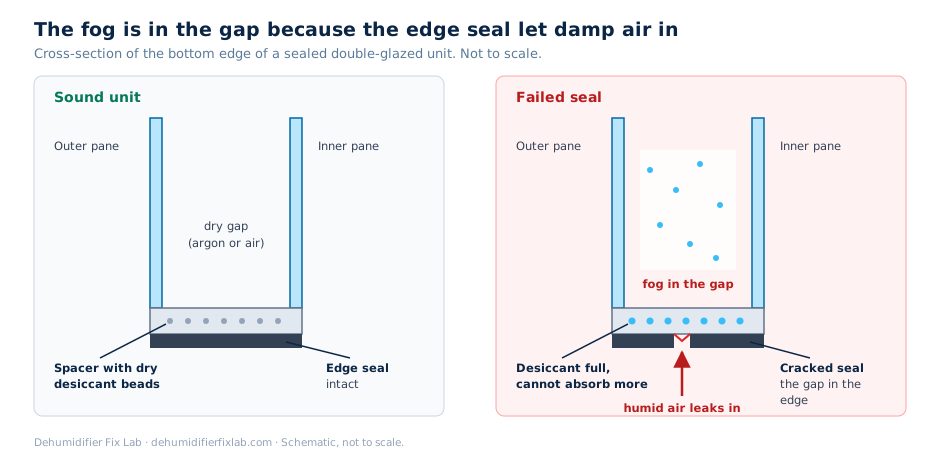
Glass heats in the sun and cools at night, and that daily movement works the edge seal over the years. Crystal Glass, a glazing firm, says most units start to fail “somewhere in the range of 10 to 20 years”, with knocks, poor original seals and factory faults shortening that. It gives no source for the figure, so treat it as a trade estimate. Once moist air gets past the seal the desiccant slowly fills, and when it can hold no more, water condenses on the cold inner face of the gap. The unit does not suddenly break; it runs out of drying capacity.
Wipe it: which side the water is on decides everything
Before you assume the worst, find out which surface is wet. Wipe the fog with a dry cloth, in the morning if you can.
| What happens | What it is | What to do |
|---|---|---|
| The water wipes away from the room side | Ordinary condensation from damp indoor air on cold glass | Cut the moisture and warm the glass, see the full condensation guide |
| The water wipes away from the outside | Dew on a cold clear night, often a sign the glazing is insulating well | Nothing, see condensation on the outside of windows |
| Neither side wipes clean, and the fog or droplets stay in the gap | Failed sealed unit | Read on |
A failed unit also behaves differently over time. Room-side condensation comes and goes with the weather and the washing. Gap fog hangs around on dry days too, because the water is not coming from your room at all (my reading of the mechanism, not a measured test).
Can you fix condensation inside double glazing without replacing the glass?
There are three routes, and only one is permanent.
- Defogging. A technician drills small holes, draws out the moisture, and reseals the unit. Crystal Glass describes this as clearing the haze without restoring the lost argon or the unit’s original insulating value, closer to a cosmetic fix than a repair. It is not a cure.
- Replacing just the sealed unit. The glass unit is swapped and the existing frame stays. This is the one that actually fixes it.
- Replacing the whole window. Only when the frame itself is rotten, warped or past saving.
Here is my opinion, and it comes from reading what each route does rather than from selling any of them: if the frame is sound, a new unit beats a defog every time, because a defog leaves the same tired seal in place. I cannot give you a price I can stand behind, as quotes vary by size, glass type and region. For orientation, The Eco Experts quote £50 to £180 per window for resealing, a figure from their own page that I have not been able to check independently.
Check the guarantee before you pay anyone
Look at the paperwork first. The Eco Experts note that the standard warranty on double glazing is 10 years, and advise checking the guarantee if condensation appears in a window younger than that. The paperwork usually lives in a drawer nobody has opened since the installation.
A seal that fails at five years is a manufacturing question, not a wear-and-tear one.
A dehumidifier will not clear the gap, but it still has a job
I will be blunt, because this is a dehumidifier site and you might expect me to say otherwise: a dehumidifier cannot dry the space between your panes. That air is sealed off from your room. You would be drying the room around a closed box.
Where it does help is on the room-side face of the same windows. If you have gap fog and wet glass in the morning, you have two problems, and the second one is fixable. The EPA advises keeping indoor humidity below 60 per cent, ideally 30 to 50 per cent, and acting quickly to dry wet surfaces and cut the moisture source. If damp windows are routine in your house, what size dehumidifier you need depends on the room, and how to stop condensation on windows covers the free fixes first.
Fogged glass between the panes is a slow problem: plan it, don’t panic
The honest summary of condensation inside double glazing is this: it is a worn-out part, not a damp house, and it will not clear on its own. The unit loses some insulating value, the glass looks tired, and the desiccant will not recover. But the water is sealed in the gap, away from your walls, so there is rarely any rush.
Run the wipe test, check the guarantee, then decide whether to defog a single awkward pane or replace the unit. And keep the room side dry, so that the next fogged window you see is a different problem.
FAQ
Why is there condensation between my double glazing panes?
The sealed unit has lost its airtight edge seal, so damp air has entered the gap and filled the desiccant in the spacer. Once the desiccant is full, moisture condenses on the cold glass inside the gap.
Can condensation inside double glazing be removed?
A technician can draw the moisture out and reseal the unit, which clears the fog for a while, but it does not restore the lost gas. Wiping, heaters and dehumidifiers cannot reach the gap.
Is condensation inside double glazing dangerous?
It is not a hazard in itself, because the water is sealed in the gap. It does mean the unit insulates less well, and the glass may stay misty or stained.
How long do double-glazed units last before they fail?
Figures vary by maker and conditions. One glazing firm quotes 10 to 20 years for most units, without a source, and the standard warranty cited by The Eco Experts is 10 years.
Does a dehumidifier stop condensation between the panes?
No. The gap is sealed off from the room, so no amount of room dehumidifying will dry it. A dehumidifier only helps with condensation on the room-side glass.

